

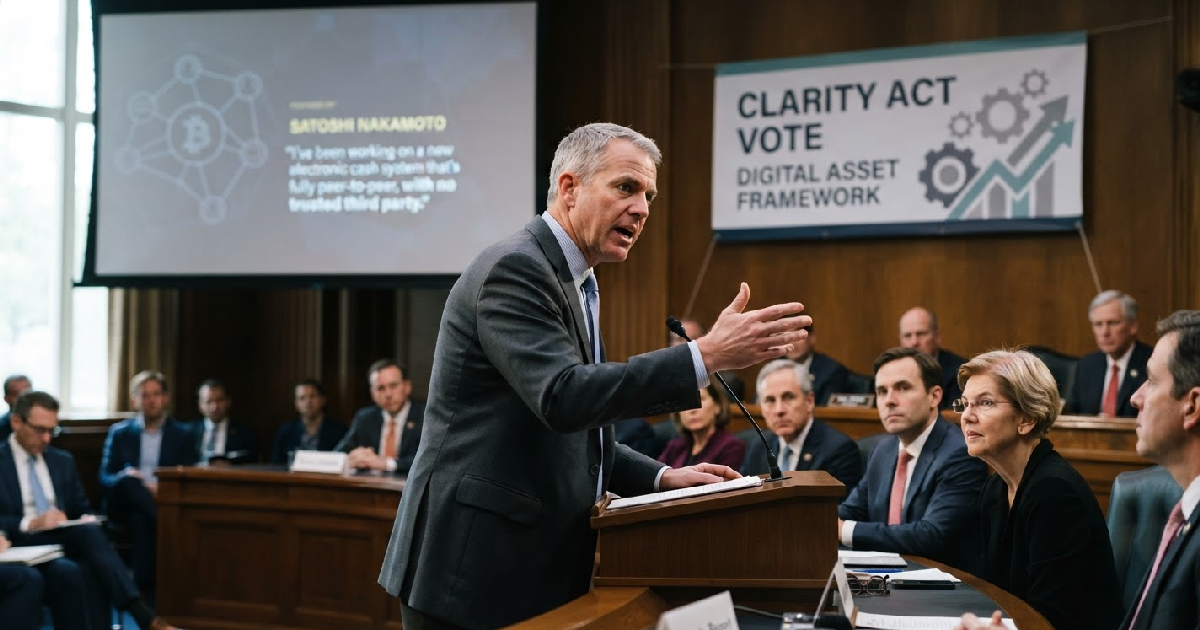
Scott Bessent pushes Senate for immediate Clarity Act vote, quotes Satoshi Nakamoto
U.S. Treasury Secretary Scott Bessent urged the Senate on Thursday, July 30, 2026, to immediately vote on the crypto Clarity Act, invoking Satoshi Nakamoto. S. Treasury Secretary Scott Bessent made an urgent public appeal on Thursday, July 30, 2026, imploring the Senate to immediately vote on the crypto Clarity Act. He notably invoked Bitcoin creator Satoshi Nakamoto in his strong remarks, aiming to push the landmark legislation through before Congress breaks for its August recess.
Bessent specifically called out Democratic Senator Elizabeth Warren for obstructing the bill, accusing her of leading an “Anti-Crypto Army” that fears advancing crucial digital asset regulation. This public pressure underscores the high stakes involved in establishing a clear regulatory framework for the burgeoning cryptocurrency industry in the United States.
Treasury Secretary Bessent’s Urgent Appeal for Crypto Clarity
Secretary Scott Bessent took to X, formerly Twitter, to broadcast his unequivocal demand for a Senate vote on the Clarity Act. He wrote, “vote NOW on this landmark legislation,” highlighting the pressing need for regulatory certainty in the digital asset space.
In a striking move, Bessent quoted Satoshi Nakamoto directly, stating, “If you don’t believe me or don’t get it, I don’t have time to try to convince you, sorry.” This pointed reference aimed to dismiss lingering doubts and criticisms, framing the legislative push as a clear-cut choice for America’s economic future.
The Looming August Recess Deadline
The push for a vote is acutely time-sensitive, driven by the rapidly approaching August recess for Congress. Lawmakers are scrambling to finalize the Clarity Act, a bill that, despite its bipartisan origins, faces significant resistance from some Democratic factions.
Bessent didn’t mince words about the opposition, claiming Senate Democrats are stalling out of fear of Senator Warren. He challenged them directly, asking if they would stand for “American Exceptionalism” or “cede American leadership of a global industry.”
The Clarity Act’s Broad Regulatory Ambition
The Clarity Act is designed to establish a comprehensive regulatory framework for the cryptocurrency industry in the United States. Its primary goals include defining digital asset classifications and clearly delineating the regulatory boundaries between the Securities and Exchange Commission (SEC) and the Commodity Futures Trading Commission (CFTC).
This legislative effort also incorporates important amendments addressing ethics concerns, alongside provisions from the Blockchain Regulatory Certainty Act (BRCA). These additions aim to instill greater confidence and stability within the digital asset ecosystem, providing clear rules of the road for innovators and investors alike.
Industry Backing and White House Involvement
The proposed legislation has garnered substantial support from various sectors, including major nonprofits and influential financial institutions. Their backing highlights a broad recognition of the need for structured oversight in the rapidly evolving crypto market.
For over a year, representatives from US banking, regulatory bodies, and leading crypto figures have been engaging in discussions at the White House to refine the Clarity Act. White House crypto adviser Patrick Witt even deferred military leave to see the bill through its critical pre-August recess window, illustrating the administration’s commitment.
Other key figures like SEC Commissioner Paul Atkins and former White House Crypto Czar David Sacks have also endorsed Bessent’s urgent call to action.
Senator Elizabeth Warren’s Persistent Opposition
Senator Elizabeth Warren, a prominent Democratic voice, has been a long-standing critic of the cryptocurrency industry. Her opposition to digital assets has intensified, particularly in the wake of President Donald Trump’s vocal support for the sector.
Just last week, Senator Warren publicly denounced the Clarity Act. She argued that the bill would “make it easier for criminals to move money” and asserted that “it does not stop Donald Trump from cashing in on his presidency,” casting doubt on its ethical integrity. new federal rules are critical for the industry.
The Trump Factor in Crypto Politics
President Donald Trump has made supporting the crypto industry a cornerstone of his political platform, garnering significant backing from digital asset entrepreneurs. This alignment has, in turn, fueled much of the current political friction surrounding cryptocurrency legislation.
But the Trump family has also faced criticism regarding alleged profits from various digital asset ventures, including the TRUMP meme coin and the World Liberty Financial project. The White House and President Trump have consistently denied any conflicts of interest, maintaining that their actions are in the best interest of the nation.
Broader Implications for US Crypto Leadership
Treasury Secretary Scott Bessent and his allies argue that passing the Clarity Act is vital to prevent the United States from losing its global leadership in the digital asset industry. They believe a clear regulatory framework will encourage innovation and attract more crypto businesses to establish their operations on US soil.
Beyond fostering domestic growth, the legislation also aims to reinforce the dollar’s status as the global reserve currency. It seeks to bring all crypto activity under robust anti-money laundering (AML) and know-your-customer (KYC) frameworks, thereby enhancing national security and financial integrity. digital asset entrepreneurs frequently advocate for clearer guidelines.
Market Reaction and Economic Context
News of the White House agreeing to the Clarity Act’s ethics package on July 21, 2026, saw Bitcoin’s price climb towards $67,000, signaling investor optimism. The cryptocurrency market has already surpassed $3 trillion in value as of April 9, 2026, illustrating its growing economic significance.
Furthermore, nearly one in six Americans now hold digital assets, underscoring the mainstream adoption of cryptocurrencies. The US also holds a Strategic Bitcoin Reserve, established by executive order in March 2025, containing an estimated 328,372 BTC, valued at roughly $25 billion as of early June 2026.
Stablecoins and Economic Impact
The debate around the Clarity Act also touches on the broader economic impact of digital assets, particularly stablecoins. These are projected to grow significantly, potentially reaching $2 trillion by the end of 2028.
A White House Council of Economic Advisers report on banning stablecoin yields indicated it would only minimally boost total bank lending by $2.1 billion. This represents a mere 0.02% of the $12 trillion market, with just $500 million benefiting community banks, while generating an estimated annual welfare loss of $800 million for users.
These figures highlight the delicate balance lawmakers must strike between regulation and fostering innovation.
What’s Next for the Clarity Act Vote?
With the August recess deadline looming, all eyes are on the Senate to see if Bessent’s urgent plea will translate into action. Senate Majority Leader John Thune is expected to test the Democrats’ resolve, particularly in light of Senator Warren’s continued resistance.
Republican Senator Thom Tillis plans to send a bipartisan negotiated ethics package to the White House by Friday, July 31, 2026, intensifying the pressure. The fate of the Clarity Act before the recess will significantly shape the future of digital asset market regulation in the world’s largest economy.
The current legislative standoff highlights a broader ideological battle within Washington over the role and regulation of digital currencies. The outcome will not only define the US approach to crypto but also influence global standards, cementing or undermining American leadership in this critical technological frontier. The industry, and many everyday American investors, are keenly watching these developments unfold.