

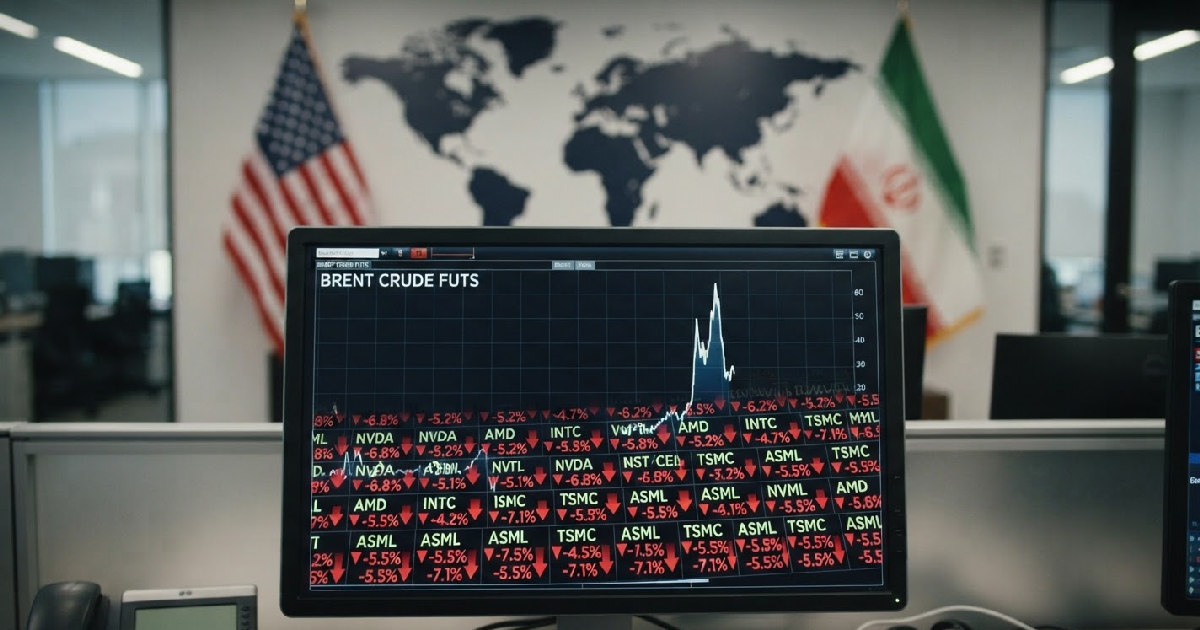
Oil price jump and chip stock rout hit markets amid Iran escalation
Iran’s attempted “surprise attack” on U.S. forces in the Middle East today has sent Brent crude oil prices climbing, reigniting geopolitical tensions. The news emerged as chip stocks continued their rout across Asian and U.S. markets, reflecting ongoing investor concerns about AI spending. These dual pressures have created a volatile backdrop for global financial markets, particularly ahead of the Federal Reserve’s pivotal interest rate decision later today.
Tehran had launched multiple ballistic missiles from Iran, with its target identified by Axios as a U.S. base in Jordan. The U.S. military swiftly responded, reportedly knocking down an Iranian missile barrage. It also worked with Saudi Arabia forces to strike sites in Iraq previously used by Tehran-backed militias for attacks in recent days.
Geopolitical tensions drive oil price jump
Brent crude, the international benchmark for oil prices, initially rose by 3.8% this morning, reaching $87.26 a barrel following reports of the attack. This escalation marked an end to a brief lull in fighting within the region. The market quickly reacted to the renewed uncertainty.
The price of Brent crude saw a further surge later in the day, climbing 6.4% to $89.47 a barrel. This accelerated increase followed comments from Donald Trump, who stated the U.S. would deliver a “beating” to Iran in retaliation for the attempted “surprise” attack. Fox News reported Trump’s intention to “hit them hard.”
Analysts Warren Patterson and Ewa Manthey from broker ING warned that the attack had “thrown cold water on the idea of a swift de-escalation in the Persian Gulf.” They cautioned about the growing risk of “more prolonged supply disruptions” if Saudi oil infrastructure continues to face targeting. This direct link between geopolitical instability and energy markets remains a significant concern for global economies.
AI sell-off continues to hit chip stocks
Parallel to the rising oil prices, the rout in chip stocks intensified overnight and continued into today’s trading. The South Korean stock market, heavily influenced by major chip companies like SK Hynix and Samsung Electronics, lost a further 8.3%.
SK Hynix shares notably slumped 9%, despite the company reporting a six-fold surge in its quarterly profit. Its rival, Samsung, whose earnings report is due tomorrow, saw its shares drop 6% today. This extended the tough trading day seen yesterday in the U.S. market.
Yesterday, US chip stocks dragged the Nasdaq down by 1%. Individual chipmakers experienced significant declines, with Sandisk falling 14%, Western Digital down 6.9%, and Micron losing 8.9% of its value. Advanced Micro Devices also faced an 8.1% drop, highlighting a broad-based retreat from the sector.
Matt Britzman, an analyst at Hargreaves Lansdown, described this as a “tougher moment” for SK Hynix’s Nasdaq debut. He suggested the sell-off in memory stocks might be more of a “sentiment reset” than a fundamental change in earnings potential. Britzman acknowledged that forecasting the rapidly evolving AI landscape remains “incredibly difficult,” leading to earnings-day volatility.
Despite the current jitters, Britzman maintains that the “bull case remains intact.” He points to the potential for structurally improved margins and significant shareholder returns as strong earnings eventually convert into substantial cash flows. Investors are recalibrating expectations from constant upgrades to a more measured outlook, even if underlying growth remains exceptional.
Federal Reserve faces finely poised decision
The dual pressures of higher oil prices and the ongoing chip stock sell-off create an uncertain environment ahead of the Federal Reserve’s interest rate decision later today. Jim Reid from Deutsche Bank noted the “volatile backdrop” as markets awaited the Federal Open Market Committee (FOMC) outcome. He called this the “most finely poised” decision in years regarding market pricing.
As of last night, markets priced in a 32% chance of a rate hike today, making it the most uncertain period for a Fed decision since December 2018. Back then, a 25 basis point hike was approximately 65% priced in the day before the announcement. The path to this point has been turbulent, with July hike pricing fluctuating wildly.
S. Consumer Price Index (CPI) print, but then rose to as high as 38% just this Monday. With Chair Warsh reportedly shying away from policy guidance, a regime shift has occurred compared to previous years when officials’ commentary provided a clearer steer to markets.
S. economists anticipate the Fed will likely keep rates unchanged today. However, they see “significant” risks of a hike, given how the renewed Middle East escalation complicates the inflation outlook, and expect at least a couple of dissents in favor of a hike if rates remain steady.
com/international-news/stocks-rise-oil-falls-us-iran-deal-expectations-2026-wrap/”>Global markets often react sharply to such decisions.
Broader market trends and corporate results
Amidst the volatility, European stock markets opened higher, with the Stoxx Europe 600 index up 0.3%. The UK’s blue-chip FTSE 100 index also touched an intraday high this morning, rising as much as 0.7% to 10,951 points. It later pared some gains but remained up 0.2% at 10,895.
Russ Mould, investment director at broker AJ Bell, attributed the FTSE 100’s resilience to its minimal exposure to technology and AI stocks. The index also benefited from strong corporate results from several heavyweights. Standard Chartered, for example, announced a $1 billion share buyback after better-than-expected second-quarter profits.
The London-headquartered bank, which earns most of its revenue in Asia, saw pre-tax profits rise 2% to $2.3 billion, exceeding analyst forecasts of $2.1 billion. CEO Bill Winters stated that the bank’s “upgraded income guidance and new share buyback of $1bn reflect our confidence in the business.” Reckitt Benckiser also reported stronger-than-expected sales in its second quarter, with like-for-like sales of core brands increasing by 4.2%.
The consumer goods group also predicted a lower impact from the Iran war on its costs than previously forecast. Meanwhile, mining giants Rio Tinto and Glencore provided positive updates. Rio Tinto reported a 43% jump in profit to $6.9 billion, driven by stronger commodity prices. Glencore’s copper production increased by 15%, thanks to higher grades at key operations. Asian markets often see shifts from similar global economic news.