

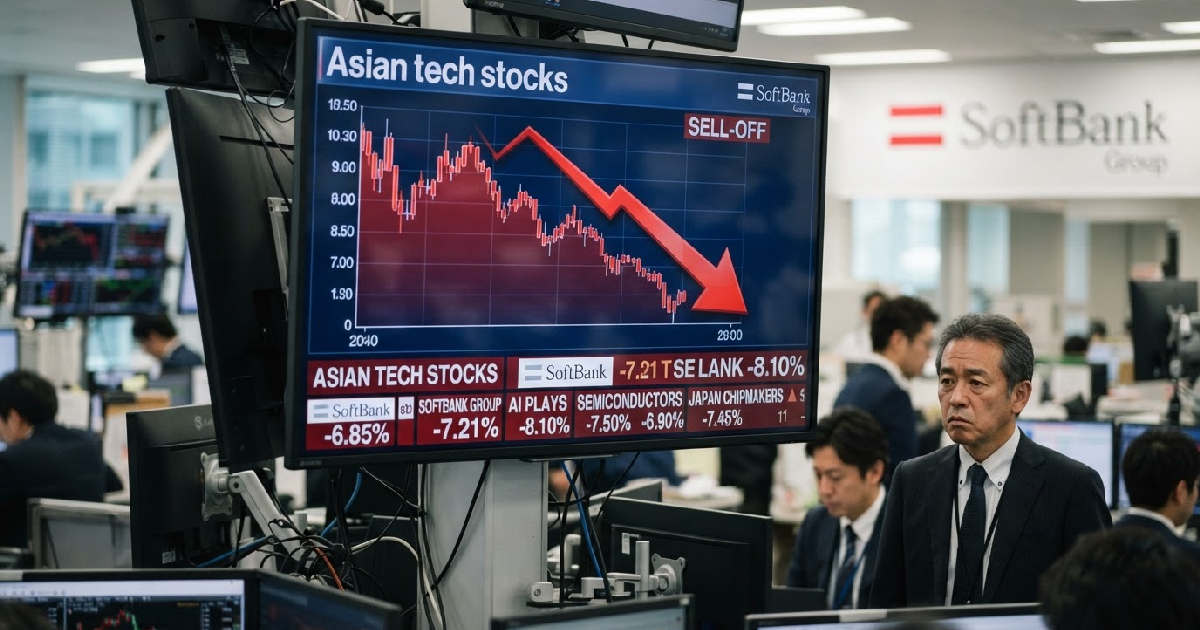
Asian tech stocks slump as AI plays take a hit, SoftBank Group down over 7%
Asian technology stocks saw a notable sell-off on Wednesday, July 29, 2026, extending recent declines across major markets. Companies with high exposure to Artificial Intelligence (AI) plays were particularly hit hard. This downturn impacted stock values in Hong Kong, South Korea, Japan, Taiwan, and mainland China.
SoftBank Group, a prominent example of a company deeply invested in AI, saw its shares lose more than 7%. The broader market unease stems from growing concerns over AI investment costs, intense competitive pressures, and wider market reassessments of technology valuations.
Semiconductor giants face sharp declines
The session proved challenging for Asia’s vital semiconductor sector, with chip names leading the regional declines. In South Korea, SK Hynix slid more than 10% after the chip giant missed analysts’ estimates. This happened despite the company reporting another record quarterly profit and revenue.
Other major South Korean tech companies also faced significant pressure. Samsung Electronics lost over 4% of its value, while LG Innotek fell by 9%. Seoul Semiconductor dropped more than 6%, indicating widespread weakness across the country’s chip industry.
Japanese chipmakers didn’t escape the downdraft either. Computer memory manufacturer Kioxia was down 10%. Tokyo Electron, a key supplier of semiconductor manufacturing equipment, fell 8.5%, reflecting the broad market sentiment.
The sell-off extended to other major Asian tech hubs. Mainland China’s tech-heavy ChiNext 300 index lost 1.83%, and the Hang Seng China Semiconductor Chips Index fell more than 5%. Taiwan Semiconductor Manufacturing Company (TSMC), the world’s largest contract chip manufacturer, ended the day 1.32% lower.
AI investment concerns fuel market uncertainty
SoftBank Group, known for its extensive investments in cutting-edge technology and AI, found its shares tumbling by over 7%. The conglomerate acts as a significant proxy for AI investment, partly due to its substantial stake in chip design powerhouse Arm. This makes it particularly sensitive to shifts in AI market sentiment.
Investor caution appears to be deepening around highly valued AI ventures. The market is now scrutinizing the substantial costs involved in scaling AI businesses. It’s also assessing the longer timelines for achieving sustainable profitability, a shift from earlier growth-at-any-cost narratives.
Kieron Poon, investment director of Asian equities at Aberdeen Investments, attributed some of this weakness to an “ongoing deleveraging process in Korea and softer sentiment towards global technology stocks.” This indicates that investors are becoming more risk-averse, pulling back from speculative positions that characterized previous AI rallies.
Global tech markets feel the ripple effect
The Asian market declines directly followed a weak session for U.S. semiconductor stocks overnight, highlighting how interconnected global technology markets remain. Investors watched closely as prominent American chip manufacturers experienced significant drops, setting a cautious tone for trading in Asia.
While Nvidia, a dominant player in AI chips, sank at the open, it managed to close the session flat. But other major U.S. chipmakers weren’t so lucky. Intel fell nearly 6%, and its rival Advanced Micro Devices (AMD) lost a substantial 8% of its value.
Memory storage companies also saw considerable losses. Micron Technology and Seagate Technology Holdings each dropped more than 8%. Western Digital sank nearly 7%, and Sandisk shed a steep 14%, reflecting a broad downturn in the memory sector.
S. shares of SK Hynix also mirrored this trend, dropping 9%. This synchronized movement across continents shows that investors are reacting to shared anxieties regarding the sustainability of current tech valuations, especially those tied to aggressive AI growth forecasts.
The global nature of this downturn suggests that broad economic concerns might be influencing investor behavior beyond just regional issues. com/international-news/stocks-rise-oil-falls-us-iran-deal-expectations-2026-wrap/”>global stock and oil prices.
Diverging paths for Chinese semiconductor firms
Mainland China’s tech sector experienced its own set of challenges, though with nuances. The tech-heavy ChiNext 300 index lost 1.83%, while the Hang Seng China Semiconductor Chips Index fell more than 5%. This overall weakness came despite some recent positive developments within the Chinese chip industry.
Some analysts point to the ongoing competition and regulatory environment as contributing factors. However, the market has seen instances where Chinese chip stocks rally, particularly following breakthroughs from domestic giants like Huawei. Such events highlight a complex market where geopolitical tensions and national tech ambitions play a significant role.
Taiwan Semiconductor Manufacturing Company (TSMC), the world’s largest contract chip manufacturer and a critical global player, ended the day 1.32% lower. Its performance often serves as a barometer for the health of the global semiconductor supply chain.
Analysts see buying opportunities amid market volatility
Despite the widespread sell-off, some investment professionals view the current market conditions as a strategic opportunity. Kieron Poon of Aberdeen Investments, while acknowledging the weakness, reiterated that the recent volatility “has not changed our long-term positive view” on Asian equities.
He argued that the market pullback has brought valuations to more attractive levels. “The recent market pullback has brought valuations to more attractive levels,” Poon said, “creating opportunities for us to add exposure to high quality businesses at more reasonable prices.” This perspective suggests that experienced investors are looking beyond short-term fluctuations to identify fundamentally sound companies that are now trading at a discount.
This sentiment indicates a maturing of the AI investment cycle. Early enthusiasm may have pushed valuations to unsustainable highs. But now, a more discerning approach is taking hold, separating companies with solid business models and clear paths to profitability from those riding solely on speculative hype. It’s a moment for careful selection rather than broad-brush investment.
Navigating a cautious investment climate
The current cautious climate for Asian technology stocks reflects a confluence of factors, both company-specific and broader market trends. Beyond the immediate impact of AI investment costs and competitive pressures, macroeconomic concerns also play a part. These concerns can include inflation fears or the potential for increased regulation in key markets.
For example, while not directly tied to the day’s semiconductor declines, broader economic policy in the region can influence investor confidence. Warnings about potential China trading curbs, which could affect billions in Hong Kong assets, illustrate the layered risks facing Asian equities. Such regulatory uncertainty adds another dimension to the market’s reassessment of technology valuations.
Investors are now weighing these multiple factors as they consider their portfolios. The focus appears to be shifting from sheer growth potential to resilience and strong underlying fundamentals. Companies able to demonstrate consistent profitability and strategic innovation, even in a tougher market, will likely draw renewed interest.
Ultimately, the market is recalibrating expectations for the tech sector, particularly for those firms heavily invested in the rapidly evolving AI landscape. This adjustment, while painful in the short term, could pave the way for a more stable and sustainable growth trajectory for Asian technology stocks in the long run.