

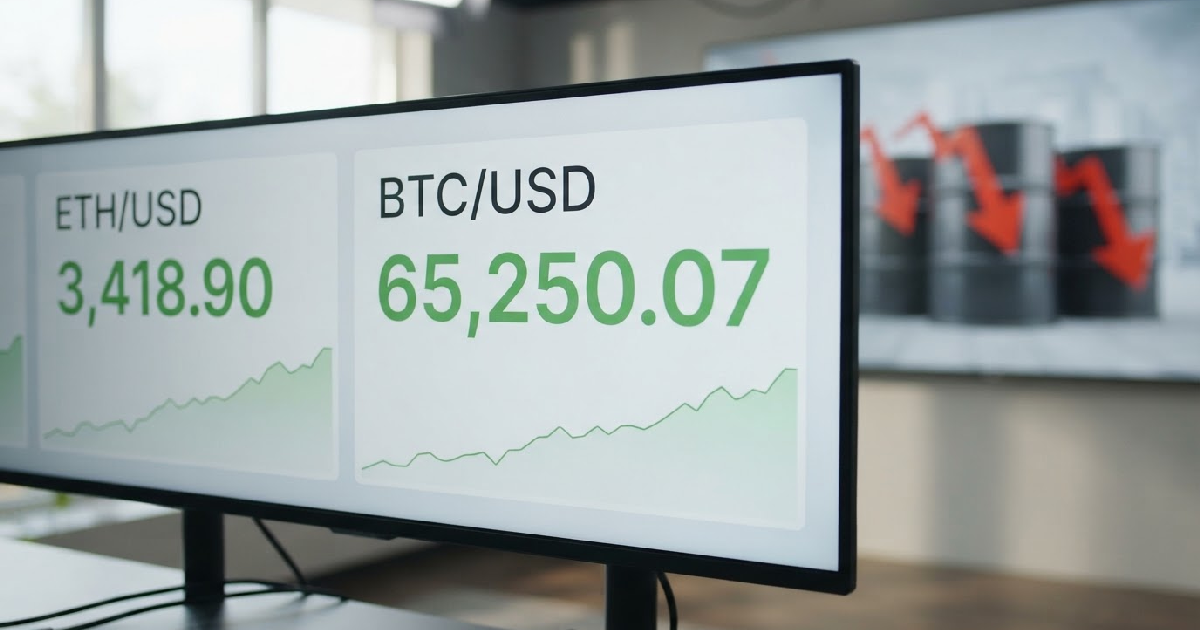
Bitcoin climbs past $65,000 as US-Iran calm sends oil prices down 5%
Bitcoin (BTC) has surged past the $65,000 mark on July 27, 2026, reaching approximately $65,250.07, as de-escalating tensions between the United States and Iran spurred “risk-on” trading across global markets. This upward movement for the leading cryptocurrency coincides with a significant 5% drop in oil prices, reflecting a broader shift in investor sentiment away from traditional safe havens and towards growth assets.
The latest rally marks a pivotal moment for Bitcoin, which saw its price climb about 1.2% over the past 24 hours. But it’s not just Bitcoin seeing gains; Ether (ETH) has outperformed, rising over 3% to nearly $1,950, alongside 1% to 2% increases for other major tokens like Solana (SOL) and XRP (XRP).
Geopolitical calm fuels Bitcoin price gains
The primary catalyst for today’s market movements appears to be a reported “hold fire” agreement between the United States and Iran. Both nations paused military strikes against each other for a second consecutive day, opening a narrow window for diplomatic dialogue and potentially a more lasting peace.
This fragile de-escalation comes after a period of intense hostilities. The war, which began in late February, saw a brief ceasefire in the second quarter that unfortunately quickly unraveled. Iran has reportedly indicated its willingness to maintain the halt in airstrikes as long as the U.S. reciprocates, hinting at a new, albeit tenuous, peace process.
Oil prices tumble amid de-escalation hopes
The geopolitical calm has had an immediate and pronounced effect on the oil market. Futures tied to West Texas Intermediate (WTI) crude plummeted approximately 5% to trade around $85. Brent crude also saw a significant fall, dropping 4.7% to $92.19.
This sharp decline in oil prices is a clear indication that markets are factoring in reduced supply risks and diminished conflict-related premiums. Historically, oil prices often react inversely to signs of peace in major producing regions, and the current situation is no exception.
Impact on broader financial markets
The positive sentiment wasn’t confined to crypto and oil. Futures linked to the Nasdaq and S&P 500 indices both traded half a percent higher, signaling a rebound in equity markets. Currency markets also reflected this “risk-on” trend, with the Australian dollar and Euro gaining strength against the U.S. dollar.
These synchronized movements across various asset classes underscore how interconnected global financial markets have become. Geopolitical stability often encourages investors to take on more risk, moving capital from less volatile assets to those with higher growth potential.
Altcoins gain ground, but Bitcoin still dominates
While Bitcoin’s return above $65,000 is a headline grabber, the notable outperformance of Ether (ETH) signals a potential rotation into alternative cryptocurrencies. Vikram Subburaj, CEO of India-based FIU-registered Giottus exchange, observed that “ether’s over 3% gain shows some rotation into alternative cryptocurrencies.”
However, Subburaj was quick to add a note of caution. He noted that despite these gains, “Bitcoin’s dominance at 58.6% shows this is not yet a broad-based altcoin trend.” This indicates that while investors are venturing into other tokens, Bitcoin still holds considerable sway over the overall crypto market.
The increased interest in altcoins like Ether, Solana, and XRP could be a leading indicator for a more comprehensive market upturn. When Bitcoin leads the charge, and other major cryptocurrencies follow with even stronger percentage gains, it often points to increasing investor confidence spreading beyond just the flagship digital asset.
Macro developments and the Federal Reserve’s looming decision
Beyond the immediate geopolitical influences, broader macro developments continue to shape market sentiment. “Prices are also responding to macro developments,” said Vikram Subburaj of Giottus exchange. The fall in Brent crude has, at least temporarily, eased some inflation concerns.
However, an immediate risk remains the upcoming Federal Reserve meeting scheduled for July 28-29. Markets are currently assigning a 36.3% probability to a 25-basis-point rate increase. Any decision by the Federal Reserve on interest rates will undoubtedly send ripples through both traditional and crypto markets.
A rate hike could temper some of the current enthusiasm, as higher borrowing costs tend to make riskier assets less attractive. Conversely, a decision to hold rates steady or signal a dovish stance could provide further impetus for the ongoing “risk-on” rally.
Bitcoin’s cyclical nature and future outlook
Some market observers are also looking at Bitcoin’s performance through the lens of its historical four-year cycles. Joao Wedson, founder and CEO of analytics firm Alphractal, commented on X that prices may be forming a bottom ahead of a potential bull run. He highlighted the approximate 900-day period between each Bitcoin Halving and the bottom of the subsequent bear market.
According to Wedson, the current cycle is already at day 827. “Based on this pattern, we can say that Bitcoin is already building its price bottom, with a potential final bottom forming sometime within the next two months,” he projected. This long-term perspective suggests that current price movements, even if volatile, fit within a predictable pattern for the digital asset.
This cyclical analysis offers a degree of reassurance to long-term holders, suggesting that recent Bitcoin price levels, even during downturns, are part of a larger, recurring pattern. If this pattern holds, then the current momentum could be the early stages of a more sustained upward trend, aligning with the “peace trade” narrative.
Previous market reactions to US-Iran developments
This isn’t the first time geopolitical shifts concerning the U.S. and Iran have impacted Bitcoin and global markets. Back in June 2026, Bitcoin climbed above $65,000 when the U.S. Treasury authorized Iran to trade petrochemicals, leading to encouraging negotiation results in Switzerland. That period saw crude oil prices slide significantly, hitting their lowest point since early March.
However, the situation quickly reversed. By July 15, Bitcoin struggled below $62,000 after renewed U.S.-Iran hostilities, including Iran targeting tankers near the Strait of Hormuz. During that time, President Donald Trump had reportedly declared the June ceasefire “over,” which saw Brent crude climb above $83 a barrel.
The volatility surrounding these events highlights Bitcoin’s sensitivity to global political and economic factors. The market’s rapid response to both de-escalation and renewed conflict demonstrates its role as both a risk-on asset and, at times, a barometer for global stability.
The fact that Bitcoin has been sensitive to geopolitical developments, particularly those involving major oil-producing regions, points to its evolving role in the global financial landscape. While often touted as a hedge against inflation or traditional market instability, its recent movements show a strong correlation with broader risk appetite linked to international relations.
What this peace trade means for investors
For investors, the return of “peace trades” suggests a renewed appetite for growth-oriented assets like cryptocurrencies. The double-digit percentage drops in oil prices and gains in equity futures indicate a collective sigh of relief from markets. This environment typically favors digital assets, which thrive on optimism and increased liquidity.
The current scenario also highlights the swift impact of de-escalation on commodities. Lower oil prices could help ease inflationary pressures, which in turn might influence central bank policies, including the Federal Reserve’s upcoming decision. Such a development could indirectly benefit cryptocurrencies by fostering a more stable economic backdrop.
But investors should remember that the current peace is described as “tenuous,” and previous ceasefires have unraveled. Any renewed escalation could quickly reverse the positive momentum. Remaining informed about geopolitical developments and central bank announcements will be crucial for navigating the market in the coming weeks.
The interplay between global politics, traditional markets, and the crypto ecosystem has never been more apparent. As diplomatic efforts continue, and the Federal Reserve prepares for its meeting, the stability of international relations will remain a key determinant for the trajectory of Bitcoin and its digital counterparts.