

NEAR Protocol Scraps Developer Gas Rebate, Bolstering Tokenomics
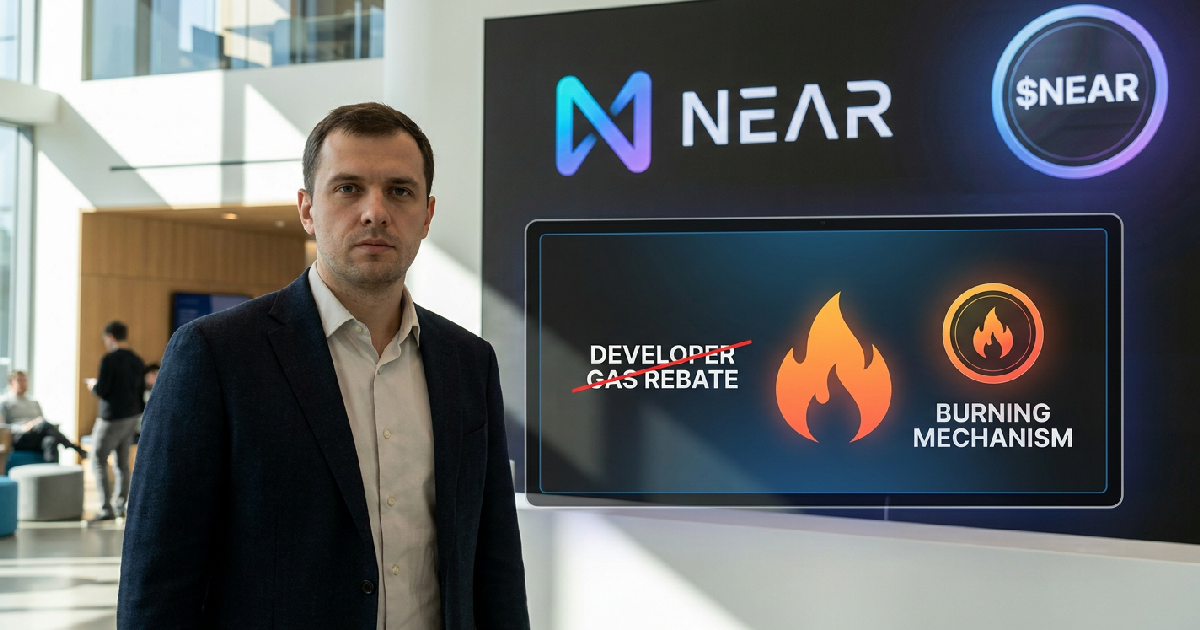
NEAR Protocol’s on-chain governance body, the House of Stake, has officially voted to eliminate the NEAR developer gas rebate, a pivotal shift confirmed by co-founder Illia Polosukhin on Monday, July 7, 2026. This decision means all network gas fees will now be burned, rather than the previous system of partly rebating them to smart-contract owners.
The change, formalized by the passing of proposal HSP-027 between June 20 and June 27, 2026, aims to streamline the protocol and enhance the deflationary pressure on the native $NEAR token. Implementation is expected around August 2026, coinciding with the nearcore v2.14 release.
NEAR’s governance body streamlines fee structure
The core of this governance decision revolves around how transaction fees are now handled on the NEAR network. Under the former design, 30% of gas fees generated by calls to a smart contract were returned to that contract’s owner, with the remaining 70% being burned.
Now, with the House of Stake’s recent vote, this developer gas rebate drops to 0%. Consequently, 100% of all eligible gas fees will be permanently removed from circulation through burning, fundamentally altering the network’s economic mechanics.
Overwhelming support for rebate elimination
The vote on proposal HSP-027 saw substantial consensus among the network’s veNEAR holders. A total of 46 votes, representing a significant 4.66 million veNEAR, were cast in favor of eliminating the rebate.
Only two dissenting votes, accounting for a mere 1,819 veNEAR, were recorded against the measure, indicating broad community alignment on the issue. Anton Astafiev of NEAR One authored the proposal.
NEAR co-founder Illia Polosukhin framed the vote as a trial run for the House of Stake’s authority over the protocol’s core economic parameters. He called it “a great test” ahead of future proposals and expressed excitement “to have explicit governance for economics of $NEAR.”
Why the developer rebate became obsolete
The original developer gas rebate mechanism, initially conceived by Illia Polosukhin, aimed to foster innovation by directly rewarding developers for popular smart contracts. This direct compensation model was intended to incentivize the creation of reusable components in the protocol’s nascent stages.
However, as the ecosystem matured, the rebate’s efficacy began to wane considerably. Its financial benefit to developers plummeted from an average of approximately 27.6 NEAR in June 2025 to a meager 1 to 5 NEAR per month per contract by 2026. This drastic reduction meant the rebate no longer served as a meaningful incentive.
Shifting monetization models for dApps
Most NEAR-based decentralised applications (dApps) no longer monetize through direct gas fees. Projects typically sponsor the gas costs for their users, generating revenue instead through alternative models like subscriptions, advertising, or various spreads on services. This makes the gas rebate an anachronism.
NEAR’s governance account described the measure as aimed at reducing “protocol complexity and misaligned incentives for builders.” Polosukhin also pointed out an accounting problem, stating the rebate was difficult to distinguish from ordinary user deposits of funds on-chain, adding unnecessary complexity for the protocol.
The network’s developer-relations account had already signaled this shift to builders in early July, advising them: “don’t factor this gas bonus into your dApp’s budget anymore.” This proactive warning aimed to manage developer expectations effectively, anticipating the change in policy.
This evolution mirrors the broader shifts in the crypto market, where innovations and new economic models are constantly emerging, as seen in the recent surge of NEAR, Ondo, and Hyperliquid crypto tokens.
Boosting NEAR’s deflationary tokenomics
The decision to burn 100% of transaction fees carries significant implications for the long-term NEAR Protocol tokenomics. By removing the 30% rebate, all gas fees that were previously recirculated back to contract owners will now be permanently taken out of circulation. This will increase the deflationary pressure on the $NEAR token, potentially enhancing its scarcity and value over time.
This move integrates with broader tokenomic refinements already underway. For instance, a recent halving upgrade reduced maximum annual inflation by 50% to 2.5%, aiming for a more sustainable inflation model. Such adjustments reflect a concerted effort to create a robust and attractive economic environment for the token, even as other major cryptocurrencies face market fluctuations like when Bitcoin prices dropped amidst capital outflows.
A new era for governance
The successful passage of HSP-027 represents a significant moment for NEAR’s governance model. Illia Polosukhin explicitly framed the vote as “a great test” for the House of Stake’s authority over the protocol’s core economic parameters, demonstrating the growing maturity of their community-led system.
NEAR’s governance is actively transitioning towards a more decentralized, community-led model, with the House of Stake serving as a new social governance layer. This framework formalizes how proposals are introduced, debated, and ratified, empowering NEAR holders to participate directly in decisions affecting the ecosystem.
Future outlook: AI and new revenue models for NEAR
The elimination of the NEAR developer gas rebate isn’t an isolated incident; it’s part of NEAR’s broader strategic evolution. The protocol is increasingly positioning itself as the “unified commerce layer” for an “agentic economy” driven by autonomous AI agents. This vision involves AI agents transacting on-chain, buying compute, settling payments, and executing trades.
NEAR’s economic model is evolving to capture value through product-level revenues, particularly from “NEAR Intents” and “NEAR AI.” NEAR Intents, a cross-chain execution layer enabling one-click swaps and unified liquidity across over 35 chains, has already settled over $19 billion in volume. Fees generated from NEAR Intents are now used for $NEAR buybacks, creating persistent buy pressure on the token.
Meanwhile, NEAR AI focuses on private inference and a secure agent harness for AI agents, with services payable in $NEAR. These initiatives point to a future where the protocol extracts value from high-utility applications rather than relying on gas fee incentives. It’s a strategic shift from subsidising development to monetizing active, valuable network usage within the blockchain ecosystem.