

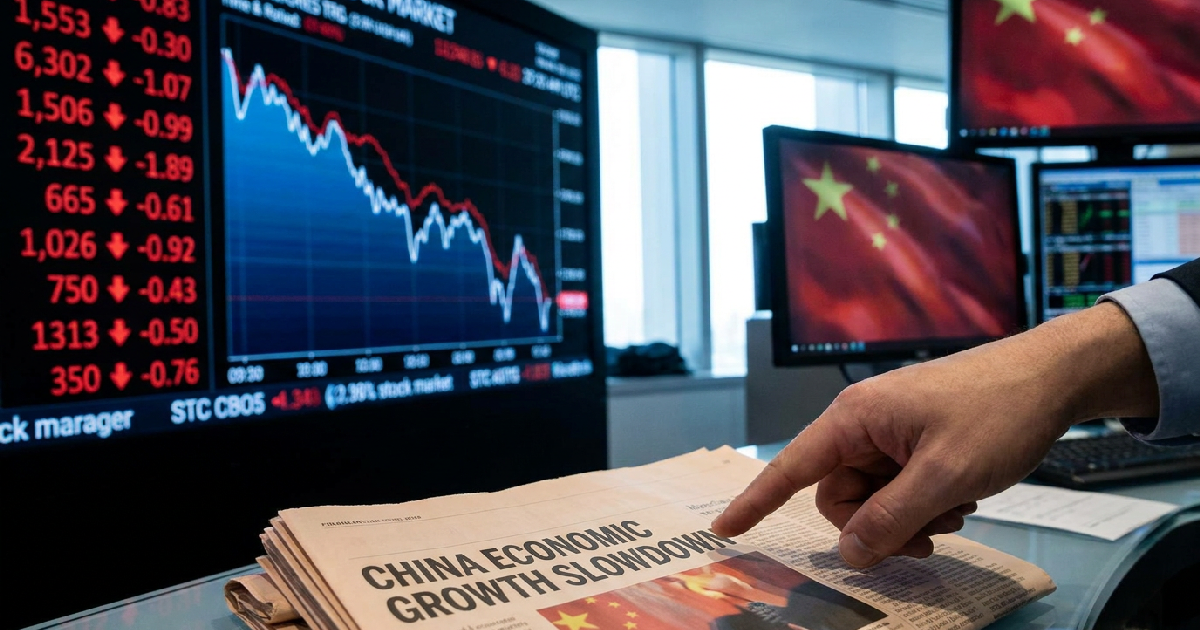
China’s economic growth slows to 4.3% as investment plummets, fanning stimulus calls
China’s economy expanded by just 4.3% in the second quarter of 2026, its weakest pace since Q4 2022, indicating a China economic growth slowdown. 3% in the second quarter of 2026, marking its weakest pace since the fourth quarter of 2022, according to data released Wednesday by the National Statistics Bureau. This China economic growth slowdown came as urban fixed-asset investment slumped unexpectedly, deepening concerns and intensifying calls for significant policy stimulus from Beijing.
The growth figure for the April to June period fell short of economists’ forecasts, who had predicted a 4.5% expansion in a Reuters poll. It also represents a notable deceleration from the 5% growth recorded in the first quarter of the year, pushing the nation further from its already modest full-year growth target of 4.5% to 5%.
Investment Drag Weighs Heavily on China’s Economy
The primary driver behind the disappointing GDP numbers was a significant downturn in urban fixed-asset investment. This crucial economic component, which includes real estate development and infrastructure projects, declined by 5.7% in the first six months of the year compared to the same period in 2025.
This drop was considerably steeper than the 4.9% fall analysts had anticipated and marked an acceleration from the 4.1% contraction seen in the first five months. Tianchen Xu, a senior economist at Economist Intelligence Unit, pointed to local governments redirecting resources toward debt restructuring and a scarcity of viable new projects as key factors behind this accelerating investment slump.
Property Market’s Persistent Shadow
The persistent downturn in China’s property market continues to cast a long shadow over investment. For years, real estate served as a robust engine for economic growth, but Beijing’s “Three Red Lines” policy, introduced in 2020 to curb excessive borrowing by developers, tightened credit significantly.
This led to widespread liquidity issues, project delays, and debt defaults among major players like China Evergrande Group and Country Garden. The crisis eroded consumer confidence, with many homebuyers left waiting for unfinished properties, fueling protests in central China in 2022.
House prices across China have fallen by approximately 30% from 2021 to 2026, with secondary home prices in 100 major cities seeing a 0.42% month-on-month decrease in June 2026. This ongoing decline means that property sales remained slow through 2023, directly impacting the willingness of both state-backed and private entities to invest in new developments.
Fitch Ratings projects new-home sales in China will dip another 11-13% in 2026.
Local Government Fiscal Strain
The woes in the property sector have severely constrained local government finances. Land sales traditionally provided a substantial portion of their revenue, but this income plummeted to 6.7 trillion yuan in 2022, a 23% reduction from the previous year. This revenue stream, which once accounted for 30% of local government income, fell to 24% in 2022.
With less revenue from land sales and tighter restrictions on new borrowing, local governments have fewer resources for the large-scale infrastructure projects that historically drove urban fixed-asset investment. As a result, many are now channeling their limited funds into managing existing debt burdens, further exacerbating the investment slowdown.
Xu emphasized that “boosting infrastructure investment will be a key focus for stabilizing growth,” highlighting the need for central government support.
Mixed Signals from Consumption and Production
While investment figures disappointed, other parts of the Chinese economy presented a more mixed picture. Both retail sales and industrial output showed signs of improvement in June, though economists caution that underlying imbalances persist.
June’s Retail Sales Rebound
Retail sales in China grew by 1% in June, bouncing back from a 0.6% drop in the prior month. This positive turnaround surpassed economists’ expectations for a modest 0.1% decline. The May retail sales had marked the first monthly decrease since late 2022, driven by weak consumer demand and aggressive discounting by merchants.
While the June rebound offers a glimmer of hope for consumer spending, its sustainability remains a question mark amid broader economic anxieties.
Industrial Output Boosted by AI Boom
Industrial output also outperformed forecasts, expanding by 5.3% in June from a year ago. This was stronger than the anticipated 4.7% growth and picked up pace from the 4.5% expansion observed in May. The National Statistics Bureau noted that robust industrial production and exports, particularly those tied to the global AI investment boom, continue to fuel headline growth.
However, this export-led industrial strength masks a deepening supply-demand imbalance within the Chinese economy. Domestic consumption and private investment still lag, weakened by the prolonged property downturn and ongoing volatility in energy prices. This bifurcation points to a challenge for policymakers: how to stimulate internal demand to match industrial capacity.
Growing Pressure for Economic Stimulus
The disappointing Q2 growth figures, coupled with the persistent investment slump, have amplified calls for more aggressive economic stimulus measures from Beijing. Economists like Tianchen Xu expect these measures to be ramped up significantly in the third quarter.
Potential actions include a policy rate cut, aimed at stimulating investment demand by making borrowing cheaper. The People’s Bank of China (PBOC), the nation’s central bank, plays a critical role here, though it operates under the direction of the Chinese Communist Party’s Central Financial Commission, limiting its independence.
Governor Pan Gongsheng, who took the helm in July 2023, faces the task of balancing growth targets with financial stability concerns.
Lessons from Past Stimulus Efforts
China has a history of deploying massive stimulus packages to counter economic headwinds. The 2008-2009 package, worth 4 trillion renminbi (approximately $586 billion USD), largely focused on infrastructure and successfully maintained GDP growth at 9.2% in 2009. However, it also led to a significant surge in local government debt and overinvestment in certain sectors, creating long-term challenges.
More recently, in response to COVID-19 lockdowns, the government introduced measures in 2022 and 2023, including monetary easing, fiscal spending, and targeted support. In September 2024, Beijing planned to issue 2 trillion yuan ($284.43 billion USD) in special sovereign bonds and cut 50 basis points.
While these measures aimed to shore up the economy, their impact on sustainable, broad-based growth remains debated, particularly given the structural issues at play.
Beijing’s Policy Dilemma
The current situation presents a complex dilemma for Beijing. While stimulus is clearly needed, the government must avoid exacerbating existing problems like local government debt and overcapacity. Officials have urged for “counter- and cross-cyclical adjustments” to address the “acute” imbalance between excess supply and sluggish demand. This suggests a desire for more targeted and structural reforms rather than just broad-brush spending.
Furthermore, China faces ongoing trade tensions with major partners, including the United States and the European Union. These geopolitical pressures add another layer of complexity to economic policymaking. Reports indicate that China trading curbs may impact substantial assets in Hong Kong, illustrating the ripple effects of policy decisions.
Any major stimulus effort will need to consider its potential implications for international trade relations and market confidence.
Broader Economic Headwinds and Outlook
Beyond the immediate GDP numbers, China grapples with several other significant economic headwinds. Urban unemployment stood at 5% in June, which is within the leadership’s target of less than 5.5% over the next five-year period. But the broader labor market, particularly for younger demographics, remains a concern.
Youth Unemployment’s Lingering Impact
Youth unemployment, specifically for ages 16-24, reached a historic high of 21.3% in June 2023, nearly double its pre-pandemic levels. While the National Bureau of Statistics later revised its methodology to exclude students, the rate remained elevated at 18.9% in August 2025.
This persistent issue stems from inadequate private sector job creation, a growing number of university graduates, and regulatory crackdowns in industries like technology that traditionally absorbed young talent.
This high youth unemployment rate not only represents a social challenge but also a drag on consumer confidence and economic vitality. A large segment of the population struggling to find stable work means less disposable income and lower overall consumption, directly feeding into the subdued demand noted by the National Statistics Bureau.
Finding productive roles for its vast youth cohort will be crucial for China’s long-term economic stability.
External Trade Tensions Remain
Geopolitical tensions continue to complicate China’s economic outlook. Escalating trade disputes with the U.S. and the EU, including tariffs and restrictions, affect China’s export-oriented industries. The ongoing push for reshoring and diversification of supply chains by Western nations could further impact Chinese manufacturing and export volumes.
Moves by companies like Posco International to build a US rare earth plant illustrate a broader global trend towards reducing reliance on single-source suppliers, which historically has benefited China. These external pressures demand careful navigation from Beijing, as they intersect with domestic challenges to shape the country’s economic trajectory in the coming years.