

Expensive Video Game Ports Drive Player Scrutiny Over Value and Quality
The video game industry is increasingly challenging player expectations with expensive video game ports and remasters, transforming classic titles like Mario and Grand Theft Auto into premium-priced offerings years after their original release. This trend is sparking debate among gamers who often see minimal upgrades for their money.
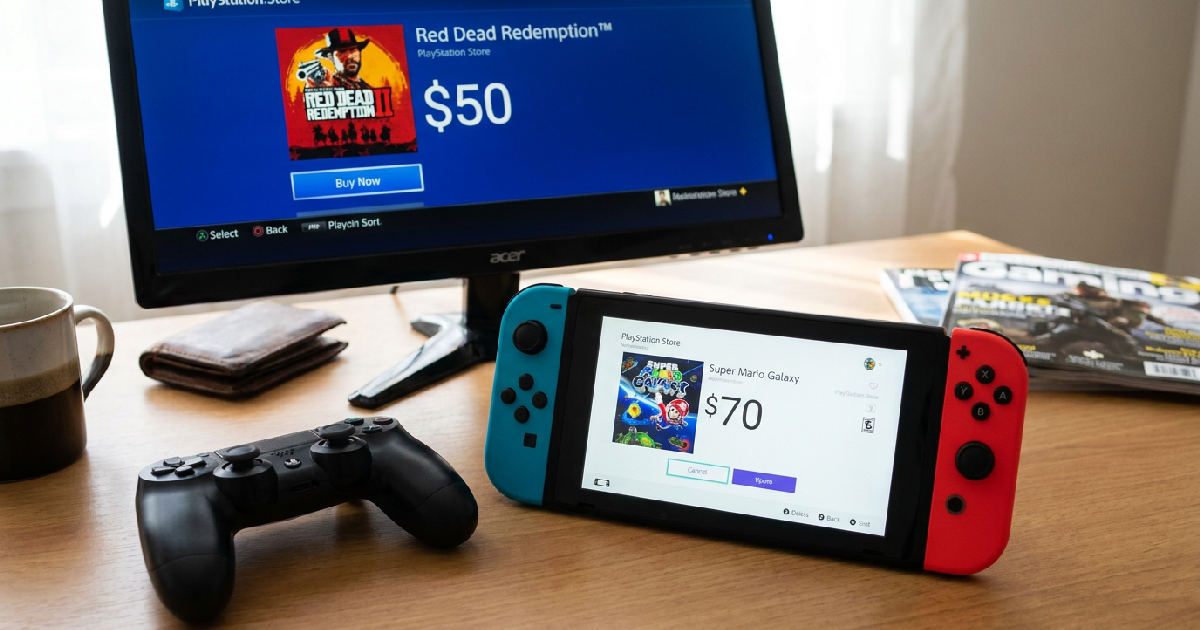
Recent releases include a $70 bundle of Super Mario Galaxy games and a $50 version of Red Dead Redemption for the PlayStation 4 and Nintendo Switch.
Why are video game ports so expensive?
Publishers argue these costs are “commercially accurate,” reflecting the often-considerable expense and effort involved in adapting older games for modern hardware. However, players frequently voice frustration when these refreshed titles offer few new features or suffer from technical issues at launch. It’s a complex balancing act for companies looking to extend game lifespans and boost revenue in a competitive market.
Nintendo recently set a $70 price tag for a bundle of Super Mario Galaxy and Super Mario Galaxy 2 for the Switch 2, slated for an October 2, 2025 release. This decision raises questions about value, especially since the original Super Mario Galaxy is available individually for $40. It seems the gaming giant expects a significant premium for repackaged nostalgia.
Rockstar Games faced public scrutiny for its $50 port of Red Dead Redemption, which launched on PlayStation 4 and Nintendo Switch in August 2023. This price point applied to a game originally released back in May 2010. Many critics highlighted that Red Dead Redemption 2, a much newer and graphically intensive title, costs only $10 more.
Burnout Paradise Remastered also generated controversy, initially hitting the Nintendo Switch with a $50 price tag. This was notably higher than its availability on other consoles. Electronic Arts eventually adjusted the Switch price to $30, but it still remained $10 more than the PlayStation 4 edition.
Other titles like Luigi’s Mansion 2 HD, released on Switch for $60 in June 2024, and Super Mario 3D All-Stars at $60 in September 2020, further illustrate this upward trend. This signals a broader industry shift towards higher pricing for re-releases.
Dissecting game porting costs and development
Understanding the distinction between a “port,” “remaster,” and “remake” helps clarify these price points. A port focuses on making a game runnable on new hardware with minimal changes. Remasters improve graphics and performance, while remakes rebuild games entirely from scratch, often with new engines.
These development processes involve varying levels of financial commitment. Small-scale porting projects can typically cost between $15,000 and $40,000. Mid-scale efforts usually range from $50,000 to $150,000, reflecting the technical complexities involved.
For large or intricate AAA titles, game porting costs can easily exceed $300,000 for a single platform. In some cases, the investment can even reach millions of dollars. These expenditures cover initial building, rigorous system tuning, and extensive quality assurance testing.
Factors like the game’s overall complexity, its size, and the target platform’s unique specifications significantly influence these costs. Adapting a game for vastly different systems, such as from PC to the Nintendo Switch, generally demands more resources than moving between similar console architectures.
Player backlash over technical issues
High retail prices for ports don’t always translate into a polished product, a point vividly illustrated by Sonic Colors Ultimate. This remastered version of Sonic Colors, released in September 2021 for $40, was plagued by significant technical defects at launch. Players reported widespread visual glitches, save file corruption, and broken level elements, with issues particularly prevalent on the Nintendo Switch.
Sega’s social media manager, Katie Chrzanowski, publicly acknowledged the problems and assured players that a patch was in the works. In a rare move for the company, Nintendo reportedly offered refunds for the buggy Switch version, underscoring the severity of the launch issues. Such incidents erode player trust and raise questions about quality control, especially for an expensive video game port.
The $50 Red Dead Redemption port also faced considerable criticism for what many players perceived as a lack of substantial enhancements. Despite its price, the 13-year-old game didn’t include significant technical upgrades or the original multiplayer mode, leading to widespread disappointment. Take-Two Interactive CEO Strauss Zelnick defended the pricing as “commercially accurate,” a stance that did little to quell player anger.
This mounting dissatisfaction contributes to what some industry observers call “remaster exhaustion.” Gamers are growing increasingly weary of frequent re-releases that offer only marginal improvements or arrive too quickly after their initial launch. Many feel this trend prioritizes publisher profits over genuine value for the consumer.
Economic drivers for re-releases
While player backlash is a genuine concern, game publishers operate within challenging economic realities. The cost of developing new AAA titles has soared dramatically over the past decade. Grand Theft Auto V, for instance, famously commanded a combined development and marketing budget of approximately $265 million.
Projections for its successor, Grand Theft Auto VI, are even more staggering, with rumored estimates placing its total budget between $1 billion and $2 billion. These astronomical figures make new game development an increasingly risky venture. It’s clear why publishers look to other avenues for revenue, like leveraging established intellectual property.
Consequently, leveraging established intellectual property through ports, remasters, and remakes becomes an attractive business strategy. It allows companies to extend the lifespan of popular titles, tap into new markets, and generate additional revenue without the colossal investment required for entirely new creations. This mitigates some of the financial risk inherent in modern game development.
Data from Ampere Analysis highlights the financial upside: between January 2024 and September 2025, players collectively spent about $1.4 billion on remakes and remasters across Xbox, PlayStation, and Steam. On average, a remake generated 2.2 times more consumer spending than a remaster, despite its higher development costs. This demonstrates the lucrative nature of these re-releases.
Engine, licensing, and testing considerations
The underlying game engine is a significant determinant of porting expense. Games built with flexible, multi-platform engines like Unity or Unreal often simplify the adaptation process. This results in quicker turnaround times and lower costs for publishers.
Conversely, titles developed on proprietary engines not originally designed for cross-platform compatibility can lead to substantial increases in budget. In some extreme cases, a significant portion of the game’s codebase might require a complete rewrite to function on new hardware. This adds complexity and time.
Beyond development, licensing fees contribute heavily to the overall cost. These include charges for platform-specific development kits, such as those required for Xbox. Third-party library licenses, like the approximately $25,000 per title for Havok Physics, also impact the budget. Rigorous quality assurance and testing across multiple platforms further inflate budgets. These hidden costs become part of the retail price.
Navigating the future of game re-releases
The current video game market presents a distinct challenge for consumers. They must weigh the desire to revisit beloved classics on new hardware against often-premium price tags. The impending arrival of the Nintendo Switch 2 also promises a further proliferation of ports and remasters.
This new hardware will provide opportunities for publishers to reintroduce classic games to dedicated Nintendo gamers. Such a landscape ensures the debate around fair pricing will continue to evolve.
Consumers are increasingly adopting a “wait for sales” strategy, recognizing that many high-priced ports eventually see reductions. This mindful purchasing approach has become a common tactic to navigate a market where perceived value often lags behind asking price. Publishers should take note of this trend.
The industry faces a delicate balancing act: maximizing revenue from popular titles while maintaining consumer goodwill. As game prices for new releases increasingly settle around $70 or even $80, the expectation for high-quality, feature-rich ports will only intensify. Future success will depend on delivering genuine value.