

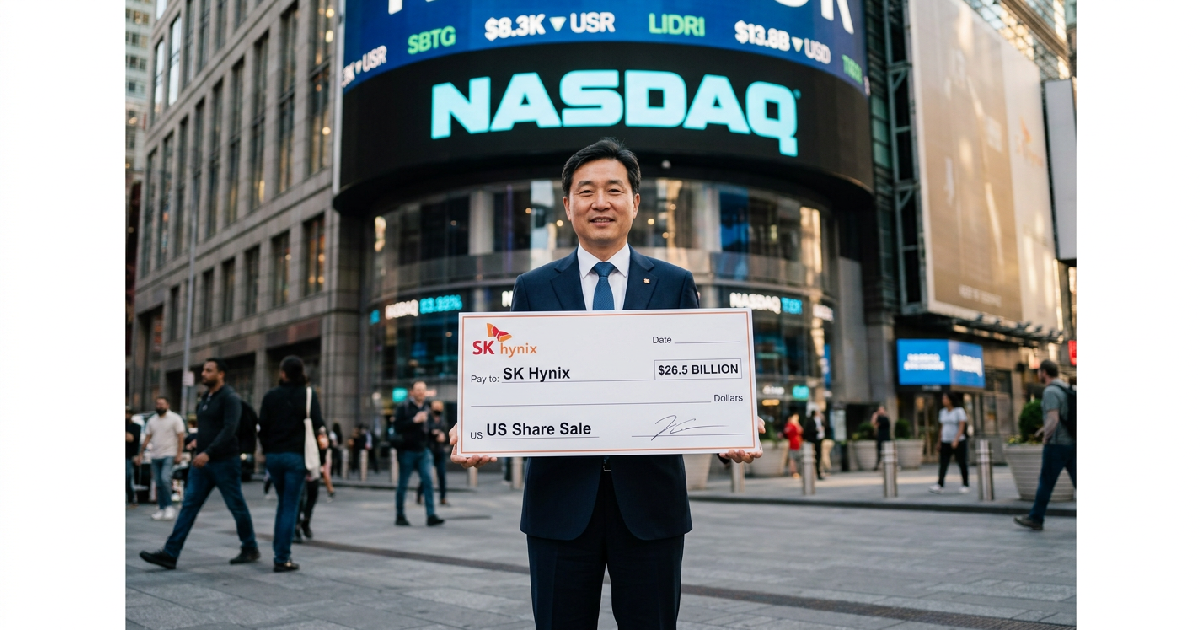
SK Hynix secures $26.5 million in record US share sale
Hynix secures 265 million in its inaugural U.S. ADR offering priced at $149 on July 9, 2026. S. American Depositary Receipt (ADR) offering on Thursday, July 9, 2026, raising approximately $26.5 billion in a deal that resets the record books for foreign listings in America. The South Korean manufacturer, a leading global supplier of high-bandwidth memory (HBM) chips, priced 177.9 million ADRs at $149 each to fund a massive expansion of its production infrastructure.
The transaction represents the largest-ever U.S. share sale by a foreign company and the second-largest stock listing globally, trailing only the $85.7 billion offering by SpaceX completed in June 2026. The move is designed to finance new fabrication facilities and equipment while helping the company broaden its shareholder base and narrow the valuation gap with its U.S.-listed rival, Micron Technology.
Nasdaq debut and the race for HBM capacity
Trading for the new securities began on the Nasdaq Global Select Market on Friday, July 10, 2026, under the temporary ticker SKHYV. Regular trading under the official ticker SKHY is scheduled to commence on Monday, July 13, 2026, with the entire offering expected to close by Tuesday, July 14. This aggressive push into the U.S.
markets comes as the company leverages a 680% rise in its stock price over the past 12 months, despite a recent 25% retreat amid a broader pullback in AI-linked chipmakers.
Investor appetite for the semiconductor giant remains intense, with the ADR offering oversubscribed by more than seven times. While the company originally aimed to raise up to $29 billion when the listing was first discussed in June, market volatility forced an adjustment to the final $26.5 billion figure.
The $149 price point represents a 2.9% premium over the closing price of SK Hynix common shares on the Korea Exchange on Thursday, based on the prevailing exchange rate of 1,509.9 won per dollar.
The structure of the deal is specifically tailored for international investors, with each ADR representing one-tenth (1/10) of a common share. This accessibility is critical as the company seeks a valuation correction similar to other global firms currently navigating shifting market sentiments. Currently, SK Hynix trades at a 12-month forward price-to-earnings ratio of 5.5 times, lagging behind Micron Technology’s 6.66 times.
Institutional backing and cornerstone investors
Confidence in the offering was bolstered by three major institutional players. Baillie Gifford Overseas, Coatue Management, and Situational Awareness Partners indicated interest in purchasing a combined $7 billion of the ADRs. This commitment accounts for approximately 24.88% of the total deal, providing a significant foundation of support for the high-profile listing.
Industry experts suggest the company’s “first-mover” status in advanced memory is a primary draw. Ken Mahoney, CEO of Mahoney Asset Management, observed that since demand is far outweighing supply, the company has maintained “tremendous pricing power.” He noted that their first-mover advantage remains a core strength in the current market environment where specialized memory is in short supply.
Record profits fueled by AI infrastructure demand
The capital raise follows a period of unprecedented financial performance for the manufacturer. SK Hynix recently posted a record operating profit of 37.61 trillion won (approximately $24.9 billion) for the first quarter. These massive earnings have led to expectations that every employee will receive an annual bonus of roughly $574,500.
This influx of cash comes at a time when top-tier capital is being diverted into artificial intelligence and next-generation technical hardware.
Daniel Newman, CEO of Futurum Group, highlighted that SK Hynix currently “leads on share and Nvidia proximity,” while rivals like Micron compete on power efficiency and U.S. positioning. The $26.5 billion in fresh capital is earmarked specifically for the physical infrastructure required to maintain this lead, including new fabrication facilities and the specialized equipment needed to mass-produce HBM chips at scale.
In South Korean markets, the stock showed resilience following the pricing. On July 10, shares rose 0.6% to 2,198,000 won in Seoul. While this was a modest gain compared to the benchmark KOSPI index’s 3.8% jump that day, it came after the stock had retreated roughly 30% from its record-high close in late June.
Investors are now focused on how quickly the company can deploy its new capital to meet the structural demand shifts in global computing.
Market implications and look ahead
The successful U.S. listing may indicate a broader trend of international tech leaders seeking deeper liquidity pools. As the company transitions to regular trading on Monday, analysts will be watching to see if the Nasdaq presence can permanently lift the company’s valuation multiples. With the offering closing on Tuesday, the focus will shift entirely to execution and the production timelines of the new fabrication sites.
The memory market remains highly competitive, with the “Big Three” — SK Hynix, Samsung Electronics, and Micron Technology — all vying for dominance in the high-stakes HBM segment. For SK Hynix, this $26.5 billion haul provides the necessary financial weight to defend its leading market position.
Success will ultimately be measured by its ability to remain at the center of the global technological pivot while effectively managing the massive capital expenditures required for its expansion.