

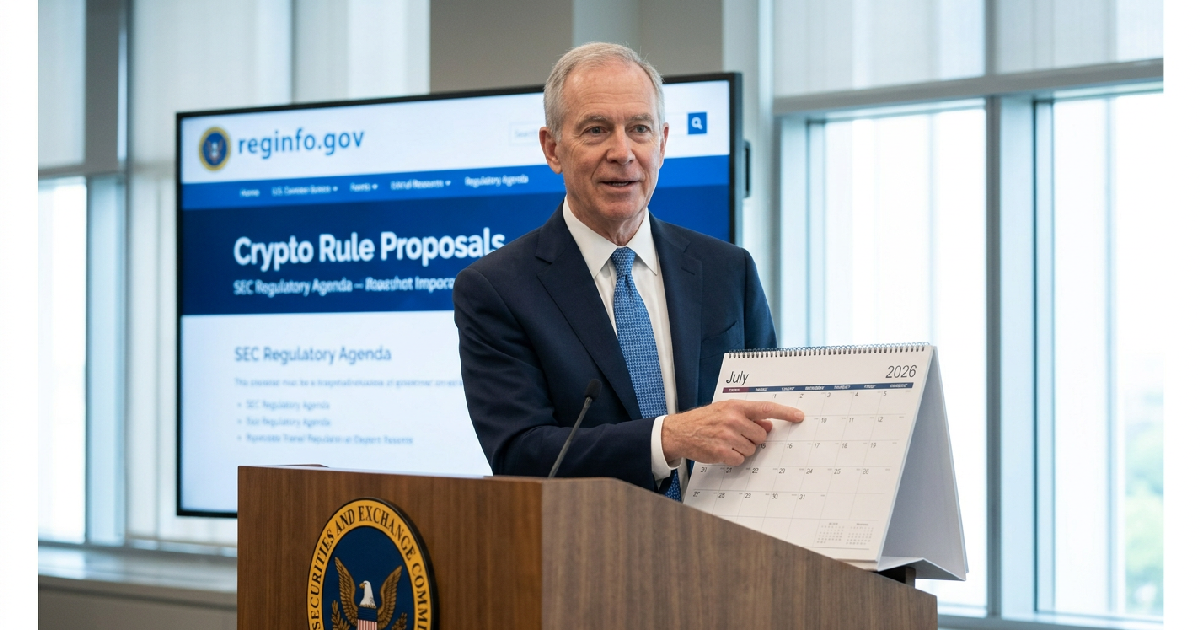
Paul S. Atkins’ agency targets July 2026 for first crypto rule proposal
The Paul Atkins agency, led by Chair Paul S. Atkins, has added three crypto-related rule proposals to its 2026 regulatory agenda. S. Securities and Exchange Commission (SEC), led by Chair Paul S. Atkins, has officially added three significant crypto-related rule proposals to its 2026 regulatory agenda. Published around July 7-8, 2026, on the federal reginfo.gov portal, these entries signal a shift toward formal rulemaking for the digital asset sector by the Paul Atkins agency.
The move supports President Donald Trump’s stated goal of making the United States a global leader in the cryptocurrency market. The agenda identifies July 2026 as a target date for the first of these proposed rules, moving the agency toward a structured governance model intended to clarify the regulatory framework for market participants.
Establishing the Regulation Crypto framework for asset offerings
This initiative, which transition the SEC from an enforcement-driven approach under previous leadership to a platform of “Regulation Crypto,” formalizes priorities first outlined in a June draft strategic plan.
While the commission has not yet released the exact text for the proposals, the agenda provides public timetables and specific Regulation Identifier Numbers (RIN) for each item. The proposals are currently being reviewed by the White House Office of Information and Regulatory Affairs.
Despite this move toward formal rules, Chair Atkins confirmed that the SEC will “continue enforcement against firms and individuals that break securities laws” as the new framework is developed.
The primary item on the new agenda is the “Crypto Assets” rule, designated as RIN 3235-AN38, which aims to clarify the rules for the offer and sale of digital assets. The SEC intends for these rules to provide greater certainty to the market and facilitate capital formation while ensuring investor protection.
To achieve this, the commission is considering the introduction of temporary registration exemptions for specific activities, including developers issuing crypto investment contracts. This could help startups raise approximately $5 million over their first four years without immediate full registration.
The proposed framework also targets larger-scale capital formation. Under the current plan, entrepreneurs could raise up to $75 million annually through specific token sales, provided they meet certain criteria. Furthermore, the SEC is exploring “safe harbors” that could allow tokens to escape securities classification if their creators cease essential managerial efforts.
This shift is designed to accommodate innovation as projects move toward decentralization, though the commission will still require adherence to federal securities laws for assets that do not meet these specific exemptions.
Updating broker-dealer capital and recordkeeping requirements
The second major pillar of the 2026 agenda (RIN 3235-AN48) addresses the financial infrastructure supporting digital assets by amending existing rules for broker-dealers. The SEC plans to recommend modifications to Rule 15c3-1, which governs net capital requirements, and Rule 15c3-3, the customer-protection rule.
These amendments are intended to address the unique liquidity and operational risks associated with crypto assets. Part of this move involves establishing minimum liquid capital requirements and specialized insolvency rules to ensure failing firms can liquidate in an orderly manner.
These updates also extend to the SEC’s recordkeeping rules 17a-3 and 17a-4. The commission aims to clarify how broker-dealers must create, store, and report transaction data specifically for crypto assets.
While the agency has previously updated custodians in various filings to ensure asset safety, these new rules would provide a broader regulatory baseline for all registered broker-dealers. The goal is to enforce heightened scrutiny for custodians and brokers, potentially leading to stricter requirements for asset segregation and trading surveillance.
Market structure and the future of onchain trading
The third agenda item, RIN 3235-AN49, focuses on “Crypto Market Structure Amendments” to integrate digital asset trading into the national market system. This rulemaking targets the Exchange Act Rules to account for crypto trading on Alternative Trading Systems (ATSs) and national securities exchanges.
By establishing “clear rules of the road,” the SEC intends to provide a formalized path for the issuance, custody, and trading of tokenized securities. This aligns with broader efforts to bring more crypto products onshore under U.S. oversight.
According to the SEC’s agenda statement, the proposal will require crypto exchanges and trading platforms to establish rigorous listing standards, order management rules, and surveillance systems. Platforms may also be required to delist specific tokens if they fail to meet the new criteria.
Chair Atkins noted that these amendments are essential to “advance the framework to embrace innovation and new technology” while closing existing regulatory gaps that have historically left the industry in a state of uncertainty.
Summary of the 2026 SEC crypto regulatory agenda
The U.S. Securities and Exchange Commission has confirmed the following three rulemakings for its 2026 Unified Regulatory Agenda:
- Crypto Assets (RIN 3235-AN38): Proposes rules for asset sales, including temporary registration exemptions for developers and annual fundraising caps of up to $75 million.
- Broker-Dealer Amendments (RIN 3235-AN48): Modifies financial responsibility and recordkeeping rules (15c3-1, 15c3-3, 17a-3/4) to address digital asset custody and insolvency.
- Market Structure Amendments (RIN 3235-AN49): Updates Exchange Act rules for trading on ATSs and national exchanges to include listing standards and surveillance.
Legislative tension and the impact of the CLARITY Act
The timing of the SEC’s rulemaking coincides with a critical period for digital asset legislation in Congress. Lawmakers are currently negotiating the CLARITY Act, a sweeping market-structure bill that would provide a statutory framework for tokens like Ethereum and Solana.
The bill faces an August 7, 2026, deadline for a Senate vote before the summer recess. If the bill fails to pass before this window, federal rules for crypto assets may be determined primarily by the SEC’s internal rulemaking process rather than through new legislation.
For the industry, formal rulemaking represents a double-edged sword. Unlike staff guidance or statements, rules adopted through this process carry significant legal weight and are much harder for future agency leaders to overturn.
This provides the “certainty” Chair Atkins has promised but also cements the SEC’s authority over a sector that has often operated on the fringes of existing law.
As the July target for the initial proposals approaches, the focus moves to the public consultation period where market participants will have their first opportunity to officially weigh in on the “Regulation Crypto” agenda.