

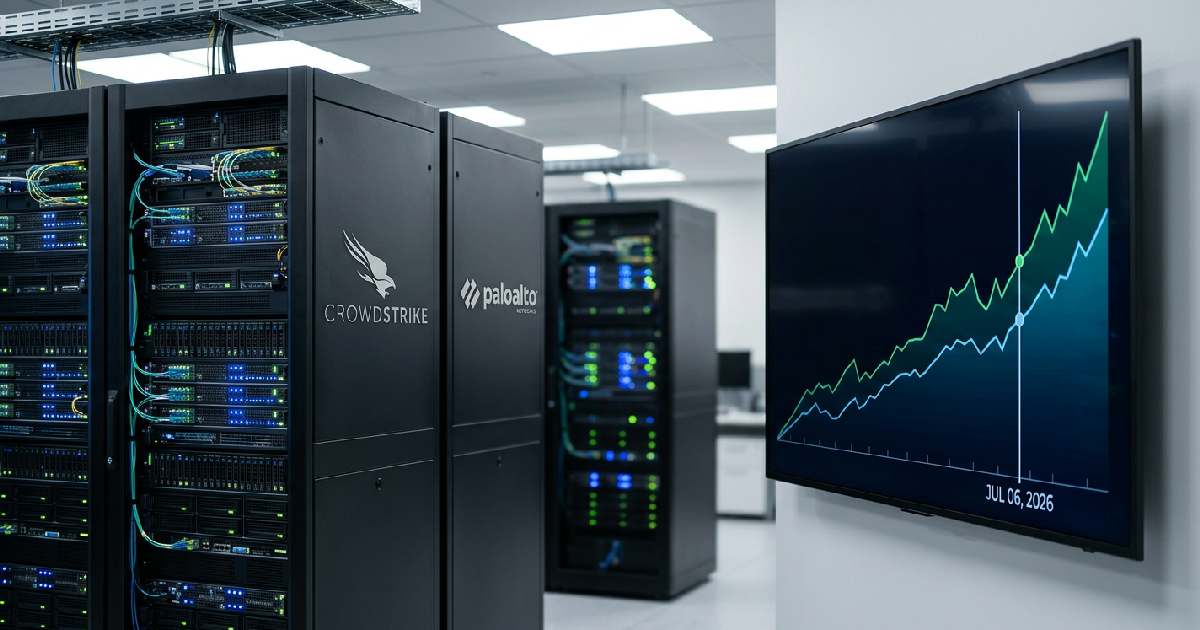
CrowdStrike and Palo Alto Networks hit all-time highs on July 6, 2026
A structural global memory bottleneck, driven by the explosive expansion of artificial intelligence data centers, has triggered a remarkable resurgence in cybersecurity stocks. Key industry players, including CrowdStrike and Palo Alto Networks, hit intraday all-time highs on Monday, July 6, 2026, as investors repositioned these firms as primary beneficiaries of the AI infrastructure buildout.
While the stocks retreated slightly on Tuesday, July 7, the underlying shift remains clear: cybersecurity is no longer viewed merely as a risk management cost but as a strategic enabler for safe AI adoption.
How the memory bottleneck drives CrowdStrike and Palo Alto stock comeback
The semiconductor landscape is currently defined by a profound shortage of High Bandwidth Memory (HBM) and enterprise solid-state drives. AI servers consume exponentially more memory than traditional compute systems, leading to a “memory wall” where hardware supply cannot keep pace with demand. This bottleneck is projected to persist through at least 2027.
For software companies, this physical constraint serves as a growth signal; as hyperscalers like Microsoft and Meta Platforms deploy hundreds of billions in capital, the need to secure these massive data workloads becomes non-discretionary.
The current market dynamic suggests that cybersecurity is the “software expression” of the red-hot memory trade. While hardware manufacturers like Micron Technology saw earnings per share soar 1,200% last quarter due to massive pricing power for limited physical goods, cybersecurity firms offer a different value proposition.
Their business models rely on ongoing, recurring revenue streams that scale with high volume as more AI infrastructure is installed globally.
This shift in sentiment follows a period earlier this year when cybersecurity names were unfairly grouped with struggling enterprise software firms. In late February 2026, CrowdStrike touched a 52-week low near $86, while Palo Alto Networks hit its own low of $139.
However, the realization that AI agents require secure permissions to function autonomously has turned the tide. This transformation mirrors shifts seen in other sectors, such as when plans for new infrastructure plants are revealed to secure critical supply chains.
Current financial projections underscore the scale of this comeback. Wall Street analysts estimate that global cybersecurity spending will exceed $520 billion for the full year 2026. This is a 100% increase from the $260 billion spent just five years ago. Much of this growth is tied to the AI-focused security subset, which is expected to ramp up significantly by 2032.
The Mythos moment and strategic AI acceleration
A primary catalyst for the recent stock surge was the “Mythos moment” in early April 2026. This occurred when Anthropic unveiled Project Glasswing, an initiative that brought together 11 organizations—including CrowdStrike and Palo Alto Networks—to secure the startup’s Mythos model. The project has since expanded to roughly 200 organizations, signaling that security integration is now a prerequisite for the next generation of AI development.
CrowdStrike CEO George Kurtz noted during a June earnings call that the market’s view of cybersecurity has fundamentally shifted. Rather than just protecting against risk, these tools are now recognized as critical enablers that determine the speed at which enterprises can adopt new technology.
Failing to implement secure AI today is increasingly compared to a business failing to establish an online presence during the rise of Amazon.
This strategic importance is also reflected in how capital is moving through the broader tech ecosystem. Just as AI and quantum tech divert capital from traditional digital assets, it is also concentrating investment into software firms that can protect high-value data.
In a world where AI can launch millions of attacks per day, the “terminal value” of these security platforms remains a focal point for long-term investors.
Recurring revenue versus cyclical hardware spikes
While memory stocks like Sandisk are up over 625% year to date, their revenue can be lumpy and dictated by physical supply-and-demand cycles. Memory prices have risen more than sixfold over the past year, leading to windfall profits for chipmakers. However, cybersecurity companies offer more predictable growth.
Palo Alto Networks CEO Nikesh Arora has emphasized that while he does not expect a “windfall” every quarter, the long-term growth rate for the sector is robust and sustainable.
The relationship between hardware and software is increasingly symbiotic. As more hardware is installed, the addressable market for security software expands. Currently, AI data centers are projected to consume roughly 70% of global memory chip production in 2026.
This concentration of high-value hardware creates a mandatory demand for protection, much like how valuation rises after adjusted EPS beats expectations when a company proves it can consistently monetize its core assets.
Protecting the new gold in an era of agentic AI
In the modern economy, data has become the primary asset, often described as “the new gold.” This makes a data breach the digital equivalent of a bank heist. The danger is heightened by agentic AI systems, which grant thousands of digital agents the permissions necessary to complete tasks autonomously.
Each of these agents represents a potential point of vulnerability that hackers can exploit from anywhere in the world.
Geopolitical tensions also play a role in this sector’s growth. Memory has become a strategic constraint, and the ability to control high-performance DRAM and HBM determines who can scale AI deployments. With nearly 70% of historical vulnerabilities in major software products being linked to memory safety issues, the hardware-software interface has become the most critical frontier in the cyber arms race.
Looking ahead, the gap between memory demand and supply is expected to widen. Projected bit demand growth of 36.2% in 2027 is set to significantly outpace a supply growth of only 19.3%. As hyperscalers project a combined $750 billion in capital expenditure this year, the “early innings” of the cybersecurity comeback appear to be supported by a massive and sustained infrastructure buildout.