

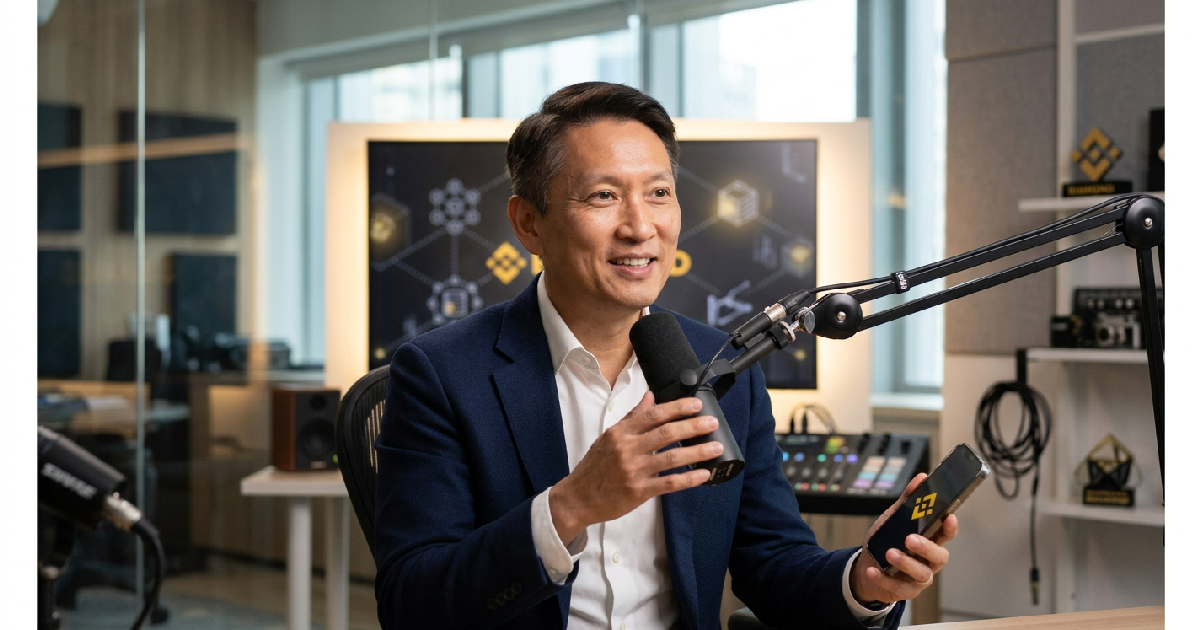
Richard Teng calls crypto a core global system on July 7 podcast
Binance CEO Richard Teng has stated that cryptocurrency has transitioned into a leading financial infrastructure, moving far beyond its initial perception as a mere trading asset.
Speaking on the “Figuring Out With Raj Shamani” podcast, published on July 7, 2026, Teng argued that digital assets are providing a new foundation for the global financial system by enabling continuous markets and significantly faster settlement times than traditional banking.
Blockchain as the future pillar of financial services
The executive, whose background as a financial regulator informed his view of blockchain as a transformative utility, highlighted deep-seated frictions in legacy finance. He specifically pointed to limited trading hours and the standard T+2 settlement cycle, where capital remains exposed to risk for two days.
Crypto markets operate on a 24/7 basis, allowing for what he calls atomic settlement, where transactions can clear near-instantly, effectively reducing counterparty and market risk for investors.
Richard Teng believes the market is evolving toward a model where the technology itself serves as the “rails” for multiple types of financial activity. He described Binance as moving toward a “financial superapp” model, aiming to provide a unified platform for diverse tools.
This expansion includes offering exposure to various assets such as commodities, petrochemicals, precious metals, and stocks, reflecting a shift from a standalone asset class to a broader global infrastructure.
This structural change is already evident in the rapid growth of tokenized real-world assets (RWAs). According to data from RWA.xyz, the value of on-chain RWAs—excluding stablecoins—tripled over the past year to reach $32.6 billion.
Richard Teng noted that major financial leaders, such as BlackRock CEO Larry Fink and JPMorgan CEO Jamie Dimon, have shown increasing openness to blockchain-based systems as they begin to recognize the operational efficiency these digital rails provide.
Improving global payments through stablecoin adoption
Stablecoins have become a cornerstone of this emerging architecture, with daily trading volumes now reportedly surpassing those of Visa. Annual payment volumes for stablecoins have exceeded $10 billion, marking them as a reliable global payments foundation.
These assets allow for borderless movement of funds without the constraints of time or the high fees typically associated with international bank transfers. While traditional cross-border transfers can take several days and incur fees of 6-7%, crypto alternatives offer a more cost-effective path for users worldwide.
The implications for financial inclusion are significant, particularly for the 1.4 billion people globally who lack access to traditional banking services. In many frontier markets, digital asset infrastructure serves as the primary means for individuals and vendors to send or receive funds.
Richard Teng estimated that the shift to crypto could save families and vendors approximately $6 billion to $7 billion annually in transaction fees that would otherwise be paid to intermediaries.
Verifiable transparency and the role of Proof of Reserve
As crypto integrates further into global infrastructure, the demand for verifiable transparency has increased. Binance currently holds over $140 billion in customer assets, which are secured and verified through a “Proof of Reserve” system.
This mechanism allows users to check on-chain whether their funds actually exist, providing a level of public auditability that is not typically available in traditional financial institutions. This trust model is central to the CEO’s vision of crypto as a reliable utility for institutional and retail participation.
The global regulatory landscape is also shifting to accommodate this infrastructure. Richard Teng pointed to the United States reorganizing its stance to become a virtual asset hub and Bhutan’s implementation of a national-level cryptocurrency payment system as evidence of high-level policy adoption.
Governments are increasingly moving away from questioning the necessity of digital assets, focusing instead on how to support and regulate the underlying technology. Capital flows in the digital space continue to be influenced by these regulatory shifts and the integration of emerging technologies.
Integrating artificial intelligence with on-chain finance
Looking toward the future, Richard Teng expects the combination of artificial intelligence and blockchain to overhaul the financial industry. He envisions scenarios where salaries are paid directly into digital wallets via stablecoins, with AI managing automated bill payments and diversified portfolios.
Such functionalities are made possible by the “borderless and timeless” nature of blockchain, which allows capital to move at a high velocity without waiting for traditional market opening hours.
Speed is becoming a primary driver for institutional adoption as more participants seek to increase capital velocity. By removing the need for multiple intermediaries and long settlement cycles, crypto-based infrastructure allows for capital to be redeployed into new investments much faster.
Despite occasional market volatility, such as the price corrections and surges witnessed in mid-2026, the fundamental utility of the technology remains a key focal point for the industry’s long-term trajectory.
Richard Teng concluded that any bank or asset manager built today from scratch would likely adopt this modern architecture rather than the models seen in the past.