

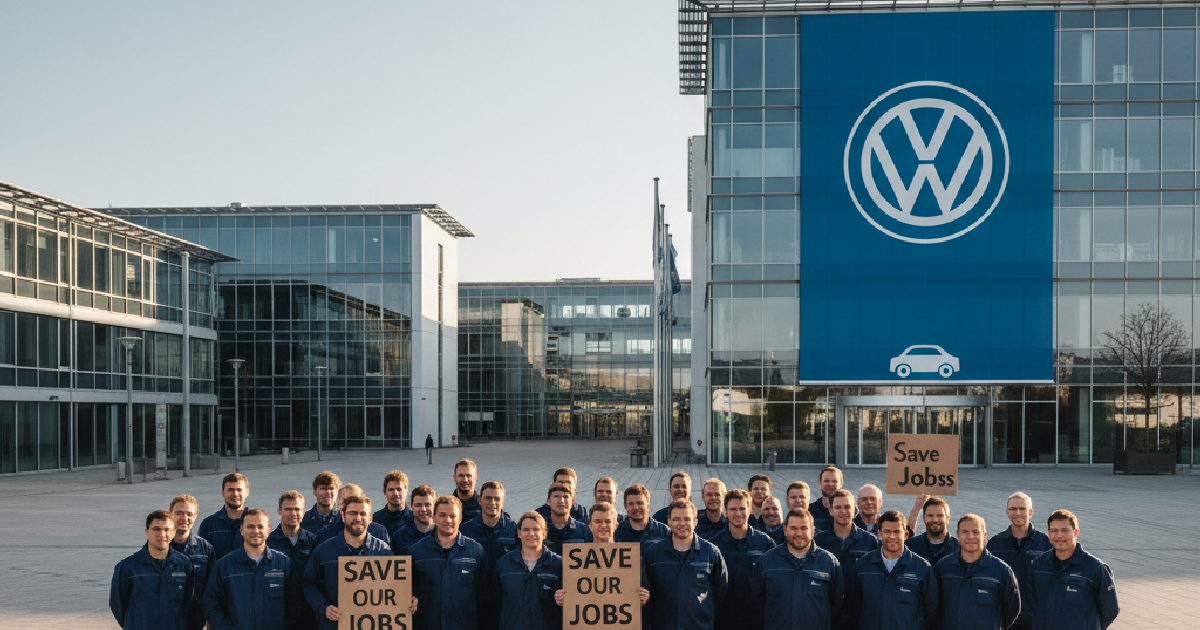
Volkswagen Group reportedly weighs cutting up to 100,000 jobs globally
The German automotive industry crisis intensified on July 2, 2026, as reports emerged that Volkswagen Group is weighing global job cuts that could double its previous targets. The Wolfsburg-based carmaker is reportedly considering the elimination of up to 100,000 positions worldwide, a move that places four major German manufacturing plants at risk of closure.
These proposed shutdowns include facilities in Hanover, Zwickau, and Emden, alongside the Audi production site in Neckarsulm.
Volkswagen Group reportedly considers massive job cuts
Industry leadership remains under immense pressure as the sector navigates a structural decline characterized by high domestic costs and eroding market share. A critical Volkswagen Group supervisory board meeting, scheduled for July 9, 2026, is expected to address these drastic measures.
The proposed cuts could put more than 45,000 German positions at immediate risk as the company attempts to stabilize its balance sheet against a backdrop of underutilized capacity.
The scale of the labor contraction across Germany has reached levels not seen in over a decade. Approximately 51,500 jobs were shed in the German auto sector during a single recent 12-month period, representing nearly 7% of the total workforce. According to analysis from EY based on Destatis figures, these losses accounted for almost half of all industrial job cuts in Germany during that timeframe.
This workforce reduction is part of a longer-term trend that has seen cumulative job losses reach approximately 112,000 positions since 2019. By the end of the third quarter of 2025, the industry employed 721,400 people, its lowest level since the second quarter of 2011. While the sector employed 731,900 people across 2025, more than 55,000 positions were eliminated within that year alone.
Key details
The German Association of the Automotive Industry (VDA) has significantly darkened its long-term outlook. The organization now forecasts that up to 225,000 jobs could vanish by 2035, an upward revision of 35,000 from its prior estimates. This forecast includes an expectation that 125,000 positions will disappear in the coming decade on top of recent cuts.
Confirmed reductions at Audi, Bosch, and Porsche
Several major manufacturers and suppliers have already confirmed specific reduction targets to stay competitive. Audi AG plans to eliminate 7,500 jobs in Germany by 2029, while the engineering giant Robert Bosch GmbH intends to cut 13,000 positions in its automotive division by 2030. These figures reflect the difficulty of maintaining legacy workforces during the transition to electric vehicle (EV) production.
Other major players are following suit with negotiated layoffs. ContiTech, a subsidiary of Continental AG, reached an agreement with the IG BCE trade union to cut 1,600 of its 7,700 jobs in Germany. This move is part of a broader global plan to eliminate 3,000 of the subsidiary’s 20,000 positions.
Even luxury manufacturers are scaling back, with Porsche discontinuing subsidiaries Cellforce Group, Porsche eBike Performance, and Cetitec, affecting over 500 roles.
The engineering firm IAV is also withdrawing from Berlin, cutting a total of 1,400 jobs across Germany. This cascading effect through the supply chain highlights the breadth of the current downturn. While some international logistics firms have managed to grow, such as when TFI International valuation rose after beating company guidance, German domestic suppliers are finding fewer opportunities for growth.
Market erosion in China signals global shifts
The decline of German dominance in Asia is a primary driver of the current industry slump. German automakers’ combined market share in China has plummeted from approximately 25% five years ago to just 13.1% in the first half of 2025.
This erosion is largely due to the rise of agile Chinese brands like BYD, which officially overtook Volkswagen to become the top-selling brand in the Chinese market.
Chinese domestic brands now control nearly 69% of their home market, leaving international competitors struggling to maintain relevance. The combined non-Chinese market share in the region dropped from 57% in 2020 to 32% in 2025. This volatility in the East mirrors broader regional instability, similar to how Citic Securities warns China trading curbs could impact billions in assets across Hong Kong.
Key details
German manufacturers have specifically struggled with software and user experience compared to brands like Tesla and various Chinese rivals. The mechanical excellence of the internal combustion era has not translated easily into the digital age. Analysts suggest that without a fundamental shift in digital architecture, legacy brands risk becoming obsolete in a market that prioritizes software over hardware.
Software struggles and the digital transition
The “user experience gap” has become a critical liability for German original equipment manufacturers (OEMs). While Mercedes-Benz and Volkswagen invested billions in EV capacity, the software platforms required to run these vehicles have often lagged behind global standards. This mismatch has contributed to underutilized production lines as tech-savvy buyers look elsewhere.
Some industry observers argue that the automotive sector must adopt a more digital-first philosophy. This technological pressure is felt across many legacy industries; for instance, Brian Armstrong warns finance must move on-chain to avoid falling behind. German carmakers face a similar ultimatum: they must either master the software layer or lose their premium status in the global market.
High energy costs cripple German industrial output
Production figures for 2026 reflect a deepening malaise in domestic manufacturing. In May 2026, German car production fell to 301,600 units from 352,966 in April, representing an 18% year-on-year decline. While two fewer operating days contributed to the drop, structural challenges remain the primary deterrent to a recovery.
Operating costs in Germany have risen to levels that make domestic production increasingly unviable. Industrial electricity prices in Germany ranged between €80 and €140 per megawatt-hour in 2025. In contrast, manufacturers in the United States and China paid between €60 and €80 for the same amount of power, creating a massive cost disadvantage for European plants.
The reliance on foreign markets has also become a vulnerability for the sector. In 2025, the automotive industry generated €527.6 billion in revenue, but 77% of that total came from exports. As US import tariffs and geopolitical tensions rise, this dependency on international sales leaves German firms exposed to policy changes outside their control.
Policy shifts and the future of vehicle incentives
Domestic demand remains weak, with 2025 registration figures still trailing pre-pandemic levels. New passenger car registrations in Germany totaled 2.9 million in 2025, but registration data from the first eight months of that year was 25% lower than in 2019. The market was further destabilized by the abrupt end of the “Umweltbonus” subsidy program in December 2023.
To counter this slump, the German federal government introduced a new €3 billion incentive program in January 2026. This scheme offers subsidies ranging from €1,500 to €6,000 for consumers purchasing or leasing new electric vehicles through 2029. While designed to stimulate demand, the program specifically targets lower and middle-income households with annual incomes under €80,000.
Mercedes-Benz Group AG serves as a bellwether for the financial toll this transition has taken. The company saw its profits drop by 56% in the first half of 2025 and is now preparing up to 16,600 job cuts globally.
As legacy manufacturers pivot toward 2035 EU fossil-fuel bans, the survival of the industry depends on whether it can balance these massive social costs with the need for rapid technological reinvention.