

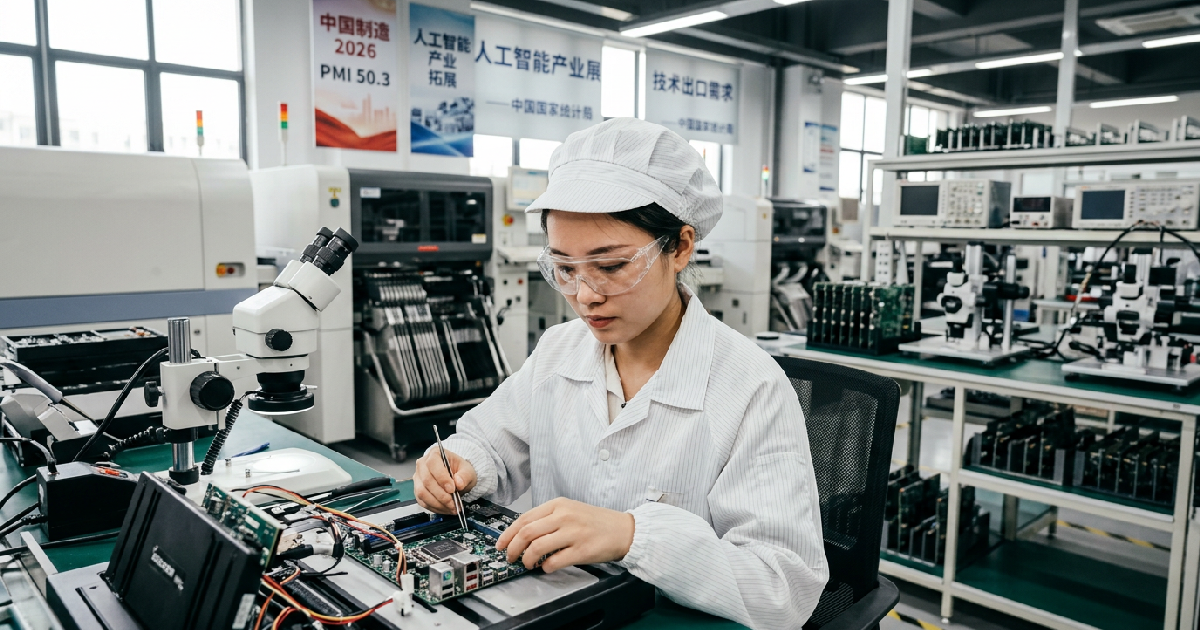
China manufacturing output expands to 50.3 in June 2026, driven by AI boom
China factory activity expanded at a faster pace than anticipated in June 2026, as the world’s second-largest economy saw a resurgence in high-tech manufacturing driven by the global artificial intelligence (AI) boom.
Data released Tuesday by the National Bureau of Statistics (NBS) shows the official manufacturing purchasing managers’ index (PMI) rose to 50.3 from 50.0 in May, successfully returning to expansionary territory above the 50-point threshold. The figure outpaced the 50.1 consensus forecast from a Reuters poll, signaling a fragile but tangible recovery for Beijing’s industrial engine.
High-tech manufacturing drives China’s industrial output
The acceleration highlights a growing divide between China’s resilient high-tech sectors and its struggling domestic markets. While global tech demand provides a vital lifeline, internal pressures remain acute as real estate development and consumer goods production continue to face significant headwinds.
Private research from the China Beige Book, which surveyed 1,321 businesses, also indicated signs of recovery following two months of sluggish growth, with both manufacturing and retail sales showing improvement in June.
The primary driver of the June expansion was high-tech equipment manufacturing, which reached a PMI of 53.5. This sector, encompassing advanced manufacturing and AI-related equipment, comfortably outperformed the broader factory sector and the consumer goods segment, which lagged at 50.2. This performance is echoed by official trade data showing a massive surge in tech-related shipments.
Key details
In May, exports of semiconductor chips increased by over 110% year-on-year, while computer hardware grew by 66%.
The global shift toward AI infrastructure has fundamentally altered China’s export composition. AI-related products accounted for 15% of the country’s total export value in May, up from 9% just three years prior. This trend is further supported by a 60% year-on-year value surge in automated data processing equipment.
This pivot to high-value goods is occurring even as capital shifts toward new technologies globally, placing China in a strategic position as the primary supplier for the global AI investment boom.
Production and new orders return to expansion territory
The details of the June report show that both supply and demand improved during the month. The Manufacturing Production Index picked up to 51.4, while the New Orders Index rose to 51.2, marking a return to expansionary territory.
Large enterprises posted a PMI of 50.7, while medium-sized firms saw a significant recovery, rising 1.9 percentage points to 50.5. However, small enterprises remained in contraction at 48.2, illustrating that the benefits of the tech boom have not yet filtered down to smaller manufacturers.
International demand also showed signs of life as new export orders rebounded to 50.1. Analysts suggest this recovery is partly due to easing tensions in the Middle East, which reduced fears of energy shocks and growth disruptions.
Domestic policymakers in Beijing have remained cautious, particularly as China trading curbs continue to be a point of concern for regional asset stability. The resilient supply side of the economy currently stands in stark contrast to muted domestic buying power.
Key details
A notable factor contributing to the June boost was a rush by exporters to ship goods to the United States. According to the National Bureau of Statistics, U.S. importers brought forward shipments following a meeting between President Donald Trump and Chinese leader Xi Jinping in May.
This frontloading also occurred ahead of the July expiry of a 10% levy under Section 122. For many manufacturers, the priority in June was to clear inventories before potential new duties emerge from ongoing Section 301 probes targeting overcapacity.
The automotive sector was a major beneficiary of this shipping rush, with car exports jumping 39% in May. Despite this activity, the manufacturing employment sub-index remained in contraction at 48.4, which suggests that factories are not yet confident enough to resume wide-scale hiring.
Instead of expanding workforces, many companies appear to be sticking to current levels or utilizing automation to manage the increased output required for high-tech assembly lines.
Weakness in construction and domestic demand persists
The service and construction sectors continue to offer a more subdued outlook. The non-manufacturing PMI edged up to 50.2 from 50.1 in May, narrowly beating the 49.9 forecast by Reuters. Within this index, the services business activity index stood at 50.4, but construction remained a major drag.
The construction business activity index stayed in contraction at 49.0, reflecting the ongoing toll of a prolonged property downturn and its impact on the wider economy.
Chinese policymakers have so far refrained from introducing meaningful easing or broad stimulus packages to boost domestic demand this year. While retail sales plummeted in May for the first time in over three years, economists largely rule out major stimulus in the short term.
However, Goldman Sachs notes that rising fiscal pressures might spur faster government borrowing in the coming months, particularly if third-quarter GDP growth fails to meet targets. For now, the strategy remains focused on high-tech manufacturing as the primary engine for resilience against external economic shocks.