

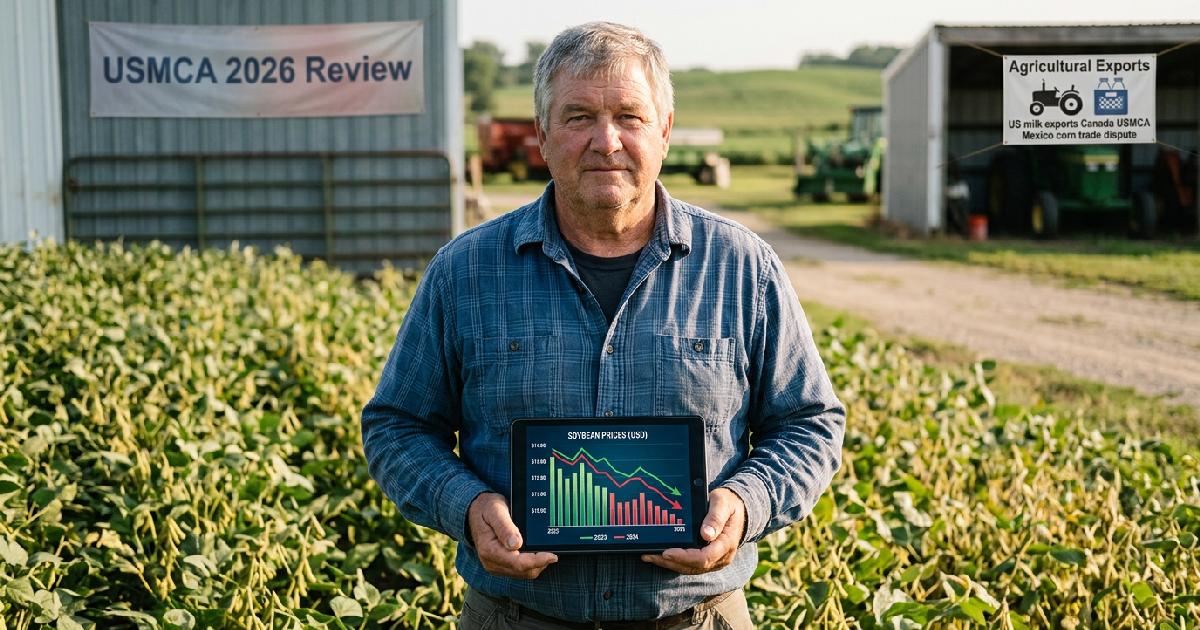
American agricultural leaders call for USMCA preservation ahead of 2026 review
American agricultural leaders are calling for the preservation of the United States-Mexico-Canada Agreement (USMCA) as the treaty approaches its mandatory six-year joint review, which is scheduled to begin by July 1, 2026.
For producers like Iowa farmer Stu Swanson, the trade pact represents a vital buffer against a mounting crisis characterized by weak commodity prices and rising input costs. Swanson noted that many in the industry are operating on “dwindling hope” as financial pressures intensify across the American heartland.
USMCA review 2026 and its impact on agricultural exports
The USMCA serves as the cornerstone of North American trade, facilitating approximately $1.9 trillion in total goods and services exchange between the three nations. In 2024, U.S. agricultural exports to Canada and Mexico exceeded $60 billion, accounting for nearly one-third of the country’s total overseas farm sales.
Industry advocates argue that maintaining this duty-free access is essential for rural economic stability, particularly as agricultural communities in states like Ohio and Kansas face tightening margins.
The upcoming review process allows the member countries to determine if they will renew the pact for 16 years, negotiate specific updates, or move toward annual consultations. While global markets react to shifting geopolitical deals, American farmers remain focused on the “certainty” provided by the USMCA.
Since its 2020 implementation, agricultural export value to North American neighbors grew by 47%, significantly outpacing the 18% growth rate seen in trade with the rest of the world.
Key details
The financial impact of the agreement extends beyond the farm gate to the broader U.S. economy. In 2024 alone, agricultural and seafood exports under the USMCA generated $149 billion in total economic output and supported nearly 500,000 full-time jobs.
Statistical modeling suggests that every $1 in industry exports under the agreement drives an additional $2.45 in supported economic activity. CoBank CEO Tom Halverson emphasized the long-term benefits, noting that U.S. exports to the region have grown roughly 600% since the original creation of NAFTA.
Consumers also have a direct stake in the outcome of the 2026 review. A study from Purdue University found that without the duty-free framework of the USMCA, American families would likely pay $700 more per year on groceries. This estimated increase represents roughly 7% of total household food expenditures.
Farmers are less concerned with expanding the current agreement than they are with preventing new disruptions that could further weaken an already fragile rural economy.
Mexico and Canada dominate U.S. corn and ethanol markets
Mexico has solidified its status as the top export destination for U.S. corn, purchasing $5.2 billion worth of the crop in 2025. During the 2024-2025 marketing year, the USMCA region accounted for 37% of total U.S. corn exports, representing nearly 1.776 billion bushels of demand.
This figure includes bulk corn as well as the grain equivalent of meat and ethanol exports. Just as international investments are increasingly strategic, the U.S. relies on North American demand to absorb record production levels.
The renewable fuel sector is similarly dependent on these open borders, with Canada serving as the top destination for U.S. ethanol. In 2025, ethanol exports to Canada reached $1.7 billion, while sales to Mexico totaled $166 million. The USMCA region consumed 39% of all U.S. ethanol exports during the last marketing year.
By value, these exports have grown at an average annual rate of 20.4% since the agreement was enacted, providing a critical revenue stream for corn producers.
Livestock and dairy producers see significant market gains
The livestock industry has experienced a 7.1% average annual growth rate in export value for meat products since the USMCA was implemented. Mexico is the primary market for U.S. pork, importing nearly $2.9 billion in 2025, while Canada ranks as the fourth largest market with $759 million in purchases.
These markets combined for one-third of all American beef, pork, and poultry exports during the 2024-2025 marketing cycle. Beef exports specifically reached $1.3 billion to Mexico and $874 million to Canada in 2025.
Dairy producers have also seen expanded access under the 2020 rules, particularly in the Canadian market. U.S. dairy farmers increased their market share in Canada to 3.6% in the months following implementation, up from roughly 1% under the previous NAFTA rules.
In 2025 alone, dairy exports were valued at $2.58 billion to Mexico and $1.31 billion to Canada. Leaders in the sector describe Mexico as a “very lucrative market” that provides essential sales as domestic costs remain elevated.
Key details
Soybean exports to Canada and Mexico exceeded $4 billion during the 2023-2024 marketing year, representing approximately 14% of the total U.S. soy complex exports. This demand supports a massive logistical network across the continent. Thousands of rail cars and trucks move these commodities daily, feeding into a system that generates $36 billion in annual wages.
Because transportation firms adjust to earning shifts based on trade volume, any reduction in border activity would have immediate second-order effects on the logistics industry.
As the formal review period begins on July 1, the priority for the agricultural lobby is to maintain the current rules rather than risk a full renegotiation. Farmers argue that any return to tariffs would immediately benefit global competitors like Brazil.
For the American producer, the USMCA is no longer viewed as a trade preference, but as a fundamental necessity for survival in a volatile global market.