

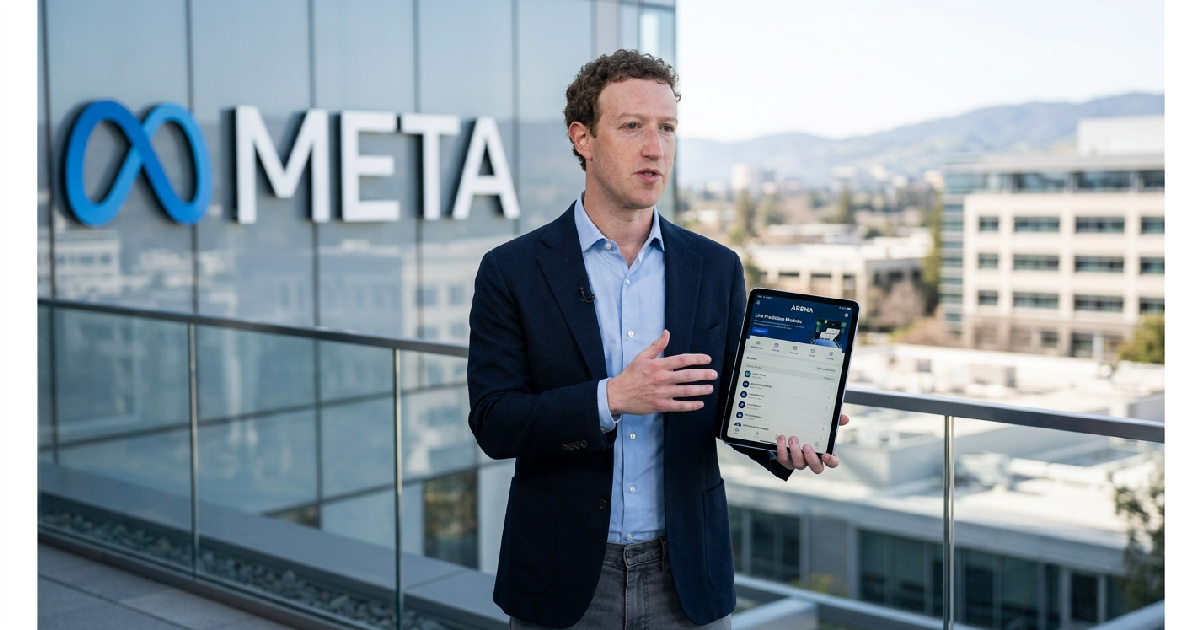
Mark Zuckerberg reportedly develops Arena app to challenge Polymarket
Meta Platforms and CEO Mark Zuckerberg are reportedly developing a new smartphone application codenamed Arena, a prediction market platform designed to compete directly with industry leaders Polymarket and Kalshi.
The project, which emerged via internal reports on June 23, 2026, marks a significant strategic pivot for the social media giant as it seeks to capture the burgeoning interest in event-based wagering and crowdsourced forecasting.
Meta enters the prediction market arena
Zuckerberg has personally directed a small, dedicated team to oversee the app’s creation, signaling that the company views this as a high-priority experimental venture.
Arena will operate as a standalone entry in the Meta app ecosystem, remaining distinct from the company’s core pillars of Facebook, Instagram, WhatsApp, and Messenger. Despite this separation, Meta intends to use its massive global reach of 3.56 billion daily visitors to funnel users toward the new platform.
Initial versions of the app are expected to feature a points-based system similar to a video game, allowing users to make “bets” on real-world outcomes without the immediate legal complexities of real-money gambling, though the company has not ruled out a move into traditional wagering later.
The timing of the Arena announcement coincide with a period of explosive growth for decentralized and regulated prediction platforms. Meta Platforms is clearly eyeing the success of Polymarket, which became a household name during the 2024 U.S. presidential election.
By launching a dedicated app, Meta is attempting to formalize a type of social behavior that already exists across its networks—people arguing over and predicting future events—but within a structured, data-driven environment.
This isnt the first time the company has toyed with this concept. In 2020, Meta launched a small-scale product called Forecast that also utilized a points system to crowdsource predictions on health and technology trends.
Key details
That project was shuttered in 2022, but the renewed effort under the Arena banner suggests that Zuckerberg believes the market is now sufficiently mature. The push for Arena is part of a broader mandate to develop “alternative” social apps based on emerging digital trends.
And while the focus is currently on the “gamified” aspect of the app, the underlying technology could provide Meta with invaluable sentiment data. In a market where Brian Armstrong warns finance must move on-chain to stay relevant, Meta’s entry into a space heavily dominated by crypto-native platforms like Polymarket shows a desire to bridge the gap between traditional social media and Web3-style engagement.
Impact on DraftKings and Robinhood shares
The market reaction to the news was swift and punitive for current players in the betting and trading sectors. Shares of DraftKings fell more than 2% in intraday trading on June 23, while Flutter Entertainment dropped roughly 2% as investors weighed the threat of a Meta-backed competitor.
Robinhood, which has recently expanded its offerings to include event contracts, also saw its share price decline following the reports.
Investors appear concerned that Meta’s nearly unlimited marketing budget and existing user base could quickly erode the market share of established platforms. If Arena can successfully transition even a fraction of Instagram’s user base into active “forecasters,” it would immediately become one of the largest prediction platforms in the world.
The scale of the opportunity is underscored by recent data from Pew Research, indicating that combined monthly trading volume for Polymarket and Kalshi jumped from $5 billion to $24 billion between late 2025 and April 2026.
Strategic shift toward standalone experimental apps
The development of Arena reflects a broader “New Products” strategy at Meta. Rather than cluttering the Facebook or Instagram interfaces with niche features, the company is increasingly building standalone apps to test user appetite. Alongside Arena, Meta is reportedly testing an app called Meta Photos, which uses artificial intelligence to generate new media types, showing a company-wide push toward diversification.
This approach allows Meta to fail fast and cheaply without damaging its primary brands. If Arena gains traction, it can eventually be integrated or cross-promoted more heavily. If it fails, it remains a footnote in Zuckerberg’s experimental portfolio. The “everything app” strategy seen in Asian markets like WeChat is being adapted by Meta into a more fragmented, specialized ecosystem of services.
The decentralization of social media has led to capital moving in new directions. Some investors have shifted focus as Bitcoin (BTC) price drops due to capital being diverted into AI and other high-tech sectors. Meta is positioning Arena to be at the intersection of these trends, combining social data, AI-driven insights, and the competitive nature of financial forecasting.
Navigation of the regulatory landscape
One of the largest hurdles for Arena will be the evolving regulatory environment in the United States and Europe. On June 10, 2026, the Commodity Futures Trading Commission (CFTC) proposed new rules that would specifically ban contracts tied to war, assassinations, and terrorism. These rules are designed to prevent prediction markets from becoming “incentives for harm,” a criticism often leveled at unregulated offshore platforms.
Key details
By starting with a points-based system, Meta avoids immediate CFTC oversight that applies to real-money wagering. This “play money” approach serves as a regulatory sandbox, allowing Meta to build the community and the interface while lobbyists and lawyers determine the feasibility of a full-scale betting launch.
However, the path isn’t entirely clear, as federal authorities continue to scrutinize how large tech firms handle user data and financial incentives concurrently.
Competing with decentralized rivals
Meta’s biggest competition isn’t just DraftKings; it’s the decentralized world of Polymarket and individual tokens. The crypto community has proven that it prefers permissionless platforms where transparency is guaranteed by the blockchain.
For Meta to succeed, Arena will need to offer a user experience that is significantly more polished or social than what a DeFi app can provide. We have seen how Near Protocol and Hyperliquid crypto tokens surged by offering specialized utility, and Meta will have to find a similar “hook” for its non-crypto audience.
Future outlook for the Arena platform
The road ahead for Arena depends on its ability to turn casual scrolling into active participation. The total volume of trade in the global prediction market topped $130 billion in the year leading up to June 2026, proving that the financial appetite for “being right” is massive.
Meta doesn’t necessarily need users to bet thousands of dollars; if they can capture the “wisdom of the crowd” for advertising and data purposes, the app could be profitable without ever taking a direct commission on a wager.
As the 2026 midterm elections approach in various regions and major sporting events dominate the calendar, the demand for real-time forecasting will only grow.
Meta’s Arena project represents a major bet on the future of social engagement, suggesting that the next generation of social media won’t just be about sharing photos—it will be about betting on what happens next.
Whether Zuckerberg can succeed where Forecast failed remains to be seen, but the market is clearly watching with a mix of anticipation and anxiety.