

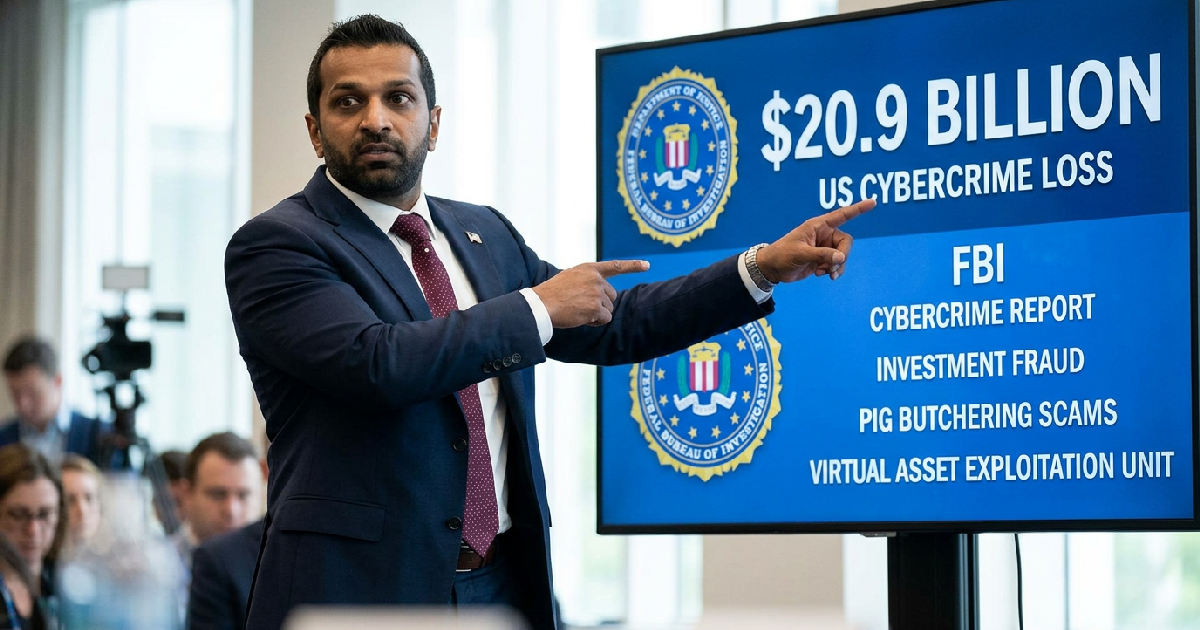
FBI Director Kash Patel warns crypto fraudsters as US cybercrime losses hit $20.9 billion
FBI Director Kash Patel issued a direct warning to cryptocurrency fraudsters on June 19, 2026, as the bureau intensifies its enforcement effort to dismantle global investment scam networks. Through the promotion of Operation Level Up, the bureau is shifting its strategy toward early intervention to prevent Americans from losing further assets to sophisticated schemes.
Patel stated that criminals have been taking advantage of the American people for too long, promising that federal agents will find those responsible and bring them to justice.
The scale of the financial threat is stark. In 2025, U.S. cybercrime losses reached a staggering $20.9 billion, with investment fraud alone accounting for $10.7 billion of that total. These figures highlight the evolving tactics of organized crime groups that often operate from overseas.
Operation Level Up targets pig butchering networks
By focusing on the criminal organizations rather than the underlying technology, the FBI is signaling an aggressive pursuit of the infrastructure utilized by these syndicates.
Operation Level Up serves as a proactive cornerstone of this push, moving beyond traditional investigations. Federal agents now analyze transaction data and intelligence reports to identify victims while they are still in contact with fraudsters.
This approach involve agents making direct phone calls or sending emails to warn individuals that the platform they are using is fraudulent. This mirrors how broader banking jobs face transformation as data analysis becomes central to identifying high-risk activity in real-time.
A primary concern for the bureau is the “pig butchering” phenomenon, a trust-based manipulation tactic where fraudsters build relationships with victims over weeks or months. These scams typically begin with unsolicited contact via social media, dating apps, or professional networking sites. Once trust is established, victims are directed to fake trading platforms that display fabricated profits to encourage larger deposits.
The technical side of these investigations is handled by the Virtual Asset Exploitation Unit (VAXU), an initiative first announced by U.S. Deputy Attorney General Lisa O. Monaco. The VAXU serves as a nerve center for blockchain analysis and virtual asset seizure.
By tracing digital footprints, the unit aims to disrupt ransomware and investment fraud before funds are laundered. This technical monitoring is vital, as a sudden bitcoin price drop or spike can often be linked to the movement of illicit funds across exchanges.
Combating the trend of physical cash couriers
The FBI has also identified a shift toward the use of physical cash couriers to bypass banking safeguards. In these cases, scammers instruct victims to withdraw cash and hand it over to individuals posing as investment representatives. This tactic is designed to avoid the automatic monitoring systems used by financial institutions.
The United States Secret Service (USSS) is currently supporting Operation Level Up to address these physical components of the fraud chain.
James Barnacle, Deputy Assistant Director of the FBI’s Criminal Investigative Division, noted that the proactive nature of recent operations is designed to stop the cycle of loss early. By intervening before multiple deposits are made, the bureau hopes to significantly reduce the multi-billion dollar impact of these scams on American households.
The FBI reminded the public that its agents will never move communications to private messaging apps or ask for bank account details during an investigation.
International operations against organized crime compounds
Because many fraud operations are based overseas, the FBI is leaning on international cooperation to disrupt organized crime compounds. A recent coordinated operation involved the Dubai Police and China’s Ministry of Public Security, targeting at least nine different compounds. Furthermore, law enforcement partners in countries including Thailand have participated in crackdowns against the large-scale syndicates running these investment schemes.
The global reach of these efforts was evidenced by “Operation Blackout,” which targeted scam centers across Asia, Africa, and the Middle East. In May, the FBI reported seizing $8 billion in cryptocurrency and 127,000 BTC as part of this broader push. While the com/crypto-news/bitcoin-relief-rally-bitcoin-drops-to-72-868-on-733-million-institutio/”>bitcoin drops to lower levels seen recently fluctuate the total value, the volume of assets seized demonstrates the bureau’s increasing ability to track digital ledgers. Private sector partners like Meta, Microsoft, and Starlink have also assisted by removing fraudulent accounts and terminating satellite kits linked to illegal activity.
Enhanced enforcement and new leadership roles
The Department of Justice continues to expand its specialized units, including the National Cryptocurrency Enforcement Team (NCET). Eun Young Choi was named the first director of the NCET to focus specifically on digital asset crimes. This team works alongside the FBI’s Virtual Assets Unit to provide the expertise necessary to handle complex blockchain investigations and prosecute high-level ringleaders.
In early June, the FBI also rolled out a “Most Wanted Fraudsters” list, an initiative tied to the White House Task Force to Eliminate Fraud. This list aims to bring public attention to the individuals managing these global fraud networks.
Brian Turner, Executive Assistant Director of the FBI’s Criminal, Cyber, Response, and Services Branch, emphasized that the VAU is essential for pursuing those who use cryptocurrency for ransomware child exploitation, and financial crimes.
Future strategy for victim notification and reporting
As the FBI moves forward with Operation Level Up, the focus remains on early victim notification. By sharing illicit domains and accounts with the private sector, the bureau seeks to close off the infrastructure scammers rely on.
Authorities believe that faster reporting through the Internet Crime Complaint Center (IC3) is the best way to improve the chances of tracing and freezing stolen funds before they disappear.
The bureau’s multi-pronged approach addresses the financial, technical, and physical infrastructure of modern fraud. While scammers continue to evolve their methods, the permanent nature of the blockchain provides a roadmap for federal investigators. For the FBI, the priority is clear: disrupting the criminal organizations behind the screens and protecting the financial security of American citizens from overseas exploitation.