

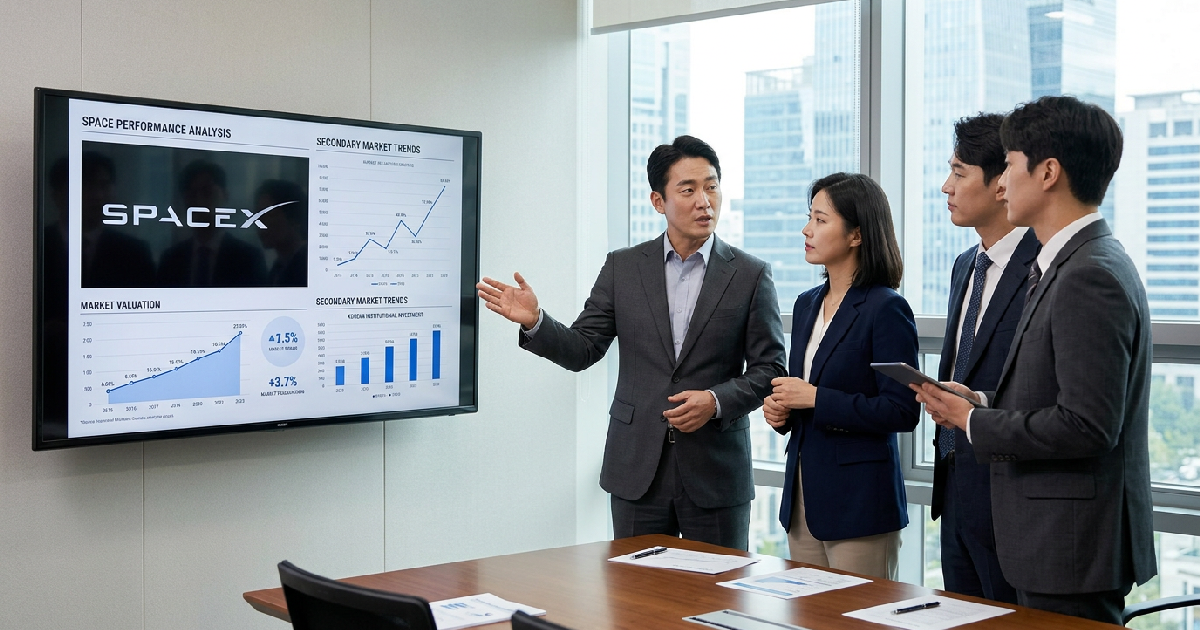
SpaceX secures $800 million from South Korean investors on June 17, 2026
SpaceX has successfully raised $800 million from a consortium of South Korean institutional investors during a private secondary share sale that coincided with a significant internal trading debut on June 17, 2026.
The funding round, which drew heavy participation from Seoul-based asset managers and pension funds, underscores the growing international demand for equity in Elon Musk’s aerospace firm as its valuation continues to climb toward historic heights.
The transaction allows early employees and existing investors to sell their holdings to a fresh wave of international capital. This massive influx of Korean liquidity highlights a shift in global investment patterns, as major Eastern financial institutions increasingly prioritize private technology giants over traditional public equities.
The $800 million commitment is one of the largest single-country private infusions SpaceX has received in recent years, signaling strong confidence in the Starship program and the expanding Starlink satellite network.
Industrial analysts suggest that South Korean investors are looking to hedge against domestic market volatility by securing stakes in American “frontier” technology. This move mirrors a broader trend where supply chain resiliency and technological sovereignty are becoming the primary drivers for capital allocation.
For many in Seoul, a stake in SpaceX is not just a financial play but a strategic positioning within the future of the global telecommunications infrastructure.
South Korean financial giants lead the SpaceX funding charge
The $800 million was reportedly aggregated through several prominent Korean brokerage firms acting as intermediaries for high-net-worth individuals and institutional clients. While the specific identities of all participating funds remain confidential due to the private nature of the secondary market, sources indicate the round was oversubscribed within hours of opening.
This mirrors the high-intensity demand often seen in the digital asset space when Ethereum whales accumulate large portions of supply during market shifts.
The enthusiasm from South Korea comes at a time when SpaceX is reaching a critical operational cadence. With dozens of Falcon 9 launches already completed this year and the Starship platform nearing full orbital reliability, the company’s revenue streams from both government contracts and commercial satellite launches have stabilized.
This stability has turned SpaceX into a “must-have” asset for large-scale portfolios that previously viewed space as too speculative.
Secondary markets provide an alternative to traditional IPOs
SpaceX remains one of the world’s most valuable private companies, and CEO Elon Musk has repeatedly delayed a public listing in favor of these internal secondary rounds. By allowing investors to trade shares twice a year, the company provides liquidity without the regulatory burdens of a standard Initial Public Offering (IPO).
This model has proven successful in maintaining a high valuation while keeping the company’s long-term Mars-focused mission shielded from quarterly public market pressures.
For the Korean investors, the secondary market entrance offers a rare entry point into a cap table that is notoriously difficult to penetrate. Historically, SpaceX has been selective about its partners, often favoring American venture capital firms like Sequoia or Founders Fund. The inclusion of a large Korean block suggests a strategic opening to Asian markets where Starlink is seeking to expand its regulatory footprint.
Strategic implications for the global aerospace market
The timing of this $800 million draw is particularly relevant as the aerospace sector faces increased competition from state-backed programs in China and Europe. By locking in long-term capital from South Korea, SpaceX strengthens its ties with a nation that is itself an emerging power in satellite technology and semiconductor manufacturing.
This relationship could facilitate future collaborations on hardware procurement or ground-station deployments within the Korean peninsula.
This capital injection also comes amidst a broader transformation in how global banking leaders view the intersection of technology and labor. Much like how banking jobs face AI transformation, the aerospace industry is seeing a shift toward automated manufacturing and reusable rocket flight-paths.
SpaceX’s ability to draw nearly a billion dollars in a single day from a single foreign market demonstrates its dominance in this new industrial era.
Future outlook for SpaceX valuation and share availability
With this latest round, SpaceX’s valuation is expected to be adjusted upward in subsequent filings. The company’s internal share price has shown consistent growth, often outperforming the broader S&P 500 tech sector. As long as the company maintains its current launch frequency and continues to win NASA Artemis contracts, the demand for secondary shares is likely to remain high among global institutional players.
Looking ahead, the next internal trading window is expected to open in late 2026. Financial observers will be watching closely to see if other sovereign or institutional groups from Japan or the Middle East attempt to replicate the South Korean success.
For now, SpaceX continues to fund its ambitious deep-space goals through a unique blend of operational revenue and the seemingly bottomless appetite of private global investors.