

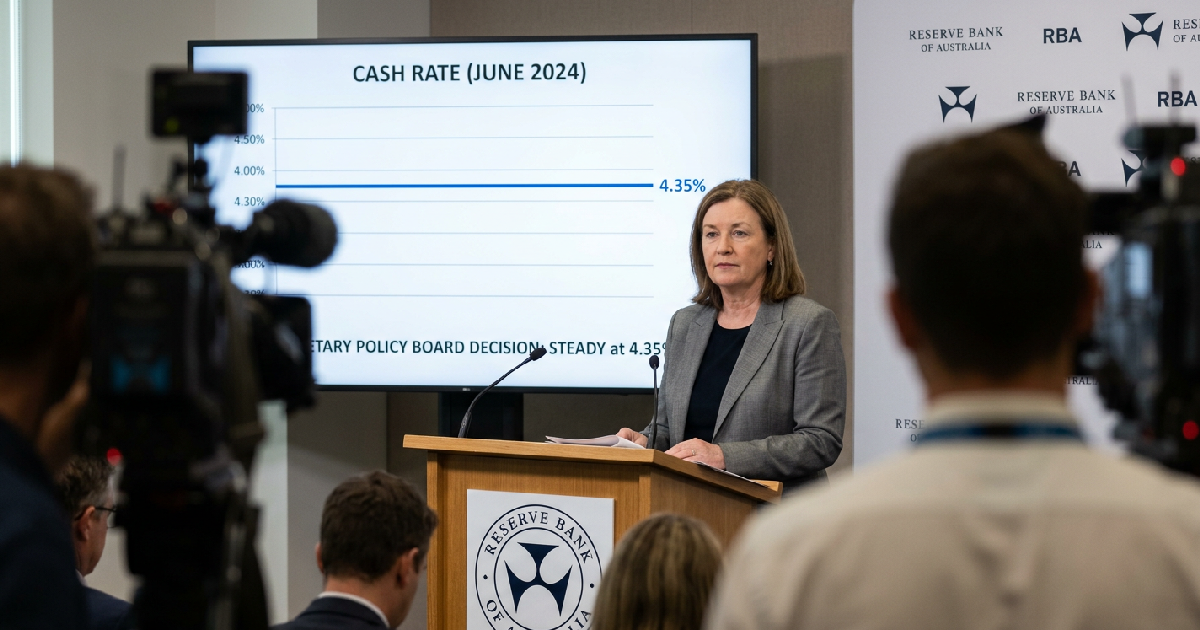
Reserve Bank of Australia holds cash rate at 4.35% on June 16
The Reserve Bank of Australia (RBA) opted to maintain the official cash rate at 4.35% during its policy meeting on Tuesday, June 16, 2026, marking the first pause in tightening this year.
Despite the hold, Governor Michele Bullock issued a stern warning that the Board remains prepared to resume interest rate hikes if inflation proves more stubborn than forecasted.
This decision follows a period of aggressive tightening, including three consecutive 25-basis-point increases in February, March, and May, as the central bank struggles to tether annual inflation closer to its 2% to 3% target range.
The RBA Monetary Policy Board reached a unanimous decision to leave the target rate unchanged, giving members more time to evaluate how previous hikes are permeating the broader economy. With annual inflation sitting at 4.2% and underlying inflation at 3.
4% as of April 2026, the central bank is walking a fine line between cooling price pressures and avoiding a severe domestic downturn.
Governor Michele Bullock clarified in a press conference that “inflation remains too high” and noted that the current pause should not be misinterpreted as a signal that the peak of the cycle has been reached.
The global economic climate played a significant role in the RBA’s cautious stance. The Board highlighted concerns regarding oil supply disruptions and ongoing conflicts in the Middle East, which continue to apply upward pressure on global energy costs.
While Governor Bullock noted that reports of a potential end to Middle Eastern hostilities are welcome, the bank remains wary of cost pressures becoming entrenched in the Australian wage and price-setting framework.
Monetary policy outlook and the persistence of Australian inflation
The central bank’s decision to hold the cash rate at 4.35% reflects a growing need to assess the delayed impact of monetary policy. Because interest rate changes often take months to fully affect consumer behavior and business investment, the Board is looking for evidence that their recent string of hikes is effectively slowing demand.
“Leaving rates on hold today will allow the board to assess how these previous increases are flowing through the economy,” Governor Michele Bullock told reporters following the announcement.
Domestic conditions currently present a mixed bag for policymakers. Gross Domestic Product (GDP) grew at a modest 0.3% quarterly pace in the first quarter of 2026, indicating a period of below-trend growth. Household consumption remains weak, and dwelling investment has stalled as the cost of borrowing bites into disposable income.
This slowing in consumer spending is precisely what the RBA intended to achieve, yet the persistence of service-side inflation remains a primary concern for the Board.
The labor market has shown signs of softening, with the unemployment rate coming in higher than anticipated in April 2026. However, overall employment levels remain resilient by historical standards. The RBA’s current forecast suggests that unemployment will gradually rise to approximately 4.25%.
Managing this transition without triggering a recession is the central challenge for the RBA, especially as supply chain resiliency remains a priority in an era characterized by geopolitical volatility and shifting trade routes.
Market reaction and the Australian dollar’s performance
Financial markets reacted swiftly to the RBA’s announcement and the accompanying hawkish rhetoric. The Australian Dollar (AUD) dipped 0.3% to trade at US$0.7050, as some traders had hedged against the possibility of a surprise hike. Meanwhile, three-year government bond yields edged up by 2 basis points to 4.
457%, signaling that investors took the RBA’s warning about future hikes seriously. Interest rate swaps currently indicate a 30% chance of an additional hike when the Board meets in August.
For many Australian families, the hold provides a temporary reprieve after a bruising start to 2026. Governor Michele Bullock acknowledged that the three rapid-fire hikes implemented earlier this year “are tough for households.” This sentiment aligns with a broader trend in global finance where banking leaders view technological shifts and evolving labor markets as the primary drivers of long-term economic change, alongside traditional monetary tools.
Future projections for the cash rate through 2027
While the RBA has left the door open for further tightening, the consensus among major financial institutions suggests a period of stability may be on the horizon. Economists at NAB, Commonwealth Bank of Australia (CBA), and ANZ do not expect a reduction in the cash rate until 2027 at the earliest.
This long-term “higher for longer” stance suggests that the RBA is prioritising the return of inflation to the 2-3% band over immediate economic stimulus.
The RBA’s priority remains fixed on ensuring that inflation does not become embedded in the economy’s functioning. High inflation “erodes the value of savings, hurts household budgets, and worsens income inequality,” according to previous RBA statements. The Board’s current projections anticipate that CPI inflation will hover around 3.
5% through the end of the year, only touching the top of the target range by the end of 2025.
Geopolitical developments remain the ultimate wildcard for Governor Michele Bullock and the Board. Any escalation in international conflicts that impacts energy markets could force the RBA’s hand earlier than expected. For now, the central bank maintains a “wait and see” approach, keeping the 4.
35% rate as a baseline while monitoring whether the Australian economy can achieve a soft landing amidst the most aggressive tightening cycle in decades.