

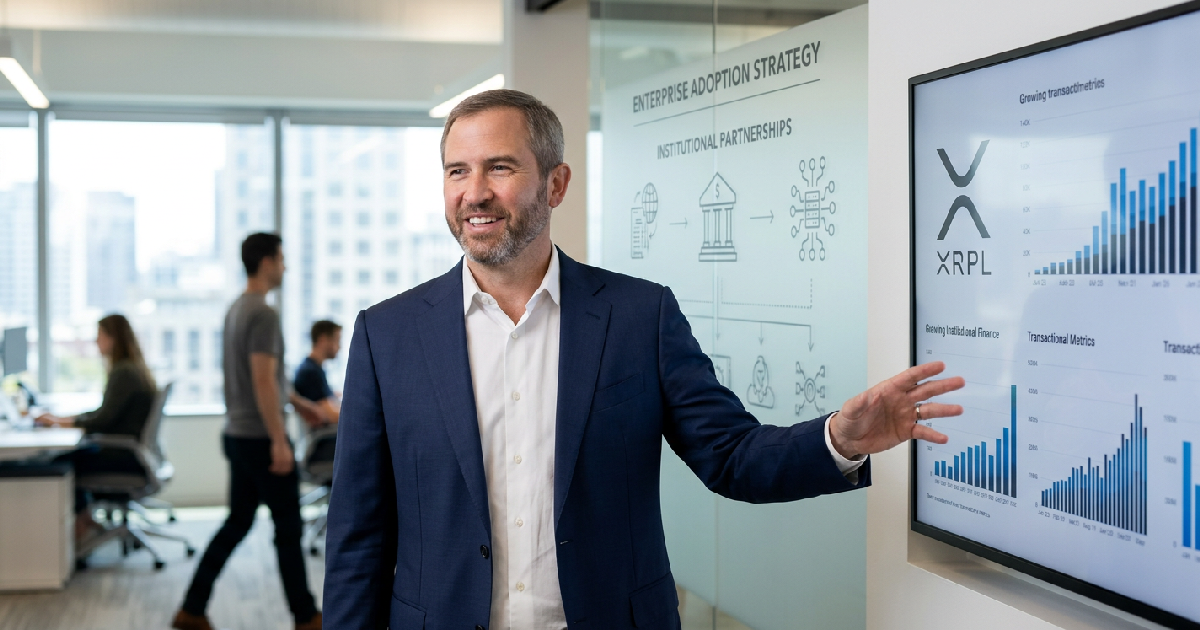
Brad Garlinghouse announces institutional shift vindicates Ripple’s strategy on June 11, 2026
Ripple Labs CEO Brad Garlinghouse recently declared that the ongoing industry-wide shift toward institutional blockchain adoption serves as a total vindication for the enterprise-first strategy his company has championed for years.
In a public exchange on June 11, 2026, Garlinghouse claimed that rival networks, which previously dismissed the XRP Ledger’s focus on banking and regulated finance, are now attempting to replicate that same model as the market matures.
The admission came following comments from Hugo Philion, the co-founder of Flare, who noted on a recent podcast episode that the broader cryptocurrency market is reversing its once-hostile stance toward Ripple.
For much of the last decade, Ripple and its native token, XRP, faced sharp criticism from decentralized finance purists for prioritizing partnerships with central banks and traditional payment providers. That narrative is now shifting as “institutional” becomes the primary buzzword for surviving ecosystems.
And it’s not just Ripple claiming victory. The broader market sentiment appears to be following the capital. As institutional investors increasingly dominate the space, the “be your own bank” ethos is being augmented by a “bank the blockchain” reality. This shift occurs even as Bitcoin drops to $72,868 on institutional outflow, proving that professional money now dictates the pulse of the major assets.
Brad Garlinghouse argues rival networks mocked the XRP vision
For years, the XRP Ledger was often the “black sheep” of the crypto world because it didn’t align with the libertarian ideals of total anonymity and anti-establishment protocol.
Brad Garlinghouse noted that many current market leaders once mocked the idea that blockchain technology should work within the existing financial system rather than trying to burn it down. He suggested that seeing these same projects now court banks is the ultimate form of flattery.
The Ripple executive’s comments highlight a significant cultural divide that has existed since 2012. While projects like Ethereum and Solana focused on retail-driven decentralised applications, Ripple built a “liquidity hub” designed specifically for cross-border settlements and Treasury management. So, as regulators in the US and Europe tighten their grip, the compliance-ready infrastructure of XRP has moved from a point of contention to a competitive advantage.
But the road to this “vindication” hasn’t been without its hurdles. Ripple spent years in a high-profile legal battle with the Securities and Exchange Commission (SEC), a fight that often saw Ethereum whales accumulate supply while XRP was delisted from various exchanges. Now that the regulatory fog is beginning to lift, Ripple’s original thesis—that crypto is a tool for financial institutions—is becoming the industry standard.
Hugo Philion highlights the changing narrative at Flare
Hugo Philion, speaking on the AllInCrypto Podcast, provided the spark for this latest round of debate. He argued that the “toxic” atmosphere surrounding XRP in the mid-2010s was largely born out of a misunderstanding of what the network was trying to achieve. According to Philion, the market is finally waking up to the fact that institutional integration is the only path to multi-trillion-dollar valuations.
Flare, which has a long-standing relationship with the XRP ecosystem, is currently preparing for the Flare 2.0 update. This expansion aims to bring smart contract capabilities to the XRP Ledger, further bridging the gap between old-school finance and new-school utility. This technical evolution is part of why Ripple supporters believe they are winning the long game against more volatile, retail-focused tokens.
Institutional pivot becomes a survival strategy for crypto firms
The rush toward institutional products is no longer optional for major blockchain foundations. With the entry of Wall Street giants into the spot ETF space, projects that cannot offer clear regulatory pathways or enterprise utility risk becoming obsolete. Ripple’s long-term play for the “Internet of Value” appears to be the blueprint that younger protocols are now studying to ensure their own longevity.
This transition isn’t just about technology; it’s about the bottom line. As liquidity becomes more concentrated in regulated venues, the “walled garden” approach for which Ripple was once criticised is being rebranded as “enterprise security.” We are seeing a massive transformation in how these jobs are viewed, much like UBS Asia President Iqbal Khan views AI as a fundamental shift for the banking sector’s future.
What this means for the XRP Ledger roadmap
Ripple isn’t resting on its laurels despite the CEO’s claims of vindication. The company is currently pushing for greater adoption of its Liquidity Hub and exploring the integration of sidechains to compete with Ethereum’s dominant DeFi ecosystem. The goal is to prove that XRP can handle more than just simple payments; it wants to be the base layer for all institutional tokenized assets.
The industry will likely see more partnerships between traditional finance (TradFi) and blockchain firms in the coming months. If Garlinghouse is correct, the next cycle of growth won’t be driven by anonymous developers or meme tokens, but by the very banks and institutions that the crypto industry once vowed to replace.
For XRP holders, the “Yes” from their CEO is a signal that the decade of being an outsider is officially over.