

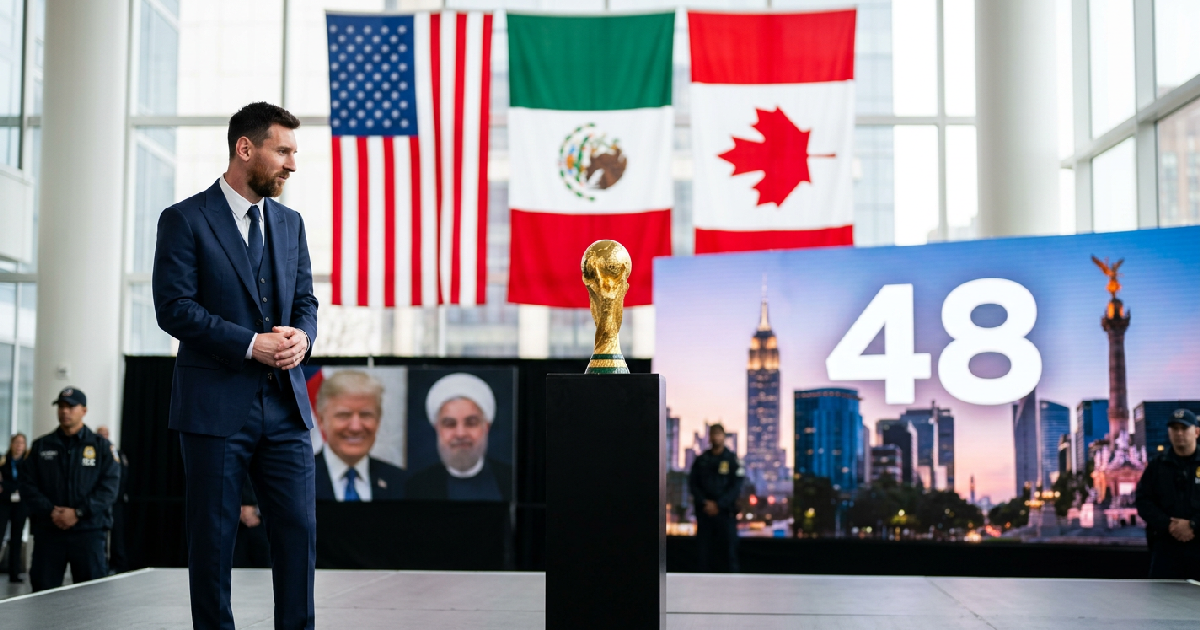
2026 FIFA World Cup expands to 48 teams, heightening geopolitical tensions
The 2026 FIFA World Cup is set to become the largest and most politically charged sporting event in history as it prepares to kick off across the United States, Mexico, and Canada.
With 48 teams competing in 104 matches over nearly six weeks, the scale of the tournament presents an unprecedented intersection of global diplomacy and elite athletics. From the presence of football icon Lionel Messi to the complex geopolitical tensions involving Donald J.
Trump and Iran, the tournament will serve as a high-stakes stage for more than just trophy hunting.
Organisers face the daunting task of managing a three-country hosting model that stretches from Vancouver to Mexico City. The expanded format adds 16 teams to the traditional 32-team roster, significantly increasing the logistical load on local infrastructure.
This expansion aims to broaden the game’s global reach, but it also invites a more diverse array of political sensitivities into the locker rooms and onto the pitch. Security and immigration agencies, including U.S. Immigration and Customs Enforcement (ICE), are already coordinating for the influx of millions of international visitors.
The timing of the tournament places it squarely in the middle of a shifting international relations landscape. While fans focus on the prowess of superstars like Lionel Messi, government officials are bracing for the inevitable friction that comes with hosting nations currently at odds on the world stage.
The involvement of the Islamic Republic of Iran, for instance, remains a focal point given the ongoing diplomatic friction with Washington. These tensions are further complicated by the domestic political climate in the United States, where figures like former President Donald J. Trump continue to influence trade and migration policy.
Geopolitical tensions and the 48-team expansion
The decision to expand the tournament to 48 teams has effectively doubled the potential for political flashpoints. By inviting more nations, FIFA has ensured that the 2026 FIFA World Cup will be a microcosm of current global conflicts. Group stage matches could potentially pit rivals against one another in high-pressure environments.
Security officials are particularly concerned about matches involving nations with histories of diplomatic hostility, where the pitch often becomes a proxy for national pride and grievance.
The sheer number of matches—104 in total—means that the tournament will dominate the global news cycle for over a month. This provides a massive platform for protests, diplomatic statements, and political branding.
In recent years, athletes have become increasingly vocal about social and political issues, and the North American stage is expected to amplify these voices. Whether it is human rights or immigration reform, the 2026 FIFA World Cup will likely see as much action in the press rooms as in the stadiums.
Logistical preparations are already testing the resiliency of the host nations. Officials are working to ensure that the transport of teams and fans across three international borders remains seamless. This requires a level of cooperation between the U.S., Mexico, and Canada that is often difficult to achieve in the political sphere.
The supply chain resiliency of the tournament is being monitored closely to prevent any disruptions to the nearly six-week schedule.
The role of Iran and international diplomacy
The Islamic Republic of Iran’s participation is one of the most watched aspects of the tournament’s political layer. Tensions between Tehran and Washington have historically bled into the sporting world, and the 2026 FIFA World Cup is no exception.
Security protocols are being tightened to manage potential protests from diaspora communities and to ensure the safety of all participants. The backdrop of shifting oil prices and nuclear negotiations adds a layer of gravity to every Iranian match on U.S. soil.
Earlier this year, reports suggested that Donald J. Trump reportedly requests edits to proposed deals involving the region, highlighting how intertwined sports and executive policy remain. As the tournament nears, the State Department and FIFA must balance the “beautiful game” with the harsh realities of international sanctions.
For the players, the challenge is maintaining focus on the ball while the world watches for any sign of political defiance or solidarity.
Managing the Messi effect and celebrity security
Lionel Messi remains the central figure of the tournament’s commercial and sporting appeal. His presence in Major League Soccer (MLS) has already transformed the sport’s profile in the United States, and the 2026 FIFA World Cup is expected to be his final global act.
For the host cities, the “Messi effect” means sold-out stadiums and a massive increase in security requirements. Protecting the world’s most famous athlete across three different countries is a task of historic proportions for local law enforcement.
Broadcasters are also gearing up for record-breaking numbers. Media outlets are investing heavily in talent to cover the spectacle both on and off the field. Recently, Fox Sports unveiled its star-studded punditry panel featuring Zlatan Ibrahimovic to provide expert analysis.
This level of media saturated ensures that every move Messi makes—and every political statement he or his teammates might support—will be broadcast to billions of viewers simultaneously.
Heightened security isn’t just for the players. ICE and other border agencies are under pressure to manage the visa process for millions of spectators without causing a public relations crisis. The balance between national security and the welcoming spirit of the World Cup is delicate. Any perceived overreach by immigration officials could lead to international backlash against the host nations, particularly the United States.
Regional impact on the U.S. Mexico and Canada hosting trio
The economic stakes for the host cities are enormous, with billions of dollars in projected revenue at play. From New York to Guadalajara, local governments are pouring funds into stadium upgrades and public transit. However, this investment comes with the risk of displacement and rising costs for local residents.
The tournament serves as a test case for whether three diverse nations can execute a singular, cohesive vision for a global event of this magnitude.
Mexico and Canada bring their own unique domestic challenges to the table. In Mexico, the tournament is seen as a chance to showcase economic modernization, while in Canada, the focus is on expanding the popularity of soccer in a hockey-dominant market.
The coordination between the three capitals involves not just sports ministers, but also heads of state and trade officials. The 2026 FIFA World Cup is, in many ways, an extension of the North American trade and security alliance.
As the tournament approaches, the conversation is shifting from “if” it will be successful to “how” it will be remembered. Will it be defined by the goals of Lionel Messi and the triumph of the expanded 48-team format? Or will the headlines be dominated by the interventions of Donald J.
Trump, the presence of Iran, and the enforcement actions of ICE? In 2026, the world will find that sport and politics are no longer just colliding—they are entirely inseparable.