

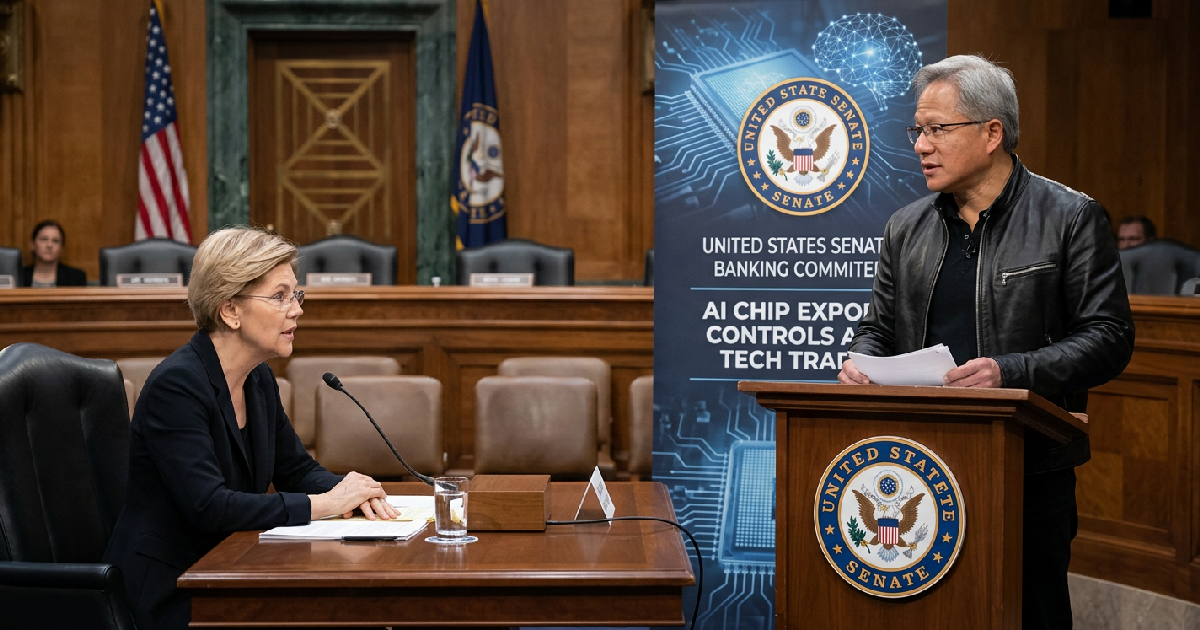
Elizabeth Warren summons Jensen Huang to testify on AI chip sales to China
U.S. Senator Elizabeth Warren (D-Mass.) has officially invited Nvidia CEO Jensen Huang to testify before the Senate Banking Committee on June 11, 2026, to address the company’s ongoing sales of artificial intelligence chips to China.
The formal request, delivered via a letter on June 4, gives Huang until Monday, June 8, to confirm his attendance for a session intended to scrutinize how advanced U.S. technology might be aiding foreign military and surveillance capabilities.
The invitation marks a significant escalation in congressional efforts to oversee the export of high-performance hardware during a period of heightened geopolitical tension.
The Senate’s interest focuses on whether U.S. technology companies are prioritizing corporate profits at the expense of national security. Senator Elizabeth Warren, in a recent interview, argued that while these companies are seeing massive gains, the long-term cost is the erosion of American security.
She noted that AI chips entering the Chinese market are frequently repurposed for military use rather than remaining within the civilian tech sector. This hearing aims to get a direct accounting from the head of the world’s most valuable semiconductor company regarding these trade-offs.
Nvidia’s role in the global tech landscape has become increasingly complicated as Washington tightens the screws on trade. Last year, the divergence of capital into AI and quantum tech highlighted how central this hardware has become to modern infrastructure.
For Nvidia, the Chinese market represents both a massive revenue stream and a regulatory minefield. CEO Jensen Huang has previously described his company’s compliance efforts as a “regulatory decision” rather than a business one, though it has resulted in significant financial friction.
National security concerns over China AI chip exports
The Senate Banking Committee is expected to dive deep into the specific hardware being sold and the loopholes used to acquire it. Senator Elizabeth Warren specifically highlighted that U.S. chips exported to China are “undoubtedly” undermining security.
This follows a Bloomberg investigation from June 3, 2026, which discovered that seven Chinese universities with direct ties to the People’s Liberation Army (PLA) have sought out Nvidia’s H200 processors despite existing restrictions.
Beyond the immediate military threat, there is the issue of surveillance. U.S. officials fear that advanced AI capability allows the Chinese government to enhance its domestic monitoring systems, which are among the most sophisticated in the world. As the federal government considers new mandates, such as how the com/crypto-news/clarity-act-advances-senate-ethereum-solana-xrp-rules/”>Clarity Act advances to the Senate for crypto regulation, the tech industry is bracing for a similar tightening of rules around hardware exports.
A history of friction between Nvidia and Washington
This is not the first time CEO Jensen Huang has faced pressure from the Senate. In May 2025, Senator Elizabeth Warren and Senator Jim Banks (R-Ind.) questioned the establishment of an Nvidia facility in Shanghai. They warned that localizing research and development could inadvertently accelerate China’s domestic AI ecosystem.
Nvidia has argued that many of these restrictions could backfire by pushing Chinese buyers toward domestic competitors.
The financial stakes of these diplomatic hurdles are immense. In April 2025, the Bureau of Industry and Security (BIS) blocked the export of Nvidia’s H20 -— a chip specifically tailored for the Chinese market to meet previous rules. This single move reportedly led to a $4.5 billion loss for the company.
These losses reflect the volatility that tech firms face when navigating the “China-plus-one” strategies and trade wars that have defined the mid-2020s.
Analyzing the effectiveness of current export controls
The June 11 hearing will serve as a report card for the Bureau of Industry and Security’s export controls. These rules, first introduced in October 2022, were designed to starve the PRC of supercomputing power. However, recent reports suggest the controls are porous.
On June 1, 2026, the Department of Commerce attempted to close a loophole allowing Chinese subsidiaries located outside of China to purchase Blackwell processors, Nvidia’s latest high-tier chip.
Huang has admitted that Nvidia has “essentially ceded” large portions of the Chinese market to local players like Huawei. As U.S. chips become harder to get, Chinese domestic chipmakers have seen their ecosystems rapidly mature. This creates a paradox for U.S.
lawmakers: strictly banning exports may protect current secrets but could permanently remove American influence from one of the world’s largest markets, while boosting foreign competitors.
Economic impact and Senator Elizabeth Warren’s broader agenda
While the hearing is primarily about security, Senator Elizabeth Warren is also anticipated to connect Nvidia’s dominance to wider economic concerns. She has recently proposed an excise tax on data centers to mitigate the labor disruptions caused by AI automation. The revenue from such a tax would theoretically fund job training, education, and healthcare initiatives for workers displaced by the very chips Nvidia produces.
The senator’s reach into the tech sector mirrors her previous work in the financial sector, where she recently looked at how a valuation correction can impact share prices and investor confidence.
For Nvidia, a public grilling in front of the Banking Committee carries the risk of spooking investors who have grown accustomed to the company’s meteoric, largely unchecked growth. The outcome of Huang’s testimony—or his refusal to appear—could dictate the next phase of tech-trade policy.
Future outlook for Nvidia and U.S. chip policy
If CEO Jensen Huang agrees to testify by the June 8 deadline, the session will likely be one of the most-watched corporate events of the year. It will provide a rare public look at the tensions between Silicon Valley’s global ambitions and Washington’s geopolitical defenses.
Huang’s previous statements suggest he will lean on the argument that Nvidia follows the law as it is written, placing the burden of any “security gaps” back on the regulators.
Data from the International Data Corporation (IDC) in April 2026 already shows that Nvidia’s dominance in China is fading. Between Beijing’s push for “de-Americanization” and Washington’s export bans, the window for U.S. semiconductor dominance in the region is closing.
Whether the Senate Banking Committee chooses to double down on restrictions or find a new middle ground will determine the competitive landscape of the global AI industry for the remainder of the decade.