

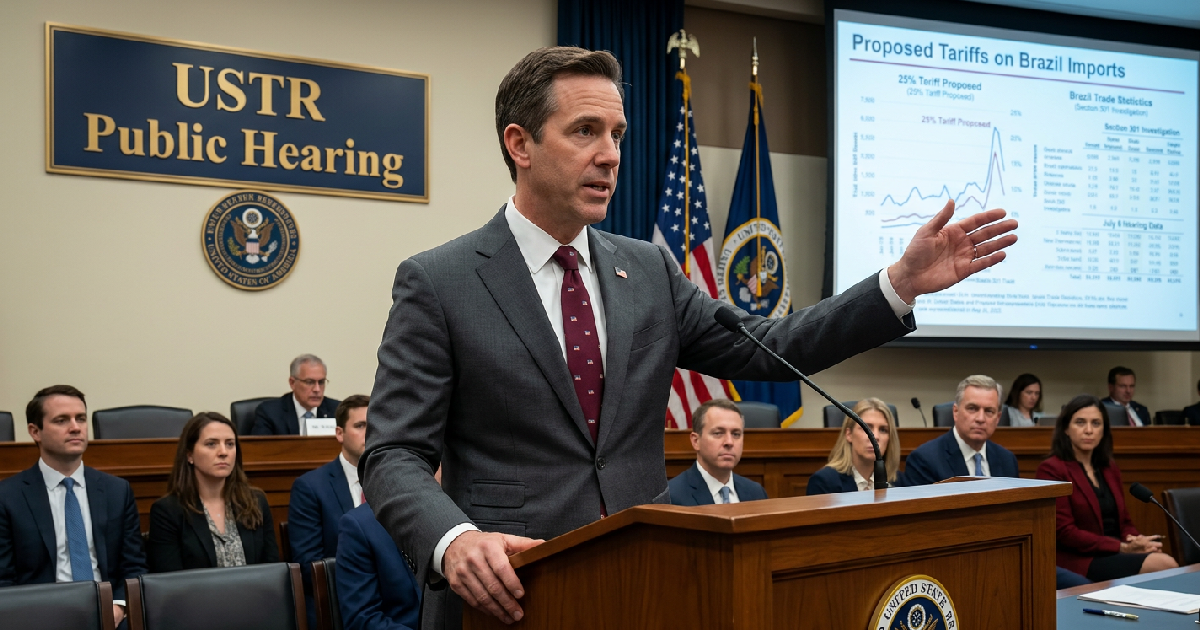
United States Trade Representative proposes 25% duty on Brazil goods
The Office of the United States Trade Representative (USTR) has proposed a 25% tariff on imports from Brazil, marking a sharp pivot in trade relations between the two nations. This proposed levy stems from a Section 301 investigation that the agency initiated last year. To gather industry feedback and testimony regarding the potential economic impact, the USTR has scheduled a public hearing for July 6.
Section 301 of the Trade Act of 1974 allows the U.S. government to investigate and respond to foreign trade practices that it deems unfair or discriminatory toward American commerce. While the agency has not specified the exact trade practices targeted in this latest move, the float of a 25% duty suggests a rigorous enforcement stance. Importers and supply chain managers are now reviewing their sourcing strategies as the hearing date approaches.
This development comes as global trade routes continue to face various logistical and geopolitical hurdles. For instance, international shipping has already encountered disruptions this year as US naval forces redirect commercial vessels during maritime blockades elsewhere. The prospect of new tariffs on Brazilian goods adds another layer of complexity for businesses managing international flows of raw materials and finished products.
Public hearing set for July 6 to review levy impact
The upcoming public hearing on July 6 serves as a critical window for domestic industries to express their concerns or support for the proposed tariffs. During these sessions, the USTR typically hears from manufacturers, retailers, and trade groups who may be affected by increased costs. Businesses often use these opportunities to request exclusions for specific products that cannot be easily sourced from other countries.
The result of the Section 301 investigation and the subsequent hearing will determine whether the 25% levy is implemented in full or modified. Stakeholders are particularly focused on which specific product categories will be included in the final list. If enacted, the tariffs would likely force a rapid recalculation of landed costs for goods arriving in U.S. ports from Brazil.
Broader economic shifts are already influencing how international companies report their performance in this volatile environment. For example, recent financial data showed TFI International valuation moved following an earnings beat that surpassed guidance. Such fluctuations highlight how sensitive transportation and logistics providers are to changes in trade volume and regulatory costs.
Section 301 investigation process and background
The USTR launched the investigation into Brazil last year, though the specific industry sectors under scrutiny were not detailed in the recent proposal. Under Section 301, the U.S. Trade Representative has the authority to take all appropriate and feasible action to obtain the elimination of an act, policy, or practice of a foreign country that violates a trade agreement. This process often includes a period of negotiation before duties are actually collected.
The 25% figure is a common threshold in such enforcement actions, designed to provide enough leverage to reach a bilateral resolution. However, if negotiations fail to produce a result satisfactory to the USTR, the duties can go into effect shortly after the public comment period and hearing process. This has historically led to retaliatory measures from trading partners, a prospect that economists are monitoring closely.
Implications for the North American logistics sector
Logistics operators must now prepare for a potential shift in trade patterns between North and South America. High tariffs often lead to “front-loading,” where importers rush to bring goods into the country before the new tax takes effect. This behavior can lead to sudden spikes in demand for container shipping and warehouse space, further straining already lean supply chains.
The U.S. government has been increasingly active in using trade levers and legislation to manage economic interests. This trend is visible across multiple sectors, as seen with federal moves like the Clarity Act which advances to the Senate to oversee digital assets and blockchain protocols. Whether in physical goods or digital services, the emphasis remains on establishing stricter rules for international commerce.
As the July 6 hearing nears, the USTR will continue to accept written submissions from interested parties. The final decision on the Brazil tariffs will be a bellwether for U.S. trade policy in the region through the remainder of 2026. For now, the focus remains on the evidence presented next month and the potential for a diplomatic breakthrough before the levies are finalized.