

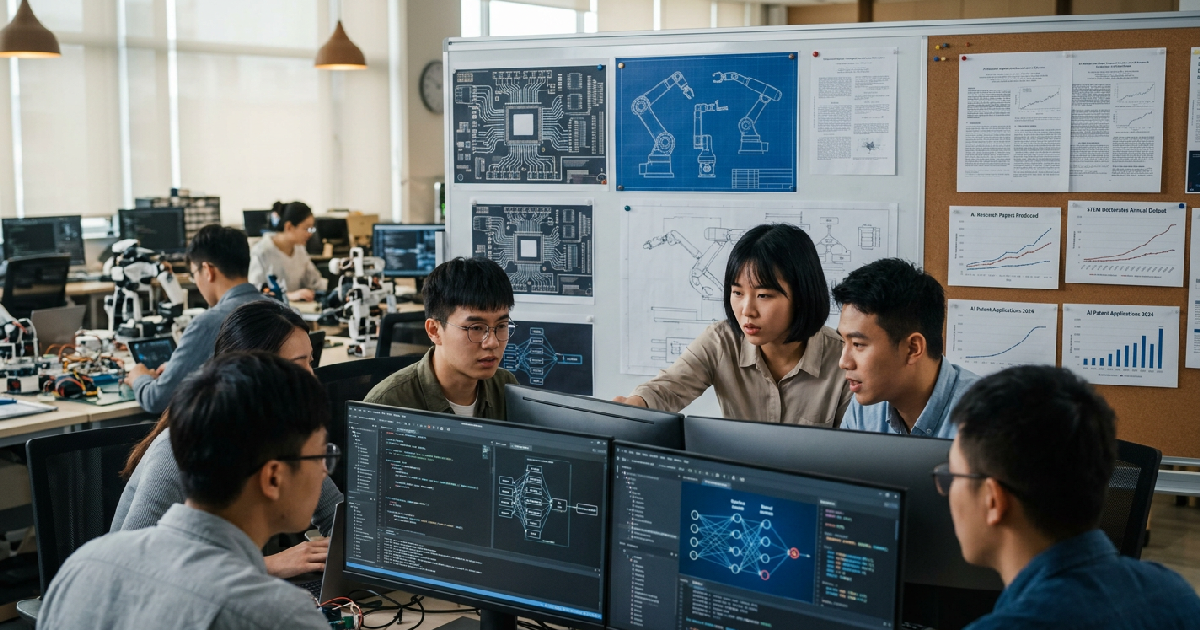
China’s 3.57 million STEM graduates annually challenge US AI leadership
57 million STEM graduates annually. This figure represents about 40% of China’s total university degrees, vastly outstripping the American pipeline. By comparison, the United States mints fewer than 820,000 STEM graduates each year, accounting for just 20% of its degrees awarded.
The disparity in human capital has become a focal point for analysts tracking the global “AI productivity war,” as the sheer volume of technical expertise in China begins to reshape the development of next-generation algorithms.
Recent tracking indicates the competitive landscape is shifting rapidly. S. and Chinese AI models has effectively closed.
This milestone marks a significant acceleration for Chinese generative AI models, which have moved toward parity on major benchmarks like MMLU and HumanEval. S. 7%, illustrating how narrow the technical divide has become.
While American firms still hold a lead, the cushion that once protected Silicon Valley is thinning as China leverages its massive workforce of 105,103 AI scientists.
The scale of China’s technical education system is difficult to overstate. S. 8 million graduates from universities and colleges.
This influx of talent is particularly visible in advanced research. S. rate, an annual increase of 9% compared to 3% in the United States.
com/crypto-news/bitcoin-btc-price-drops-ai-quantum-capital-outflows-2026-update/”>AI and quantum tech divert capital away from traditional assets.
Comparing Chinese and American STEM graduate output
The imbalance in technical training begins at the undergraduate level and widens through vocational specialisation. In the United States, only 6% of undergraduates major in engineering. In 2021, American institutions awarded 127,000 bachelor’s degrees in engineering and 105,000 in computer science. These figures highlight a domestic talent pool that is struggling to keep pace with the infrastructure demands of the AI era. In contrast, China graduates roughly 2 million STEM bachelor’s degrees every year, providing a massive foundation for its domestic tech industry.
S. continues to lead in the quality of its research output. 8 for Chinese papers.
3x advantage in breakthrough discoveries and fundamental algorithmic innovations since 2019. S. institutions saw 1,847 papers accepted at a 67% rate, while China had 1,203 papers accepted at a 52% rate.
com/crypto-news/brian-armstrong-finance-move-on-chain-warning/”>Brian Armstrong warns finance must move on-chain to stay relevant in a tech-driven economy.
Growth rates in advanced AI doctorates and PhDs
The battle for the “vanguard” of AI innovation is increasingly being fought at the doctoral level. In 2022, China awarded more than 50,970 STEM doctorates, while the United States awarded 33,820. Projections for 2025 suggest this gap will continue to widen, with China expected to produce more than 77,000 STEM PhD graduates annually, compared to approximately 40,000 in the U.S. China has consistently produced more STEM doctorates than the United States since the mid-2000s, building a generational advantage in seniority and expert-level leadership.
This deep bench of PhD-level talent allows China to dominate the sheer volume of intellectual property filings. In 2024, China filed 58,900 AI patents, leading the U.S. in applications by a ratio of 2.7 to 1. However, U.S. innovation remains more efficient; American patent filings had a 73% grant rate, whereas Chinese filings saw a 41% grant rate. While China focuses on quantity, the U.S. continues to produce the highest share of “hit” papers, accounting for 43.9% of the global top 1% of impactful research.
Convergence and the narrowing AI performance gap
The speed at which Chinese models are catching up to Western capabilities is a direct result of this massive labor force. Since 2023, Chinese models have trailed U.S. capabilities by an average of seven months, though the range has fluctuated between four and 14 months. By early 2025, reports suggested that Chinese generative AI models likely faced a three to six-month performance gap, but even that window is shortening. This rapid iteration is necessary to compete with the 40 notable AI models produced by U.S.-based institutions in 2024.
The technical requirements for staying ahead are becoming increasingly resource-intensive. Training compute is doubling every five months, while datasets double every eight months. This creates a high-pressure environment where having more scientists to manage these vast systems becomes a distinct advantage. To secure the physical infrastructure required for this growth, the U.S. has seen new industrial developments, such as when Posco International reveals plans for US rare earth plant with ReElement Technologies to bolster the hardware supply chain.
Investment and the future of AI productivity
The U.S. still maintains a massive lead in raw capital investment. In 2024, private AI investment in the United States reached $109.1 billion, a figure that continues to drive the creation of high-end models and infrastructure. However, the limit of capital is its inability to produce a scientist overnight. As power use doubles annually and technical demands grow, the U.S. reliance on a smaller, though highly productive, pool of talent faces a test of sustainability against China’s broader, state-directed educational output.
Ultimately, the AI productivity war may be won by the nation that scales the fastest. China’s strategy appears to involve a “human wave” of millions of technical workers to implement and optimize AI across its industrial base. While the U.S. remains the birthplace of the most influential “hit” papers and fundamental breakthroughs, its challenge in the coming years will be maintaining that qualitative edge while its rival produces more than four times the number of engineers each year to operationalise the technology.