

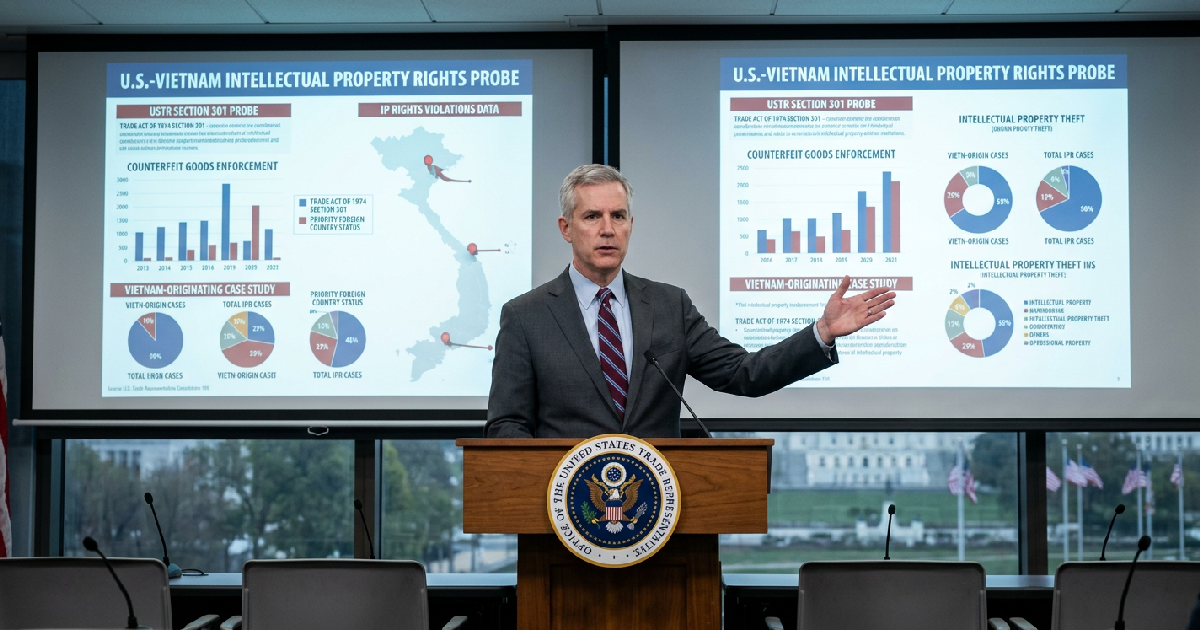
Office of the U.S. Trade Representative launches probe into Vietnam’s IP practices
S. Trade Representative (USTR) announced on Friday it is launching a formal investigation into Vietnam’s intellectual property (IP) protection and enforcement practices. S.
commerce. This significant escalation in trade tensions follows Vietnam’s recent designation as a “Priority Foreign Country” in the agency’s Special 301 Report.
The federal agency stated it will examine whether Vietnamese authorities have failed to provide adequate and effective protection for patents, trademarks, and copyrights. This move marks a pivot for the Office of the U.S. Trade Representative, which has historically balanced trade growth with Vietnam against mounting complaints from American software, pharmaceutical, and entertainment firms. By invoking Section 301, the U.S. government signals that diplomatic dialogues may no longer be sufficient to protect American innovation in the region.
And while the investigation is just beginning, the potential consequences are severe. S. government to levy billions of dollars in tariffs against China during recent trade disputes.
S. Trade Representative finds that Vietnam’s practices are harming American businesses, the executive branch could impose retaliatory tariffs, tighten import quotas, or suspend trade concessions. com/international-news/posco-international-build-us-rare-earth-plant/”>global companies search for supply chain alternatives to satisfy Western market demands without relying solely on Chinese manufacturing.
Understanding the Section 301 probe into Vietnam
The Office of the U.S. Trade Representative has identified specific areas of concern that prompted this legal action. Chief among them is Vietnam’s alleged failure to crack down on digital piracy and the widespread sale of counterfeit goods in physical marketplaces. For years, American trade officials have warned that the lack of criminal enforcement against IP thieves in Vietnam has created an uneven playing field for legitimate U.S. exporters.
The USTR statement noted that the investigation will seek to verify if Vietnam’s policies are “unreasonable or discriminatory.” Beyond simple counterfeiting, the probe may also look into bureaucratic hurdles that delay patent approvals or legal frameworks that make it difficult for U.S. companies to defend their intellectual property in Vietnamese courts. The outcome remains uncertain, but the mere opening of the case serves as a warning shot to Hanoi.
Market implications for American and Vietnamese firms
The timing of this investigation is particularly sensitive for Vietnam, which has positioned itself as a primary beneficiary of the “China Plus One” strategy. As American firms move production of electronics and apparel to Vietnamese factories, they have become more vocal about the risks of technology theft. This tension is mirrored in other sectors, such as the logistics industry, where recent reports on rising valuations suggest that cross-border trade efficiency is becoming a critical metric for investors.
If the Office of the U.S. Trade Representative finds Vietnam’s practices to be deficient, it could disrupt the very supply chains that U.S. companies are trying to build. Manufacturers of high-tech components are particularly wary of markets where IP enforcement is lax. Conversely, if Vietnam implements rapid reforms to satisfy Washington, it could solidify its position as the top manufacturing hub in the Association of Southeast Asian Nations (ASEAN).
Previous trade friction and the priority foreign country status
Vietnam’s road to this Section 301 investigation was paved by its inclusion on the “Priority Watch List” and its eventual elevation to the “Priority Foreign Country” category. These designations are reserved for nations that the U.S. believes have the most egregious IP policies or practices. By reaching this level, Vietnam joined a small list of countries subject to heightened scrutiny and potential direct intervention by the U.S. federal government.
Historically, Section 301 investigations have been a precursor to intense negotiation periods. During the Trump administration, similar probes were used as leverage to extract concessions on currency valuation and trade imbalances. Even with the current shifting geopolitical landscape—where we see diplomatic deals influencing global stock movements—the U.S. remains focused on protecting domestic commercial interests from perceived unfair competition abroad.
What to expect during the investigative process
The USTR will begin a period of public comment and likely hold hearings to gather evidence from affected U.S. businesses. During this phase, trade officials will collect data on lost revenue, legal costs incurred in Vietnam, and specific instances where Vietnamese law failed to protect American IP. Under Section 301 of the Trade Act of 1974, the agency has wide latitude to investigate not just laws on the books, but how those laws are actually enforced on the ground.
Hanoi is expected to respond by highlighting recent legislative efforts to modernize its IP framework. Vietnam’s government has previously argued that as a developing economy, it requires more time to build the judicial capacity necessary for rigorous IP enforcement. However, with the investigation now officially active, the clock is ticking for Vietnam to show concrete results rather than just legislative promises.
Future outlook for U.S. and Vietnam trade relations
The Office of the U.S. Trade Representative hasn’t yet specified a deadline for the conclusion of the probe, but these investigations typically take several months to a year. During this window, both nations have an opportunity to reach a settlement that avoids tariffs. If a deal is struck, it could include new requirements for Vietnamese customs to seize counterfeit goods at the border or stricter penalties for online piracy.
But there is no guarantee of a smooth resolution. If the U.S. moves forward with tariffs or other trade barriers, it could drive up the cost of consumer goods in the United States, from sneakers to smartphones. For Vietnam, the stakes are even higher; losing preferential access to the U.S. market would be a staggering blow to its export-led economy. The coming months will reveal whether this investigation leads to a new era of cooperation or a prolonged trade war in the Pacific.