

Brian Armstrong warns finance must move on-chain to avoid obsolescence
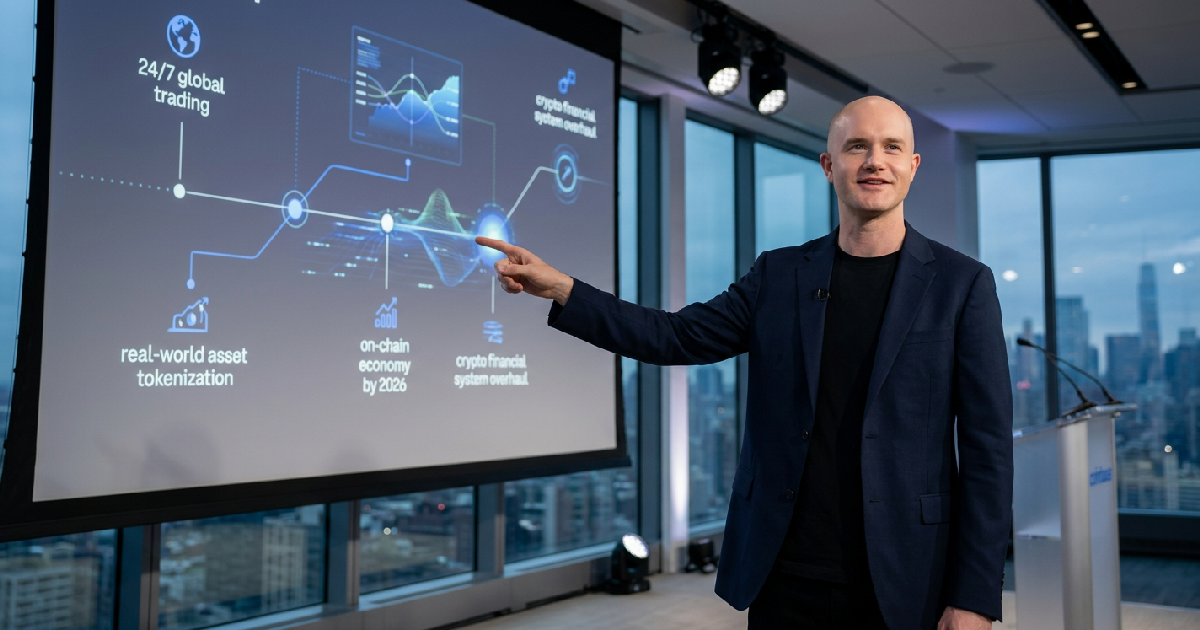
Coinbase CEO Brian Armstrong warned that the legacy financial system faces an existential threat if it fails to move on-chain, comparing the current shift to the disruptive transition from Blockbuster to Netflix. In a series of statements released on May 24 and May 25, 2026, Armstrong argued that the on-chain economy has officially reached escape velocity, suggesting that crypto infrastructure is now capable of overhauling global finance. He outlined a strategic roadmap that includes real-world asset tokenization and 24/7 global trading as essential upgrades for surviving the next decade.
The timing of the comments coincides with Coinbase’s Q1 2026 earnings results, which showed a significant surge in crypto adoption. Armstrong’s thesis rests on the idea that if a transaction involves money, it will eventually involve crypto. He noted that while businesses are currently choosing to integrate blockchain technology because they recognize its efficiency, a tipping point is approaching where adoption will become a matter of necessity rather than choice. Those who wait too long, he cautioned, will be left desperately following the leaders.
Industry data supports this aggressive outlook. Tokenized real-world assets (RWAs) are now projected to reach a massive $16 trillion by 2030, a figure that highlights the growing appetite for moving traditional financial instruments like bonds, real estate, and credit onto the blockchain. As ondo and other hyperliquid tokens surge on the back of rising interest in decentralized finance, the infrastructure to support this volume is becoming increasingly robust.
Eight pillars for a decentralized financial future
To facilitate this transition, Brian Armstrong identified eight specific areas where traditional finance must modernize. Central to this vision is the tokenization of real-world assets, which allows for fractional ownership and instant settlement. Furthermore, the CEO emphasized the need for 24/7 global trading, arguing that the current “9-to-5” banking schedule is an archaic remnant of a pre-internet world that cannot compete with always-on blockchain ledgers.
Payments also feature heavily in his roadmap. Armstrong advocates for next-generation payment systems built entirely on stablecoins, specifically highlighting the growth of USDC. As of Q1 2026, the stablecoin market capitalization has crossed $300 billion, providing the necessary liquidity for large-scale commerce. By using Layer-2 solutions like Base, Coinbase aims to enable money to move at the speed of the internet, bypassing the delays and fees associated with traditional wire transfers and clearinghouses.
The role of artificial intelligence in on-chain finance
A newer addition to Armstrong’s vision involves the integration of artificial intelligence (AI). He predicts that by 2030, autonomous AI agents could process between $3 trillion and $5 trillion in transactions. These agents will require financial “rails” that are fast, cheap, and global—qualities that traditional banking systems currently lack. Armstrong believes crypto is the only viable option that meets all three criteria for these high-frequency machine participants.
Beyond simple transactions, AI is expected to revolutionize risk assessment, credit scoring, and compliance. By running these processes on-chain, financial institutions can theoretically reduce human error and bias while increasing the speed of lending. However, this shift occurs as capital flows toward AI and quantum tech occasionally cause volatility in the broader crypto market, forcing firms to balance innovation with stability.
Coinbase growth and the emergence of the everything exchange
Coinbase’s Q1 2026 performance serves as a proof of concept for Brian Armstrong’s assertions. The company achieved an all-time high in global crypto trading volume market share during the quarter. This growth was fueled largely by the “Everything Exchange” initiative, a single platform designed to trade everything from digital assets and stocks to prediction markets. In March 2026 alone, prediction markets generated over $100 million in annualized revenue for the firm.
The Base network, Coinbase’s proprietary Layer-2 solution, has become a cornerstone of this ecosystem. Stablecoin transaction volume on Base grew tenfold year-over-year, with 90% of the volume coming from agentic (AI-driven) transactions. These numbers suggest that the platform is successfully transitioning from a simple brokerage into a foundational layer for the broader internet economy. Despite this, regulatory clarity remains a hurdle, especially as the Clarity Act advances in the Senate, potentially introducing new federal rules for major assets like Ethereum and Solana.
Institutional shifts toward sound money
The final pillar of Armstrong’s argument focuses on the concept of “sound money.” He defines this as currency that cannot be arbitrarily printed by governments, thereby preserving its long-term value. In an era of high global debt and varying inflationary pressures, Armstrong argues that crypto provides a necessary hedge. This sentiment is driving Coinbase’s Assets Under Management (AUM) to record levels. By February 2025, the firm held $0.42 trillion in customer assets, which would rank it as the 8th largest brokerage in the U.S. by AUM.
For traditional banks, the choice is becoming stark. Armstrong suggests that the “Netflix moment” is here, and the infrastructure for a new system is already being built. As firms look toward low-cost capital formation and expanded accessibility, the move on-chain is no longer a theoretical debate but a strategic requirement. Whether traditional institutions can pivot fast enough to compete with native on-chain entities like Coinbase remains the central question for the remainder of 2026.