

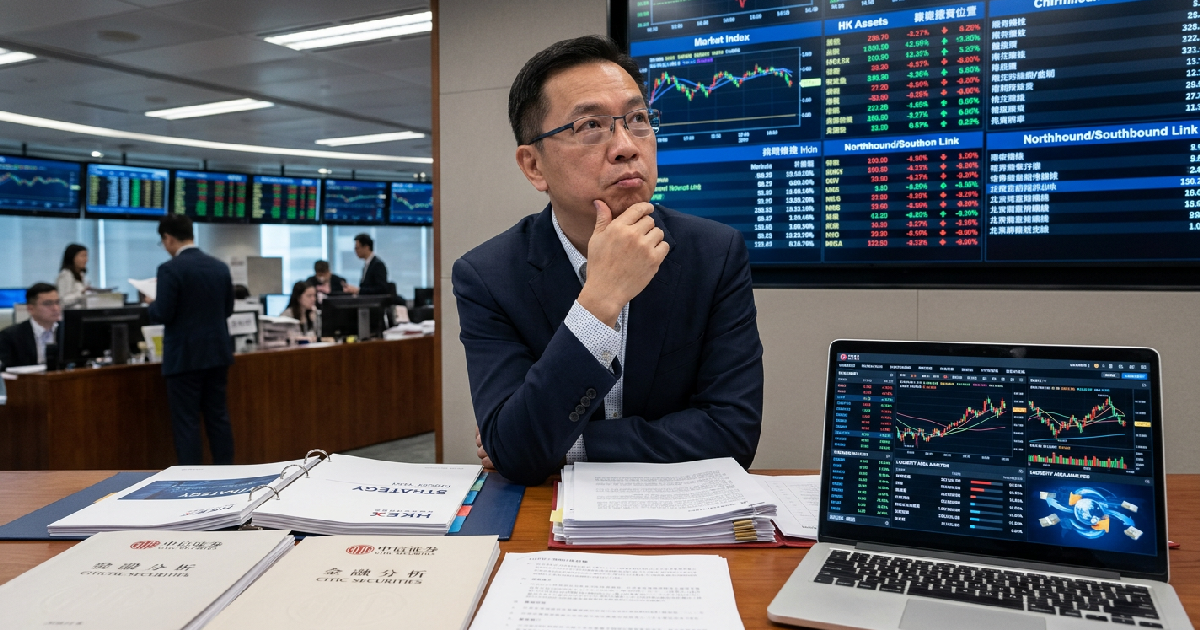
Citic Securities warns China trading curbs may hit $32 billion of HK assets
Citic Securities has warned that newly proposed China trading curbs could potentially impact $32 billion of Hong Kong-listed assets as regulatory pressure on cross-border capital flows intensifies. The brokerage firm released a report on May 25, 2026, detailing how the restrictions on mainland investors could trigger a significant reshuffling of liquidity in the Hong Kong market. These measures appear designed to stabilize the yuan and prevent capital flight through the popular Southbound Stock Connect links.
The potential contraction in trading volume comes at a sensitive time for the Hong Kong Stock Exchange. Analysts at Citic Securities noted that the $32 billion figure represents a substantial portion of the average daily turnover historically generated by mainland retail and institutional players. If implemented in full, the curbs would effectively lock out a specific class of “offshore mainland” accounts that have long used Hong Kong as a gateway for international diversification.
Market participants are closely watching the fallout, particularly for mid-cap stocks that rely heavily on mainland inflows. While the Lincoln International valuation correction recently highlighted how quickly sentiment can shift in the global financial sector, this latest move by Chinese regulators introduces a different layer of policy risk. Investors are now calculating the “China discount” anew as the rules of engagement for cross-border trading are rewritten.
Impact of the Citic Securities forecast on Hong Kong liquidity
The primary concern for the Hong Kong market is the sudden withdrawal of “southbound” capital, which has been the lifeblood of several sectors. Citic Securities indicates that the curbs target “grey area” accounts — mainland individuals who opened accounts in Hong Kong before previous restrictions were tightened. These investors have continued to trade despite shifting narratives on capital controls, but the new framework leaves little room for ambiguity.
This $32 billion risk isn’t just a theoretical number; it reflects the deep integration of mainland wealth into the Special Administrative Region’s financial fabric. Institutional desks in Hong Kong are reportedly preparing for a period of lower volatility but also lower profitability as commission revenues are expected to take a hit. Many traders fear that the reduction in mainland activity will make the market more susceptible to swings initiated by Western hedge funds.
Specific sectors vulnerable to the trading restrictions
Technology and healthcare stocks are likely to feel the sharpest pinch from these restrictions. These sectors have traditionally attracted the most aggressive mainland buying through the Stock Connect programs. Without that consistent bid, companies listed in Hong Kong may struggle to maintain their current P/E multiples, especially if global interest rates remain elevated.
Real estate developers with dual listings are also under the microscope according to the Citic Securities analysis. These firms often use their Hong Kong shares as collateral for financing. A drop in liquidity could technically trigger margin calls or complicate future equity raises. The focus is squarely on how these firms will bridge the gap if the $32 billion in mainland-driven asset value begins to evaporate.
Regulatory shift aims to stabilize the onshore economy
Beijing’s decision to tighten the screws on Hong Kong trading is not happening in a vacuum. Chinese regulators are increasingly concerned about the divergence between the mainland economy and offshore capital movements. By restricting these trades, they hope to keep a tighter lid on domestic savings and ensure that liquidity stays within the onshore A-share market to support local industrial policy.
Economic observers suggest this is a defensive posture. As TFI International’s recent valuation rise showed, some logistics and trade-related entities are finding success through internal efficiencies, but the broader financial sector remains tethered to central bank directives. The tightening in Hong Kong is effectively an extension of that domestic control, intended to limit “leakage” into foreign currencies.
Brokerage houses prepare for a lean summer
Beyond the immediate asset impact, the brokerage industry itself faces a structural challenge. Firms that built their business models around serving mainland clients in Hong Kong are now forced to pivot. Several mid-sized houses have already begun discussing layoffs or mergers to cope with the anticipated drop in trade orders.
Citic Securities has hinted that while the transition will be painful, it might lead to a “healthier” investor base in the long run. The argument is that the market will become less prone to the speculative frenzy often associated with retail-driven momentum from the mainland. However, for most fund managers, the short-term reality of a $32 billion liquidity hole is far more pressing than long-term stability projections.
The future of the Stock Connect and Hong Kong’s role
The longevity of the Hong Kong-Mainland Stock Connect is not in question, but its character is clearly changing. What was once envisioned as an ever-expanding bridge is now being fitted with sophisticated filters and gates. This evolution changes the fundamental value proposition of Hong Kong as a “super-connector” for global finance.
If the $32 billion in assets identified by Citic Securities is indeed sidelined, the Hong Kong Stock Exchange may need to accelerate its efforts to attract more international listings from the Middle East and Southeast Asia. Diversification of the investor base is no longer just a strategic goal; it is a necessity for survival in a restricted trading environment.
In the coming weeks, market regulators are expected to provide more granular details on the implementation timeline for these curbs. Until then, the $32 billion figure will likely act as a ceiling for optimism in the Hong Kong financial community. The message from the mainland is clear: control over capital flows takes precedence over the unbridled growth of the offshore market.