

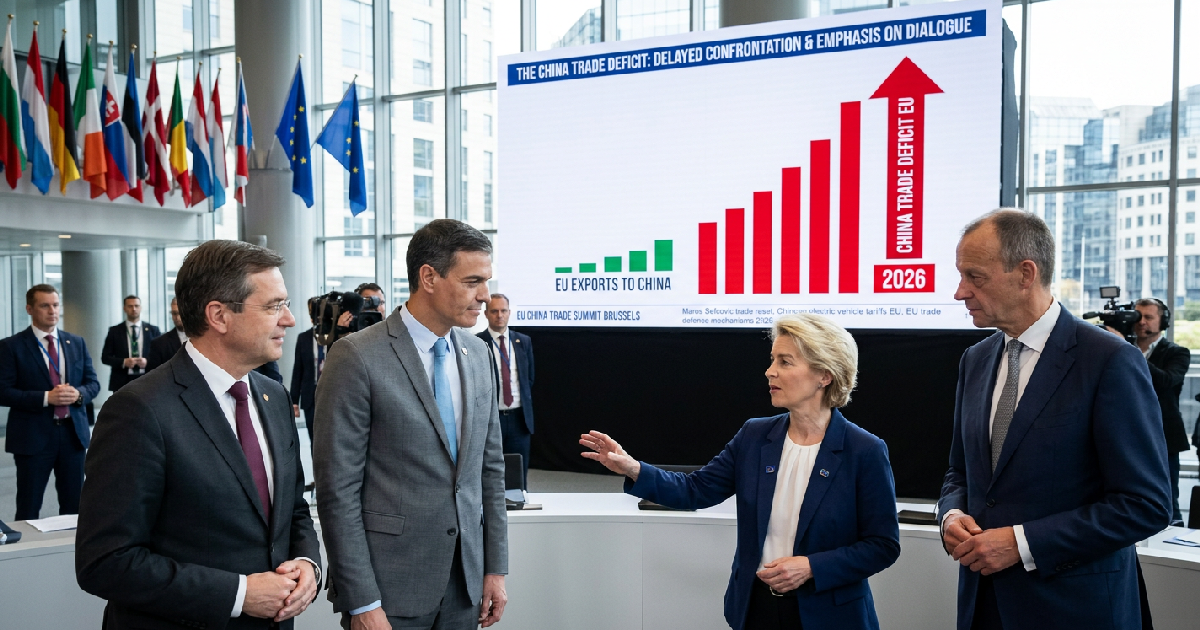
European Union leaders delay economic dispute with China, seek dialogue
European Union leaders meeting in Brussels have opted to delay a trade confrontation with China, choosing instead to pursue high-level dialogue while bolstering the bloc’s internal trade defense mechanisms.
German Chancellor Friedrich Merz, Spanish Prime Minister Pedro Sánchez, and Luxembourg Prime Minister Luc Frieden joined European Commission President Ursula von der Leyen at the June 18-19 summit to address a trade deficit described by officials as “unsustainable.”
The decision to hold back on immediate, aggressive new measures signals a preference for a “reset” over a rupture. While Brussels debated tougher curbs on state-subsidized products and a growing reliance on Chinese critical supplies, the summit concluded with a request for the European Commission to engage Beijing through negotiation.
EU leaders prioritize dialogue to rebalance trade relationships
This cautious stance comes even as supply chain resiliency is prioritized over cost across global markets.
The scale of the imbalance is stark. According to Eurostat, the EU trade deficit in goods with China reached €31.9 billion ($37 billion) in April 2026 alone. During the first four months of 2026, the gap expanded by 10% as Chinese firms increased their sales to the EU while the bloc imported less.
Maros Sefcovic, the EU’s chief trade negotiator, stated on June 17 that the relationship requires “rebalancing,” seeking a middle path between total confrontation and the status quo.
The diplomatic focus persists despite recent friction. On June 11, 2026, China reportedly canceled two high-level meetings with the EU, including a strategic dialogue and a ministerial-level digital discussion. Nevertheless, the summit’s conclusions emphasized using dialogue to address concerns that domestic European industries cannot withstand the current influx of cheap goods.
This approach mirrors shifts in other sectors, such as how UBS Asia President Iqbal Khan views AI as a tool for major transformation in the regional banking sector.
European Commissioner for Trade Maros Sefcovic has insisted that the goal is not open conflict. “Our trading relationship with China has reached a point that requires a reset,” he said. He further noted that “diversification requires a dedicated instrument” to protect the bloc’s interests.
This involves a more clinical assessment of how Chinese economic policy impacts the European single market, particularly regarding state intervention and subsidies.
The impact of currency valuation and manufacturing surpluses
Internal discussions in Brussels have highlighted a perceived undervaluation of the Chinese currency. Reports suggests that the yuan is assumed to be at least 25% undervalued against both the euro and the U.S. dollar, providing a sharp pricing advantage for Chinese exporters. This hasn’t stopped the flow of capital; Chinese investment in Europe surged to a seven-year high of €16.8 billion in 2025.
However, the influx of products has forced the EU to use its existing defense toolbox more frequently. Currently, 18 out of 21 new anti-dumping and anti-subsidy investigations by the EU target Chinese producers. These efforts are part of a broader global trend of protecting domestic interests, similar to when the USTR launched a probe into Vietnam’s practices to address intellectual property and trade concerns.
Countervailing duties target the electric vehicle sector
The automotive industry remains the focal point of current trade defenses. Following provisional measures, the EU implemented definitive countervailing duties on Chinese battery electric vehicles (BEVs) effective October 31, 2024. These duties, which apply for five years, are levied in addition to the standard 10% import tariff. The rates vary significantly depending on the manufacturer’s cooperation with the Commission’s investigation:
- SAIC: 36.3% duty
- Geely: 19.3% duty
- BYD: 17.0% duty
- Other cooperating firms: 21.3% duty
- Non-cooperating companies: 36.3% duty
Addressing the G7 summit, President Ursula von der Leyen noted the historic nature of the shift in trade flows. She stated that “the year 2025 will be remembered as the year where, for the first time ever, all Member States had a trade deficit with” their major trading partner in the East.
This universal deficit has impacted major economies like Germany, where China’s trade surplus doubled from $12 billion to $25 billion between 2024 and 2025.
A realistic shift toward trade defense mechanisms
The current strategy reflects a growing sense of realism within the European Council. Following the summit, a diplomat remarked on the changing environment: “We live in a world of wolves now. We no longer live in a world of pink ponies and rainbows.” This sentiment underpins the EU’s decision to bolster trade defense while maintaining open lines for negotiation.
The European Commission will move forward with strengthening “diversification instruments,” particularly to reduce dependency on China for critical minerals. While EU leaders have delayed a direct confrontation for now, the data indicates the pressure for a more permanent “rebalancing” will only increase.
With the trade deficit reaching approximately €1 billion every single day, the success of the upcoming high-level dialogues will determine if the bloc continues to rely on soft diplomacy or pivots toward harsher unilateral measures.