

exxonmobil signals potential venezuela return
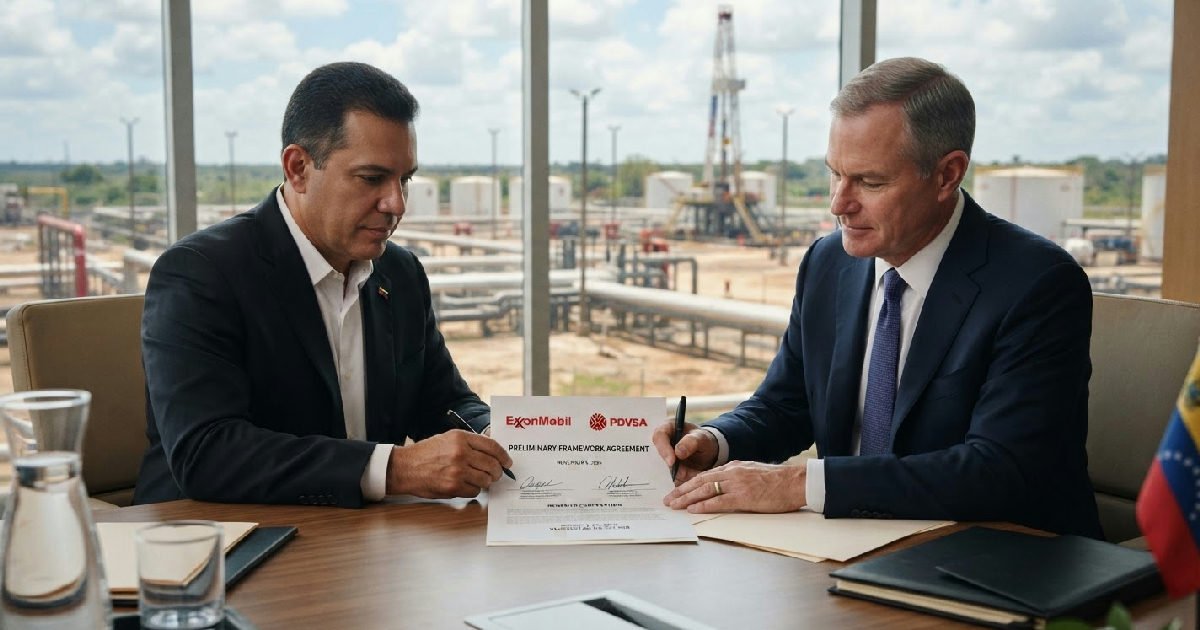
In a significant reversal, ExxonMobil is exploring a potential return to Venezuela after signing a preliminary agreement with the state-owned oil company Petróleos de Venezuela S.A. (PDVSA). The non-binding memorandum of understanding (MOU), signed November 9, 2026, opens the door for the American oil giant to re-enter a nation its own CEO once deemed “uninvestable.”
The move follows years of geopolitical turbulence, including the nationalization of ExxonMobil’s assets in 2007 and a complex history of U.S. sanctions against the South American country. This cautious first step suggests a potential thaw in relations as companies reassess the opportunities within the nation holding the world’s largest proven crude reserves.
ExxonMobil signals potential venezuela
This tentative rapprochement is built on a fragile foundation of shifting political sands. The initial catalyst was the U.S. Treasury Department’s decision on October 18, 2023, to issue General License No. 44, temporarily easing sanctions on Venezuela’s energy sector. This was a direct response to an agreement between the government of Nicolás Maduro and the opposition to hold fairer elections.
However, the sanctions relief was short-lived. By April 2024, Washington determined that Caracas had not met its democratic commitments, and the broad license was replaced with a more restrictive one allowing only for the wind-down of operations. This history highlights the political risks involved and explains the cautious nature of ExxonMobil’s current approach, which is heavily influenced by the US economic policy on the region.
Despite the sanctions snapback, negotiations have evidently continued behind the scenes. Reports indicate that ExxonMobil executives traveled to Caracas in September 2026, culminating in the recent MOU. The company is betting that the long-term potential of Venezuela’s resources may eventually lead to a more stable and predictable operating environment.
An ExxonMobil spokesperson emphasized the preliminary nature of the deal. “This memorandum is a meaningful first step,” they noted, “but any future investment would require stable policies, clear regulations, strong investment protections and competitive returns.” This statement underscores the deep-seated caution following its previous experiences.
What ExxonMobil wants in Venezuela
ExxonMobil’s interests are reportedly focused on regaining a foothold in the resource-rich Orinoco Belt, one of the largest recoverable oil deposits on the planet. The company is specifically targeting its former heavy crude projects, Petromonagas and Petrovictoria, which were known as the Cerro Negro project before being nationalized by former President Hugo Chávez.
Beyond its legacy assets, the company is also said to be seeking rights to two additional heavy oil fields in the nearby Carabobo region. Gaining access to these fields would represent a substantial addition to ExxonMobil’s global portfolio and provide access to vast, albeit technically challenging, reserves. Venezuela’s proven reserves are estimated to be over 300 billion barrels.
The focus on the Orinoco Belt is strategic. While the heavy crude is more expensive to extract and refine than lighter grades, the sheer scale of the deposits makes it a tantalizing prize for supermajors with the capital and technology to develop them effectively. A successful return would position ExxonMobil as a key player in the future of Venezuelan oil production.
This renewed interest comes after years of underinvestment have crippled Venezuela’s oil infrastructure, causing production to plummet from its previous highs. Any new venture would require billions in fresh capital to refurbish facilities, drill new wells, and restore output, a task ExxonMobil is uniquely equipped to handle.
The long shadow of nationalisation and legal battles
ExxonMobil’s caution is deeply rooted in its tumultuous history in the country. The company was a major operator in Venezuela for decades before its dramatic exit in 2007. Under then-President Hugo Chávez’s policy of resource nationalism, the government seized control of the company’s assets, leading to a protracted and bitter legal fallout.
ExxonMobil refused to accept the terms offered by the state and launched a series of international arbitration cases seeking significant compensation. Initially seeking between $10 billion and $14.7 billion, the company was awarded $1.6 billion by the World Bank’s International Centre for Settlement of Investment Disputes (ICSID) in 2014. It was a victory, but a partial one.
The legal saga did not end there. In March 2017, an ICSID annulment committee sided with Venezuela and struck down approximately $1.4 billion of the award, reducing ExxonMobil’s compensation to just $188 million. This decision underscored the legal uncertainties of operating in the country and likely informed the scrutiny on CEO statements, such as the “uninvestable” comment made by Darren Woods.
In a separate case, an International Chamber of Commerce (ICC) panel awarded ExxonMobil $908 million in 2012 in a contractual dispute with PDVSA. This complex web of legal challenges highlights why the company is now demanding “strong investment protections” and “clear regulations” before committing new capital.
Navigating a complex competitive landscape
ExxonMobil is not the only international oil company maneuvering for position in Venezuela. Its European and American rivals have been actively evaluating their own opportunities, creating a competitive landscape for the most promising assets. Chevron, in particular, has maintained a presence and is moving more aggressively.
Following the initial sanctions relief, Chevron signed a deal in September 2026 to invest $7 billion over five years into its joint ventures with PDVSA. The company’s goal is to double its production in the country to 600,000 barrels per day, demonstrating a higher risk appetite compared to ExxonMobil’s more measured approach.
European firms like Eni of Italy and Repsol of Spain have also been expanding their activities. They have been taking crude oil and condensates from their Venezuelan ventures as a way to recover outstanding debts and past investments. Their continued operations provide a blueprint for how foreign companies can function within the country’s current framework.
This activity from competitors likely added pressure on ExxonMobil to re-engage or risk being left behind if the political and economic climate does stabilize. Securing a non-binding agreement allows the company to keep its options open without making a firm financial commitment, a prudent strategy given the lingering uncertainties and broader international investment trends.
An uncertain road ahead for Venezuelan oil
The path forward remains fraught with uncertainty. The MOU is a statement of intent, not a binding contract. A final investment decision from ExxonMobil will depend entirely on whether the government of Nicolás Maduro can create and sustain a legal and fiscal framework that global energy giants find acceptable.
In October 2026, ExxonMobil CEO Darren Woods reiterated his cautious stance. He acknowledged that work on new fiscal rules and investor safeguards was underway in Venezuela but noted, “there’s a way to go.” He stressed the need for confidence that a project could be sustained through political cycles before committing shareholder capital.
The primary determinant will be the political evolution within Venezuela and its relationship with the United States. The fate of future sanctions relief is tied directly to Washington’s assessment of the country’s progress toward free and fair elections. Any backsliding on democratic commitments could see the window of opportunity slam shut once more.
For now, ExxonMobil has secured a place at the negotiating table. The agreement gives it a direct line to explore the potential of Venezuela’s vast resources, a prize that remains too large to ignore, even with the considerable risks attached.
The coming months will be critical in determining whether this “meaningful first step” leads to a genuine comeback or becomes another false dawn for Venezuela’s troubled oil sector.