

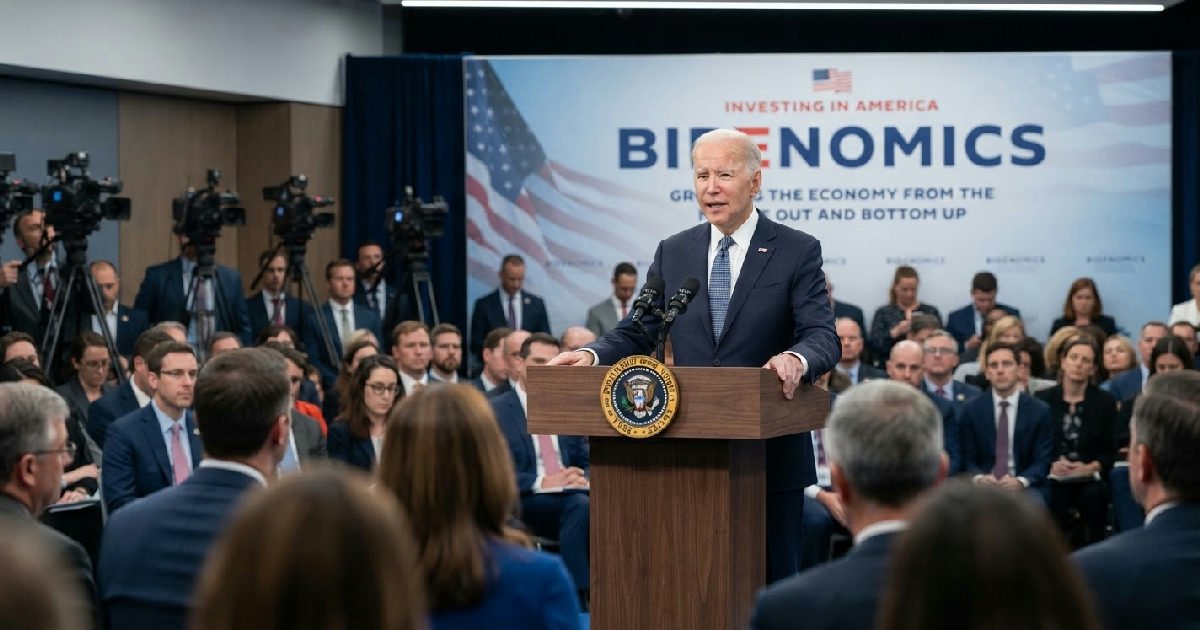
president joe biden implements bidenomics to reshape the us economy
President Joe Biden’s sweeping economic agenda, widely dubbed “Bidenomics,” continues to reshape the United States economy through a deliberate strategy of government investment, industrial policy, and wealth redistribution.
Launched in the wake of the COVID-19 pandemic, this comprehensive framework prioritises rebuilding the economy from the “bottom up and middle out,” marking a significant departure from decades of previous policy approaches focused on deregulation and trickle-down economics.
Pillars of America’s new economic agenda
The administration’s strategy has seen the passage of several landmark legislative acts aimed at stimulating growth, creating jobs, and addressing long-standing inequalities across the nation.
At its core, Bidenomics seeks to foster a more resilient and equitable economic future for American families and workers. The agenda centers on increasing American industrial competitiveness, particularly in strategic sectors like clean energy and semiconductors, while simultaneously tackling climate change and lowering costs for everyday households.
This ambitious economic blueprint has been implemented through a series of legislative actions and executive orders since March 2021, fundamentally altering the trajectory of US fiscal and industrial policy.
The Biden administration’s economic vision is built upon several interconnected pillars designed to empower workers and strengthen domestic industries. These foundational principles guide the legislative and investment decisions driving the current economic landscape. They represent a concerted effort to shift economic power and opportunity towards the middle class and working families.
The core tenets of President Biden’s economic agenda include:
- Empowering Workers: This pillar focuses on creating well-paying jobs and enhancing worker power, including the crucial ability for employees to unionize. The administration argues that a strong labour force is vital for sustainable economic growth and reduced inequality.
- Making and Building it in America: A key component involves substantial investments in national infrastructure, fostering leadership in clean energy job creation and innovation, bolstering domestic manufacturing capabilities, and prioritising American-made goods across various sectors.
- Giving Families Breathing Room: This aims to alleviate financial pressure on households by lowering costs and expanding access to essential services such as affordable healthcare, education, childcare, long-term care, housing, and high-speed internet.
- Investing in America’s Future: Beyond immediate relief, this involves rebuilding critical infrastructure and re-establishing American leadership in strategic industries like semiconductor production and clean energy technologies, crucial for long-term economic security and global competitiveness.
- Rewarding Work, Not Wealth: This pillar champions worker-centric tax reform, ensuring that wealthy individuals and large corporations contribute their fair share to the national economy. Crucially, it pledges no tax increases for households earning under $400,000 annually.
Legislative cornerstones of Bidenomics
The ambitious goals of Bidenomics have been underpinned by a series of significant legislative acts passed during President Biden’s term. These laws have directed trillions of dollars into various sectors of the economy, aiming to drive growth, innovation, and social equity. Each piece of legislation plays a distinct role in the overall strategy, from immediate pandemic relief to long-term industrial investment.
This legislative onslaught signals a profound strategic pivot, moving away from past paradigms of minimal government involvement towards a proactive, state-led approach to economic development. The scale of these investments, totaling trillions, reflects a belief that significant public expenditure is necessary to catalyse widespread change and address systemic issues that have deepened over decades.
The administration argues this comprehensive strategy is essential for re-establishing American competitiveness globally.
Together, these acts form a coherent framework, starting with immediate financial relief and gradually progressing to foundational infrastructure upgrades and strategic investments in critical industrial sectors. This layered approach ensures that while immediate crises are addressed, long-term structural changes are also being initiated, fostering a more resilient and equitable economic future.
The integrated nature of these policies aims to create a ripple effect across the economy, touching everything from employment to technological advancement.
The legislative framework underpinning Bidenomics can be summarized by these key acts:
American Rescue Plan Act (March 2021)
One of the earliest and most impactful pieces of legislation was the American Rescue Plan Act, a substantial $1.9 trillion package enacted in March 2021. This act provided critical COVID-19 relief and aimed to kickstart economic recovery by delivering direct financial aid to citizens and strengthening social safety nets.
It included $1,400 direct payments per adult, significantly expanded the child tax credit with monthly checks ranging from $250 to $300 per child, and extended unemployment benefits to support those impacted by the pandemic’s economic fallout.
Infrastructure Investment and Jobs Act (November 2021)
Following the immediate relief efforts, the administration turned its focus to modernising the nation’s crumbling infrastructure. The Infrastructure Investment and Jobs Act, signed into law in November 2021, committed approximately $550 billion in additional investment towards roads, bridges, public transit, broadband internet, and other critical infrastructure projects.
This bipartisan initiative aims not only to improve the country’s physical backbone but also to create millions of well-paying union jobs across various states.
CHIPS and Science Act (August 2022)
Recognising the strategic importance of semiconductor manufacturing and technological innovation, the CHIPS and Science Act was passed in August 2022. This legislation provides billions of dollars in subsidies and incentives to boost domestic semiconductor production and enhance public basic research.
The goal is to reduce America’s reliance on foreign supply chains for crucial microchips, thereby bolstering national security and economic resilience against global disruptions. The move also signals a direct challenge to China’s dominance in critical technology sectors, aiming to re-establish US leadership.
This focus on strategic industries extends to other areas, particularly as global trade dynamics shift. Nations are increasingly looking to secure their supply chains and technological independence, making such investments critical for long-term economic stability.
For instance, recent developments in international trade relations highlight the growing tensions and the strategic importance of domestic production capabilities, as seen in China vows retaliation for new US sanctions on its companies, underscoring the broader geopolitical context of these economic policies.
Inflation Reduction Act (August 2022)
The Inflation Reduction Act, also enacted in August 2022, represents a cornerstone of the administration’s efforts to combat climate change, lower healthcare costs, and reduce the national deficit. This comprehensive bill focuses on expanding green energy initiatives through tax credits and investments, extending health insurance subsidies, and enabling Medicare to negotiate prescription drug prices.
It is projected to achieve $1 trillion in deficit reduction over 10 years, funded in part by new taxes on corporations and increased IRS tax enforcement. The act aims to make clean energy more affordable for consumers and businesses, driving the transition away from fossil fuels.
Economic impacts and early outcomes
The implementation of Bidenomics has coincided with significant shifts in the American economic landscape. While assessments of its long-term effects are ongoing, several key metrics indicate substantial changes across various sectors since the agenda began to take shape.
Early indicators suggest a robust labor market response, marked by sustained job creation and a historically low unemployment rate. This period of economic activity, occurring amidst global uncertainties, points to a certain resilience, potentially buttressed by the policy interventions. The increase in new business formations further illustrates a dynamic entrepreneurial environment, reflecting confidence in the economic trajectory shaped by the administration’s investments and incentives.
However, these positive developments have been tempered by persistent inflationary pressures, a complex challenge influenced by both domestic and international factors. While inflation has moderated from its peak, its impact on household purchasing power remains a key area of public concern and policy focus.
Balancing robust growth with price stability continues to be a central challenge, shaping both public perception and the ongoing evolution of the Bidenomics agenda.
Employment and business growth
One of the most notable successes cited by the administration is in job creation. From President Biden’s inauguration through February 2024, monthly job creation averaged 402,000. The unemployment rate has also remained remarkably low, averaging 3.6% during 2022–2023 and staying below 4.0% for the longest sustained period since 1953 by April 2024.
This sustained period of low unemployment reflects a robust labour market despite global economic headwinds.
Furthermore, the agenda appears to have spurred entrepreneurial activity. New business formation has risen 30% from pre-pandemic levels, suggesting renewed confidence and opportunities for aspiring entrepreneurs. The “Investing in America” agenda alone has attracted over $1 trillion in announced private-sector investments in clean energy and manufacturing, pointing to a significant revitalisation of domestic industrial bases.
Inflation and household well-being
The period following the initial implementation of Bidenomics also saw a surge in inflation, which peaked at 9.0% year-over-year in June 2022. However, subsequent measures and global supply chain normalisation contributed to a decline, with inflation falling to 3.1% by June 2023 and remaining around that level through June 2024.
The administration attributes the decline in inflation, in part, to its legislative efforts to alleviate supply constraints and reduce consumer costs.
A significant impact on household well-being was seen through the expanded Child Tax Credit under the American Rescue Plan, which nearly halved child poverty to a historic low in 2021. While the expanded credit was temporary, its effect demonstrated the potential for targeted government intervention to reduce poverty rates and provide relief to working families.
Such policy interventions often have a direct impact on the financial stability of many households, a subject frequently examined in economic circles, as explored in discussions around personal finance and financial distress.
A shift from previous economic paradigms
Bidenomics represents a conscious and significant departure from the economic policies that largely dominated the United States for the past four decades. For many years, the prevailing economic philosophy favoured minimal government intervention, lower taxes on corporations and wealthy individuals, and a belief that benefits would “trickle down” to the broader population. President Biden and his administration have explicitly sought to reverse this approach.
Instead, the current agenda champions deliberate government action as a primary driver of economic growth and stability. This involves strategic investments in key sectors, robust social programmes, and a re-emphasis on industrial policy to foster domestic production and create high-quality jobs.
The administration’s view is that the biggest risk is not making too large an investment in the economy, but rather making too small a one, echoing President Biden’s own argument that “the biggest risk is not going too big … it’s if we go too small” regarding economic stimulus.
This strategy aims to foster long-term growth by empowering the middle class and workers, ensuring a broader distribution of economic gains.
Challenges and the path forward for Bidenomics
Despite the administration’s successes in job creation and investment, Bidenomics faces ongoing challenges and scrutiny. The persistent concerns over inflation, even as it has moderated, continue to weigh on consumer sentiment. Global economic instability, geopolitical tensions, and the ongoing transition to a green economy also present complex hurdles that could impact the agenda’s effectiveness and public perception in the coming years.
The long-term success of this economic transformation will hinge on its ability to sustain job growth, manage inflationary pressures, and deliver on its promise of a more equitable distribution of wealth.
The administration remains committed to its economic playbook, which President Biden states “puts working families and the middle class at the center of all of my economic policies.” How these policies continue to evolve and adapt to future economic realities will define the legacy of this new American economic agenda.
Frequently Asked Questions About Bidenomics
- What is Bidenomics?
- Bidenomics is President Joe Biden’s economic agenda, launched after the COVID-19 pandemic. It focuses on government investment, industrial policy, and wealth redistribution to rebuild the economy from the “bottom up and middle out,” departing from previous trickle-down approaches.
- What are the main pillars of Bidenomics?
- The core tenets include empowering workers, making and building goods in America, giving families financial breathing room, investing in America’s future (e.g., semiconductors, clean energy), and rewarding work over wealth through tax reform.
- What major legislative acts underpin Bidenomics?
- Key legislative cornerstones include the American Rescue Plan Act (March 2021), the Infrastructure Investment and Jobs Act (November 2021), the CHIPS and Science Act (August 2022), and the Inflation Reduction Act (August 2022). These acts direct trillions into various economic sectors.
- What have been some of the early economic impacts attributed to Bidenomics?
- Early outcomes include significant job creation, with monthly averages around 402,000, and an unemployment rate consistently below 4.0%. There’s also been a rise in new business formations and over $1 trillion in private-sector clean energy and manufacturing investments. Inflation initially surged but has since moderated.