

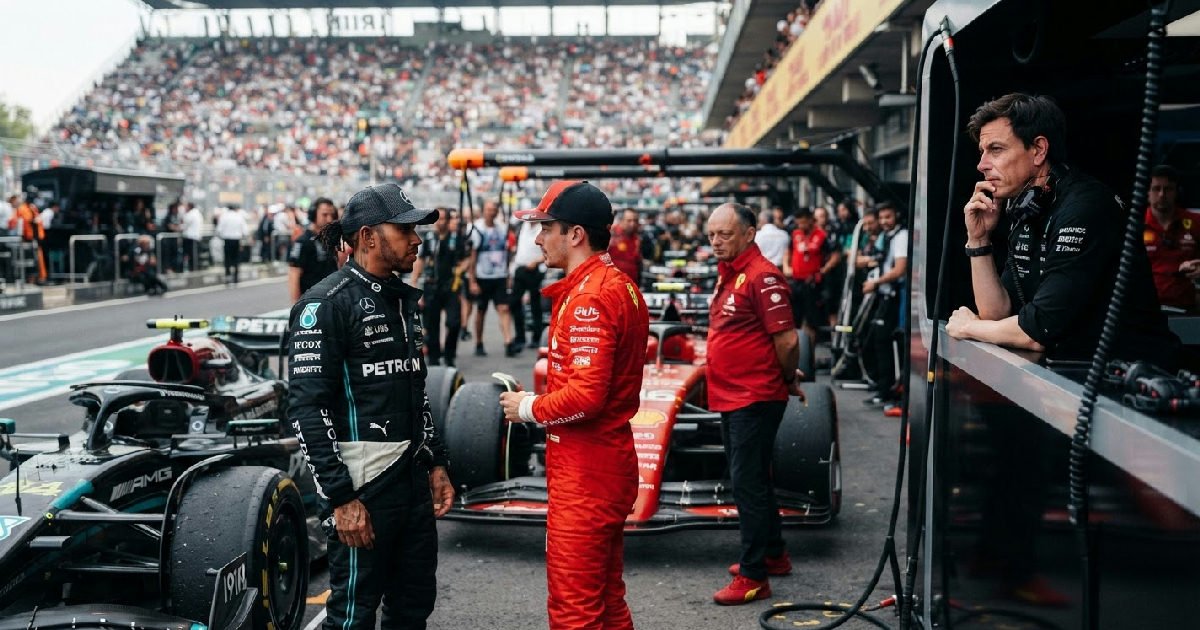
toto wolff sees hamilton leclerc ferrari tension deja vu
Mercedes-AMG Petronas Formula One Team Principal and CEO Toto Wolff recently voiced a distinct sense of “deja vu,” drawing parallels between the escalating Hamilton Leclerc Ferrari tension and his past experiences.
His comments, made on Friday ahead of the Sao Paulo Grand Prix, followed a costly opening-lap clash between Ferrari drivers Lewis Hamilton and Charles Leclerc at last Sunday’s Mexico City Grand Prix. This renewed insight into Hamilton Leclerc Ferrari tension comes as Hamilton is set to join Ferrari in 2025.
Wolff sees echoes of past Hamilton Leclerc Ferrari tension
The incident in Mexico City saw both Ferrari cars involved in a first-lap squabble, which ultimately allowed Red Bull’s Max Verstappen to secure victory. The contentious event led Ferrari Team Principal Fred Vasseur to orchestrate a crucial clear-the-air meeting in Brazil between Hamilton and Leclerc. Wolff’s perspective, rooted in managing fierce intra-team rivalries, offers a poignant lens for understanding Ferrari’s current challenges.
Toto Wolff articulated his feelings clearly, stating, “I had a bit of a deja vu moment, seeing the two red cars in front of us.” His remarks on Friday, 2026-11-07, explicitly linked the current Ferrari dynamic to the intense rivalries he managed during his tenure at Mercedes-AMG Petronas Formula One Team. He specifically referenced the recurring nature of such high-stakes competition among elite drivers.
The “deja vu” harks back to previous incidents, including a significant one that occurred on September 23, 2024, at the 2024 Singapore Grand Prix. During that race, Charles Leclerc reportedly questioned a team order over the radio, asking “Why?” when instructed to let Lewis Hamilton pass.
Hamilton eventually overtook Leclerc, a move Ferrari Team Principal Fred Vasseur later clarified as strategic to allow Hamilton to challenge George Russell ahead.
Managing alpha drivers in a competitive setting
Wolff further elaborated on the inherent difficulties of managing top-tier talents. He explained, “It’s not easy when you have two alpha drivers in the team, and they are fighting for the same position.” He emphasized that such situations demand careful management to prevent internal strife from jeopardizing team objectives, highlighting the delicate balance required.
This kind of intra-team friction can quickly escalate, affecting not only race results but also overall team morale and development. Wolff noted, “I remember the conversations we had on the radio, and it was exactly the same” when comparing the Singapore Grand Prix incident to past Mercedes challenges. His insights underscore the continuous challenge for team principals in Formula 1.
Hamilton and Rosberg: a precedent for intense competition
Wolff’s profound sense of “deja vu” is deeply rooted in the tumultuous relationship between Lewis Hamilton and Nico Rosberg when they were teammates at Mercedes from 2013 to 2016. This period saw the two drivers engage in an often-acrimonious battle for world titles, creating significant internal tension within the dominant Silver Arrows outfit.
Their rivalry was marked by several on-track collisions and public disagreements, particularly as they fought for championships between 2014 and 2016. One of the most infamous incidents occurred at the 2016 Spanish Grand Prix, where both Mercedes cars were eliminated on the opening lap after Hamilton and Rosberg collided.
Navigating high-stakes rivalries
The collision at the 2016 Spanish Grand Prix prompted a firm response from Wolff, who famously threatened both drivers with suspension from the team following the incident. He explained his approach to such high-stakes rivalries, noting, “Sometimes it needs the really tough ones, where, like the last one, to make a point.” Wolff stressed the critical importance of team respect above individual ambitions.
He highlighted the thousands of people involved and the brand’s reputation at stake. Wolff also recalled the 2014 Hungarian Grand Prix, where Hamilton notably defied a team order to let Rosberg pass, stating he was “very, very shocked the team would ask me to do that.” This illustrates the constant negotiation of competitive desire and team directives.
F1’s enduring saga: high-stakes intra-team rivalries
Intra-team rivalries are not a new phenomenon in Formula 1; they are a recurring narrative woven into the fabric of the sport. The intensity often escalates when two highly ambitious drivers find themselves in a team capable of winning championships. This creates a fascinating, yet volatile, dynamic for team management.
Perhaps the most famous rivalry was between Alain Prost and Ayrton Senna at McLaren in the late 1980s. Their championship battles included deliberate collisions and fierce personal animosity, pushing the team to its limits.
Similar tensions were seen between Sebastian Vettel and Mark Webber at Red Bull Racing, notably during the “Multi-21” incident in Malaysia in 2013 when Vettel ignored team orders to overtake Webber and win the race.
The psychology of alpha drivers
Managing multiple “alpha” drivers demands more than just engineering prowess; it requires a deep understanding of human psychology. These athletes are driven by an insatiable desire to win, a trait that makes them champions but can also lead to conflict. They are accustomed to being the undisputed number one, and sharing that spotlight often proves challenging.
Team principals must walk a fine line: allowing drivers to compete freely enough to extract maximum performance, but intervening before it harms the team’s overall objectives. It’s a test of diplomacy, authority, and strategic foresight. The stakes are always high, with team and driver reputations on the line in every race.
Ferrari’s delicate balancing act for 2025 and beyond
The parallels drawn by Toto Wolff are particularly pertinent as Lewis Hamilton prepares to join Scuderia Ferrari in 2025, partnering with Charles Leclerc. This move sets the stage for a potentially explosive combination of talent and ambition within the legendary Italian team. Fred Vasseur, Ferrari’s Team Principal, faces the unenviable task of managing two drivers who both expect to lead the charge.
Vasseur has already demonstrated his approach, having called the meeting in Brazil to address the Mexico City Grand Prix incident directly. He emphasized that the discussion had to remain private, stating, “It’s a matter of respect also for them and for the team.” His overriding message, however, was clear: Ferrari must come first, a philosophy mirroring Wolff’s own during the Mercedes years.
The road ahead for Maranello
The reported Hamilton Leclerc Ferrari tension serves as an early warning of the potential complexities ahead for the Maranello-based squad. While competition between teammates can push a team to greater heights, unchecked rivalry can derail championship bids. Ferrari’s success in the coming seasons will hinge not just on car performance, but critically on how Vasseur orchestrates this high-profile driver pairing.
The team will need clear guidelines, open communication, and potentially tough decisions to ensure both drivers contribute constructively. The F1 world will be watching closely to see if Ferrari can channel the competitive fire of Hamilton and Leclerc into championship glory, rather than internal strife. Wolff’s “deja vu” stands as a stark reminder of the tightrope Ferrari must walk to achieve its ambitions.