

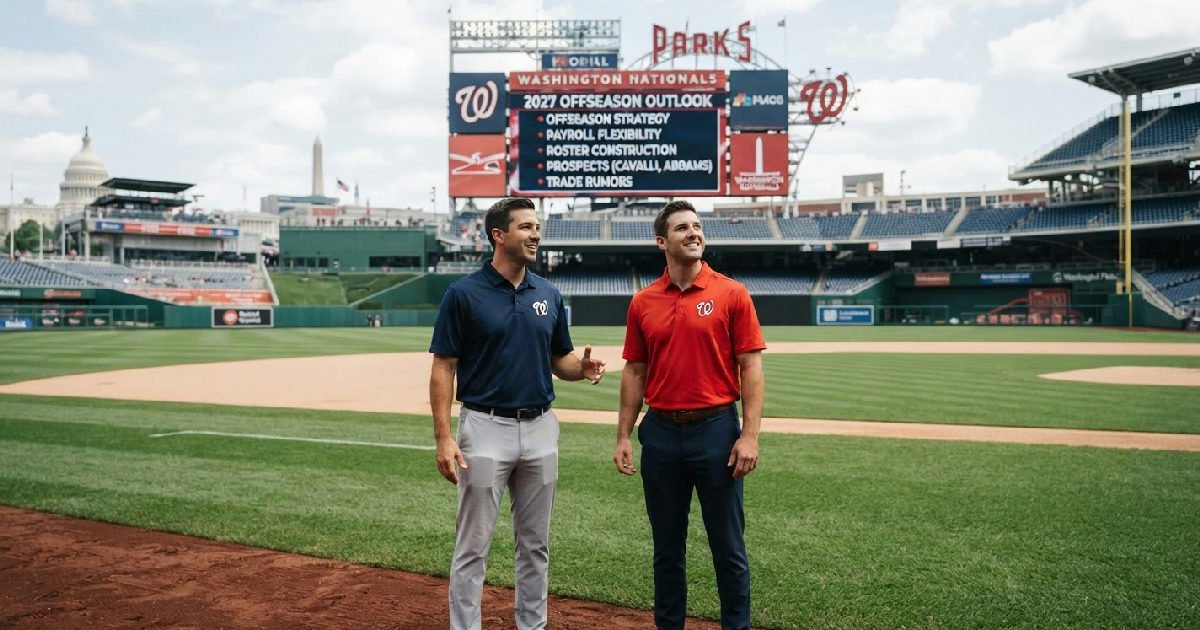
paul toboni charts washington nationals 2027 offseason outlook
The Washington Nationals are gearing up for a pivotal 2027 offseason, fresh off their most successful season since the 2019 World Series triumph. Under the new leadership of President of Baseball Operations Paul Toboni and Manager Blake Butera, the team posted a 77-85 record in 2026, marking an 11-win improvement from the previous year.
This performance kept them in the playoff hunt until August, providing a tangible foundation for future growth.
Building on 2026 Momentum and the Washington Nationals Offseason Outlook
As the club sold off assets at the trade deadline this past season, their focus now shifts to leveraging newfound payroll flexibility. The front office aims to build upon the strategic shifts that delivered unexpected success, including innovative roster management and player development.
The 2026 campaign was Paul Toboni’s first full season leading the Nationals’ baseball operations. He took the helm in October 2025, bringing a track record as General Manager for the Cleveland Guardians known for farm system development and competitive teams on modest budgets. His appointment, alongside Blake Butera as manager in November 2025, signaled a deliberate organizational shift.
Butera, formerly an executive with the Tampa Bay Rays, immediately implemented a “Tampa Bay-style approach” to the lineup and pitching rotation. This involved heavy platooning and a frequent use of openers and bulk relievers. This strategy helped maximize a roster that, while improving, still lacked elite, high-priced talent across the board.
The management duo made an immediate impact, with Toboni orchestrating shrewd moves like the inexpensive Foster Griffin signing. Griffin became an All-Star before being traded for four prospects at the deadline. Similarly, a late March DFA pickup, Curtis Mead, blossomed into a middle-of-the-order hitter before being flipped to Boston for lefty Connelly Early. Such tactical player management underlines the new front office’s data-driven philosophy.
Navigating Financial Commitments and Flexibility
A significant factor in the Washington Nationals offseason outlook is the team’s evolving financial landscape. While the club still carries substantial deferred salary obligations from past eras, the immediate payroll picture is opening up. The actual term of Stephen Strasburg’s contract is finally off the books, alleviating a major burden that accounted for over a third of the team’s payroll in 2026.
However, the team still owes $80 million in deferred salaries to Stephen Strasburg between 2028-2030. They also remain on the hook for $30 million in deferral payments to Max Scherzer through 2028, at $15 million annually. Another $4 million is owed to Kyle Finnegan through 2028. These commitments, stemming from lucrative deals years ago, highlight the long tail of high-value baseball contracts.
Despite these legacy payments, the Nationals project a 2027 financial commitment of just $13 million, including a $4 million signing bonus owed to Cade Cavalli in November. Their total future commitments, excluding deferrals, stand at a modest $77 million.
This figure places Washington significantly below the rest of the league, with the next closest team, the Marlins, sitting at approximately $82 million. This vast difference offers considerable room for strategic investment.
Key Guaranteed Contracts
- Cade Cavalli (RHP): Signed for $47 million through 2030, with a $25 million club option for 2031 (including a $2 million buyout).
- Keibert Ruiz (C): Secured for $30 million through 2030, featuring club options for 2031 and 2032.
Cade Cavalli, after a breakout 2026 campaign, has already earned an extension and is expected to anchor the 2027 rotation. Keibert Ruiz represents a stable presence behind the plate, providing a known quantity for years to come. These deals provide a bedrock of talent for the team as it considers other additions.
Arbitration Decisions and Non-Tender Candidates
The Nationals have several arbitration-eligible players whose statuses will be critical in shaping the 2027 roster. These players, while not on guaranteed long-term deals, will command raises based on their service time and performance. The projected salaries, courtesy of MLBTR contributor Matt Swartz, indicate notable figures for key contributors.
- Josiah Gray (5.075 service time): $1.6 million
- CJ Abrams (4.130 service time): $10.2 million
- Richard Lovelady (4.052 service time): $1.7 million
- Jake Bird (3.169 service time): $1.3 million
- Jake Irvin (3.152 service time): $3.4 million
- Ken Waldichuk (3.150 service time): $1 million
- Jacob Young (3.037 service time): $2.3 million
- Mitchell Parker (2.167 service time): $1.1 million
Among these, Richard Lovelady, Jake Bird, Ken Waldichuk, and Mitchell Parker are reportedly considered non-tender candidates. Decisions on these players will further shape the team’s payroll and roster flexibility, potentially freeing up additional funds for external acquisitions.
Addressing Team Needs and Bolstering the Roster
Despite their improved 2026 season, the Nationals have clear areas for improvement, particularly on the pitching side. The team’s pitching staff finished 24th in the league in strikeouts and allowed the fourth-most home runs (218). Their overall ERA of 4.67 ranked 26th in MLB, indicating a significant deficiency.
The bullpen was particularly troublesome, described as “historically bad” in 2026. Nationals relievers conceded a league-high 113 home runs, 16 more than the next closest team. The unit also set an unwelcome record with 42 blown saves, significantly higher than the average of 22 for other clubs. Reinforcing both starting pitchers and relief help stands as an obvious and confirmed priority for the offseason.
Conversely, the Nationals’ offense proved to be a strength, ranking third in runs scored across the league in 2026. This offensive prowess, combined with a dynamic approach to player management, helped the team remain competitive despite its pitching woes. The focus now shifts to balancing the roster, ensuring the pitching staff can match the output of the lineup.
Key Player Outlook and Emerging Prospects
Several players are poised to play critical roles in the Nationals’ immediate future. Cade Cavalli’s ascent has been a major storyline, solidifying his spot in the 2027 rotation. He represents a successful outcome of the team’s development efforts. Beyond Cavalli, the team is optimistic about Connelly Early, a left-handed pitcher acquired in a trade, who brings five years of team control.
President of Baseball Operations Paul Toboni has also praised Andrew Alvarez, noting that he has “thrown great” and put himself in a position for “high-quality innings” next year. These emerging arms offer internal solutions for the pitching staff, reducing the need for extensive free-agent spending. Still, external help will undoubtedly be sought to complement these talents.
On the offensive side, shortstop CJ Abrams enjoyed a career year, earning his second All-Star selection and posting impressive offensive numbers. He is expected to be a central figure, although past trade buzz suggests his name might resurface this winter.
The team’s player development system also yielded strong results across both major and minor league levels in 2026, pointing to a promising pipeline. Organizations often look to their farm systems to inject new talent and maintain competitiveness, showcasing the impact of emerging stars.
Top Prospects on the Horizon
- Eli Willits (SS): At just 18, he is considered one of the top prospects in all of baseball and could reach the majors by 2028.
- Seaver King (SS): Aged 23, King is likely to receive a call-up in 2027, viewed as ready for the big leagues.
- Jarlin Susana (P): Currently impressing in the Arizona Fall League, Susana will compete for a rotation spot next season.
- Travis Sykora (P): Recovering from elbow surgery, Sykora was outstanding prior to his injury and remains a top pitching prospect.
- Devin Fitz-Gerald (Middle Infielder): He is expected to be in the mix for a promotion, likely at second base.
- James Wood (OF): Widely regarded as one of the best hitters in the minors, Wood projects as a future offensive force.
The presence of these high-ceiling prospects gives President Paul Toboni and General Manager Ani Kilambi considerable assets. They can either develop them into future stars or use them as trade chips to acquire established talent. The Nationals’ 2026 season delivered their best performance since 2019, an 11-win improvement over the prior year.
The Road Ahead: Management’s Vision
Paul Toboni clearly articulated the front office’s philosophy, stating that “future payroll flexibility is a really good thing.” He emphasized a commitment to using this flexibility creatively, whether through signing free agents, extensions, or other strategic moves. The goal remains consistent: to build a much better team for next year and ensure sustained competitiveness into the future.
Manager Blake Butera echoed this sentiment, acknowledging that the team “left a lot of meat on the bone” in 2026 and needs to figure out how to improve. The combined vision of Toboni and Butera is focused on an analytical, disciplined approach to roster construction and in-game management. They aim to avoid the boom-and-bust cycles that have plagued many organizations.
The offseason will be critical for the Nationals. With no free agents from their 2026 roster to re-sign, the team has a clean slate to pursue external talent. The World Series is currently underway, with Game 4 scheduled for today, October 27, 2026, between the Tampa Bay Rays and the Milwaukee Brewers.
Once the series concludes, typically five days later, the free agency period will officially begin, allowing Washington to execute their strategic moves.
This period offers a significant opportunity for the Nationals to accelerate their rebuilding efforts and transition from a surprisingly competitive team to a consistent playoff contender. The disciplined approach to player evaluation and the willingness to make tough roster decisions underpin their strategy. Their ability to leverage both their financial position and a burgeoning farm system will define their success in the coming years.