

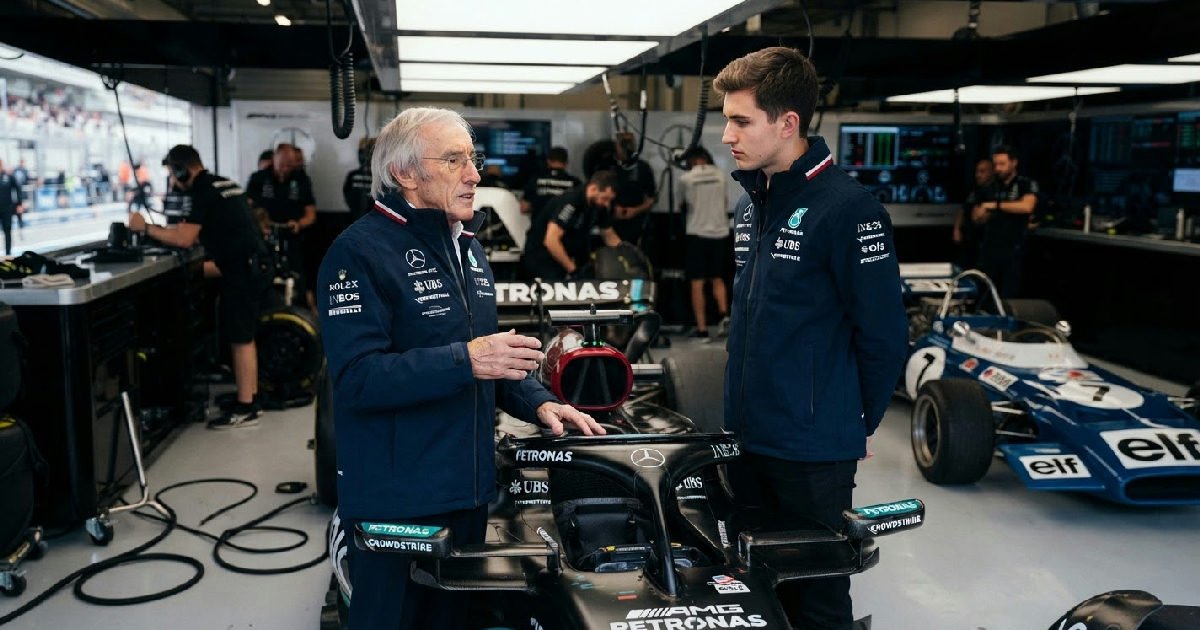
Sir Jackie Stewart on F1 Safety, more Aggression, Fewer Fatalities
Sir Jackie Stewart, the three-time Formula 1 world champion, believes the sport’s vastly improved safety standards have fundamentally altered the nature of grand prix competition, allowing modern drivers to race more aggressively. The 87-year-old Scot, whose relentless campaigning revolutionised motorsport safety, says today’s racers can take risks that would have been fatal during his era.
In a recent interview with his grandson, Lucas Stewart, the former champion reflected on the stark contrast between F1’s brutal past and its much safer present. He explained that drivers now operate with the confidence that a mistake is unlikely to cost them their life, a reality his generation could not imagine.
A near-fatal crash and F1 safety
This psychological shift, he argues, has directly contributed to a more aggressive style on track.
During Stewart’s driving career in the 1960s and 70s, the dangers were immense; he notes that he lost 57 friends and fellow competitors to the sport. “It was ridiculously dangerous. Most of my friends are dead,” Stewart stated grimly. The constant threat of injury is a burden for any athlete, similar to a tennis star’s confident wrist recovery.
The catalyst for Stewart’s lifelong safety crusade was a near-fatal crash at the Circuit de Spa-Francorchamps in 1966. This incident starkly highlighted the dire lack of immediate, professional trackside care prevalent in motorsport at the time.
The crash revealed a severe deficiency in trackside infrastructure and emergency response. “Here was a sport that had serious injury and death so closely associated with it, yet there was no infrastructure to support it,” Stewart recalled. This personal experience fueled his determination to drive change.
Following his accident, the ambulance transporting Stewart to the hospital reportedly got lost on rural roads. This further underscored the primitive medical facilities and procedures then in place. He later said he felt he had to do something about the situation.
The dawn of a safety revolution
That harrowing experience on 1966-08-28 ignited a fire in Stewart. He realised that while drivers accepted risks, the sport itself did almost nothing to mitigate them. At the time, a Formula 1 driver had a two-in-three chance of dying in a crash over a five-year period.
“As cars got faster but the tracks stayed the same, racing became unsustainable for life,” Stewart explained. He began a campaign that would define his legacy, advocating for changes that seem self-evident today but were controversial and often unwelcome at the time.
Stewart’s unpopular but essential crusade
Stewart’s push for safety was met with stiff resistance. Track owners baulked at the cost of upgrades, officials were complacent, and even some fellow drivers and fans believed that making the sport safer would diminish its appeal. He was branded a coward and an agitator for speaking out.
Undeterred, he used his stature as a champion to force change. As president of the Grand Prix Drivers’ Association (GPDA), he led driver boycotts of dangerous circuits. In 1969, the drivers refused to race at Spa until safety barriers were installed. In 1970, they boycotted the German Grand Prix at the Nürburgring, forcing organisers to make significant track improvements.
His advocacy led directly to the implementation of now-standard safety features. He championed the use of full-face helmets and campaigned for mandatory seatbelts, admitting he initially found them uncomfortable. He pushed for Armco barriers, gravel traps, and wide run-off areas to separate the track from solid objects like trees and buildings. An athlete’s mound return can similarly be clouded by such persistent threats.
How safety transformed the art of racing
The success of this campaign is why Stewart believes today’s drivers can push the boundaries of aggression. With cars designed as “survival cells” and tracks lined with sophisticated safety systems, drivers have a crucial safety net that simply didn’t exist before.
“They are more preventive in safety, but at the same time, taking advantage of that has brought it to a level that it never existed in before,” Stewart said. “They do make mistakes, but the mistakes don’t take lives as they did in the past.” This reality, he feels, is a good thing for the sport.
He described the chilling normality of death in his era. “We didn’t even stop the race. We continued to drive while somebody was losing their life,” he recalled. “Sometimes it was the terrible sight of only knowing because of his helmet that had been taken off in the accident. That type of thing doesn’t happen today.”
The legacy continues: from Stewart’s fight to the halo
Stewart’s pioneering spirit laid the groundwork for a continuous evolution in safety, a philosophy embodied by the halo cockpit protection device. Introduced in 2018 amid aesthetic complaints and resistance from some purists, the halo has proven its worth unequivocally, mirroring the initial opposition Stewart himself faced.
Its value was dramatically demonstrated at the 2020 Bahrain Grand Prix. Romain Grosjean survived a fiery, high-speed crash that split his car in two, an accident he admits he would not have walked away from without the device. “I wasn’t for the halo some years ago, but I think it’s the greatest thing that we brought to Formula 1,” Grosjean said afterwards.
Similarly, Lewis Hamilton credited the halo with saving his life at Monza in 2021 when Max Verstappen’s car landed on top of his Mercedes. “Thank god for the halo. That ultimately saved me. And saved my neck,” Hamilton stated. These incidents are a modern testament to the safety-first mindset Stewart fought so hard to instill.
A lasting impact on motorsport culture
Ultimately, Stewart hopes his greatest legacy isn’t his three world titles, but the cultural shift he forced upon motorsport. He transformed it from a sport that passively accepted death to one that actively works to prevent it. Modern American football, he has argued, is now arguably more dangerous than Formula 1.
“Making motor racing safer was one of the things that was able to be part of my life,” the former driver said. “The number of friends that died, in many cases totally unnecessarily, was taken down to a new level, and that’s been carried forth by many others.”
While he acknowledges that death is still possible, it is no longer the probable outcome it once was. That change is his greatest victory.