

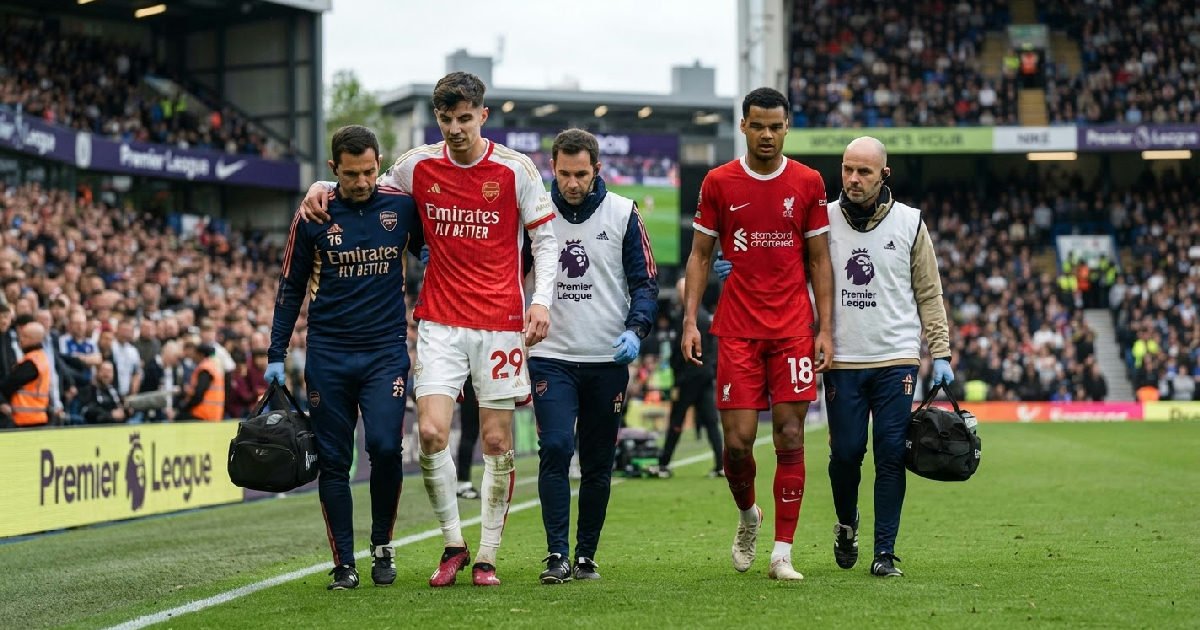
premier league injury crisis deepens after international break
Dozens of Premier League players returned from the international break with injuries, impacting clubs ahead of the league’s October 10 resumption.
The extended 16-day window, which ran from September 21 to October 6 and saw some national teams play four matches, has left clubs and Fantasy Premier League (FPL) managers scrambling to deal with the fallout.
Arsenal and Liverpool hit hardest by Premier League injury withdrawals
High-profile players including Arsenal’s Kai Havertz, Liverpool’s Cody Gakpo, and Sunderland’s Brian Brobbey are all facing spells on the sidelines. The sheer volume of casualties has reignited the debate over player welfare and extreme fixture congestion, with an estimated 25 players now considered doubts for the upcoming Gameweek 6.
Arsenal appear to be one of the clubs most significantly impacted by the break. Reports indicate that nearly a quarter of their 17 first-team players on international duty returned with fitness concerns.
The Gunners will be without German attacker Kai Havertz, who is expected to be sidelined for a few weeks due to a muscle strain, while winger Christos Tzolis is expected to miss two to three weeks with a hamstring injury sustained playing for Greece.
There are also concerns over defender Ezri Konsa, who withdrew from the England squad with a quad injury. These absences test the depth of a squad competing on multiple fronts. The constant need for a timely injury update has become a crucial part of the weekly routine for managers and fans alike, highlighting the physical demands placed on modern players.
Liverpool also face a nervous wait on key personnel. Forward Cody Gakpo is expected to miss a few weeks with an ankle injury picked up with the Netherlands.
More critically, star striker Alexander Isak returned from the Sweden camp early for assessment on a thigh issue, making him a doubt for the high-profile clash against Manchester City. Though his national team coach described it as ‘small’, his availability remains uncertain.
An unprecedented international break sparks fixture congestion debate
This injury crisis stems directly from an unusually demanding international schedule. The combined September-October break was a 16-day period where many nations played four competitive fixtures, a significant increase from the standard two. This packed schedule left minimal recovery time and has predictably led to a spike in muscular strains and fatigue-related injuries across the league.
Research conducted by Soccer Betting Sites found that a startling 12.3% of all Premier League players called up for international duty are now facing a battle to be fit for the weekend. The situation validates long-standing warnings from the global players’ union, FIFPro.
The organization has repeatedly highlighted that elite players are being pushed beyond their physical limits, with insufficient rest between high-intensity matches drastically increasing the risk of soft-tissue injuries.
While some clubs navigated the period successfully, others saw their squads depleted. Crystal Palace, Manchester United, Tottenham Hotspur, and Everton all reportedly lost between 15% and 20% of their international contingent to injury.
The global nature of the Premier League means players travel vast distances, a logistical challenge that mirrors the operations of major brands like Marriott International, but with the added physical toll of elite competition.
Confirmed absences and long-term layoffs
Beyond the immediate doubts, a number of players have been ruled out for extended periods, forcing FPL managers into early transfers. Arsenal’s attack is blunted by the absence of Kai Havertz, who is expected to be sidelined for a few weeks. His teammate Christos Tzolis is also unavailable for what could be a crucial three-week period for the Gunners.
Sunderland have been dealt a double blow. Forward Brian Brobbey sustained a hamstring injury playing for the Netherlands and will miss several weeks. Defender Dan Ballard suffered a similar injury with Northern Ireland, and his absence could potentially stretch into months, representing a significant defensive loss for the club.
Elsewhere, Tottenham’s Pedro Porro is expected to be out for several weeks with a hamstring injury, while Bournemouth’s versatile midfielder Alex Scott is facing a prolonged spell out with a thigh problem. Liverpool’s attacking rotations will be limited, with Cody Gakpo’s ankle injury ruling him out for the next few weeks.
These confirmed absences create major headaches for club managers and strategic opportunities for FPL players looking for replacements.
Key players facing a race against time for Gameweek 6
The status of many key players remains unconfirmed, leaving their availability for Gameweek 6 in question. Liverpool’s Alexander Isak is perhaps the most-watched case, given his importance and the magnitude of their upcoming fixture against Manchester City. The club remains hopeful but will await a final assessment on his minor thigh issue.
Manchester United are monitoring multiple players. Defender Patrick Dorgu limped out of Denmark’s match with a thigh injury, while reports suggest Bruno Fernandes is managing a hip issue and Noussair Mazraoui has a back complaint.
For Manchester City, an injury scare for Erling Haaland appears to have been a false alarm, with Norway’s manager Ståle Solbakken attributing his limp to fatigue rather than injury. However, young midfielder Nico O’Reilly did withdraw from the England camp.
Chelsea also have several players under evaluation. Cole Palmer missed England duty with a managed muscle issue, while Jamie Gittens’ fitness is still to be confirmed.
The FPL market for these players is highly volatile, with values shifting rapidly on every news update, a phenomenon not unlike the price fluctuations seen in the Bitcoin price breakout, where sentiment and new information can cause dramatic swings.
The ripple effect on Fantasy Premier League strategy
The sheer number of injuries has thrown many Fantasy Premier League plans into disarray. Managers who had saved transfers are now forced to use them, while others are contemplating activating their Wildcard chip to overhaul their squads completely. The three-week gap without Premier League football provided an opportunity for strategic planning, but this injury crisis has turned it into a period of reactive repairs.
One common piece of advice from FPL experts is to avoid knee-jerk transfers for players who are merely ‘doubts’. Waiting for concrete news from club managers’ press conferences later in the week is the prudent approach. Transferring out a player with a minor knock who then starts at the weekend can be a costly mistake.
Conversely, the chaos could present opportunities. Clubs that emerged relatively unscathed, such as Chelsea, Fulham, and Newcastle United, might see their players become popular transfer targets. With two more international breaks scheduled for November and March, this period serves as a stark reminder of how quickly FPL fortunes can change and the importance of having a flexible squad with a strong bench.