

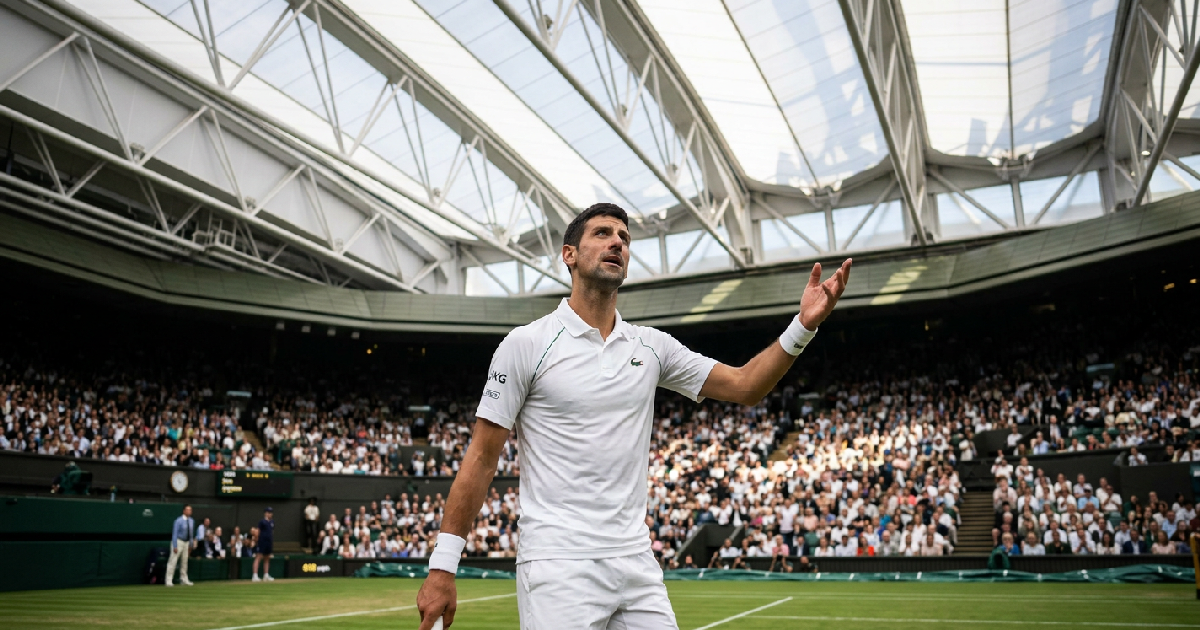
Novak Djokovic challenges Wimbledon officials over early roof closure on July 7, 2026
Novak Djokovic standardly views Wimbledon as an outdoor tournament, but his quarter-final match against Felix Auger-Aliassime was interrupted by a controversial decision to close the Centre Court roof early.
The Serbian veteran voiced a strong complaint on July 7, 2026, after organisers moved to create indoor conditions at 7:40 pm despite local sunset times recently extending past 9:00 pm.
Djokovic challenges All England Club over roof protocols
While Djokovic argued the roof should remain open as long as possible, the decision was ratified, forcing the remainder of the contest to be played under cover.
The dispute centered on the timing of the closure, which Djokovic perceived as inconsistent with the tournament’s own recent standards. He noted that on other days during the Championships, officials had been hesitant to close the roof even as late as 8:30 pm.
By intervening more than an hour earlier, the organisers drew the ire of the 24-time Grand Slam champion, who confronted the tournament hierarchy directly on court. “You are so proud of your rules, that you are not sticking to any kind of rules,” Djokovic told officials during the exchange.
“You have no idea what the rule is.”
The protest on Centre Court highlighted the tension between players and the All England Lawn Tennis and Croquet Club (AELTC) regarding how and when the retractable roof is deployed. Djokovic insisted that as an outdoor event, the natural elements should be preserved for as long as safety and light allow.
The shift to indoor play was particularly significant given the playing style of his opponent. Much like tactical friction in other elite sports, the environmental change introduced new variables into the high-stakes quarter-final.
Felix Auger-Aliassime is widely regarded as a player who thrives in indoor conditions, having secured six of his nine ATP Tour singles titles on indoor hardcourts. While the Canadian feigned frustration alongside Djokovic during the delay, the lack of wind and the controlled climate under the roof generally favor his powerful serve and flat groundstrokes.
Djokovic, who has 428 weeks as world number one, has previously stated that playing with the roof open or closed “feels like playing two different matches.”
In the end, the tournament referee’s decision stood, and the structure was deployed to ensure the match reached a conclusion. The move ensured the match stayed on schedule for the London crowd, but it left the Serbian deeply unsatisfied with how the regulations were applied. For Djokovic, the decision represented a departure from the “outdoor” spirit that he believes should define the Wimbledon experience.
A long-standing history of roof controversies at Wimbledon
This is not the first time Novak Djokovic has found himself at odds with the AELTC over the Centre Court roof, which was first installed in 2009. During his 2018 semi-final against Rafael Nadal, he clashed with officials over whether a match that started late should continue under lights or be suspended.
Similar complaints followed in 2022, when he argued the roof was being shut while there was still sufficient natural light to continue play outdoors.
In 2024, Djokovic raised different concerns, suggesting that the humitidy and conditions created by the closed roof made the grass surface slippery and dangerous—a complaint he had also voiced the previous year. These recurring incidents suggest a fundamental disagreement between the all-time great and the tournament organizers over evening scheduling.
Djokovic has often pointed out that the physical preparation for an indoor match differs significantly from an outdoor one, particularly concerning humidity and court traction.
Impact on the upcoming semi-final against Jannik Sinner
The physical and mental energy expended during the dispute and the subsequent play under the roof may impact Djokovic’s recovery for the next round. He is slated to face Jannik Sinner in the semi-finals, a match that pits the 39-year-old veteran against the current best in the world.
Sinner has been a formidable hurdle for Djokovic over the last year, and many fans are questioning if the Serbian will be “gassed” after the intensity of the quarter-final.
Jannik Sinner’s baseline power and consistency will require Djokovic to be at his physical peak. Some observers believe the veteran’s mental resilience remains his greatest asset, having used technical frustrations as fuel in the past. Just as champions must navigate unexpected turns in other arenas, Djokovic must now reset after a night of high-court drama and officiating disputes.
The AELTC has focused on maintaining a rigid schedule to satisfy global broadcasters and local spectators, but the pressure to move matches indoors may continue to face player resistance. If the tournament continues to prioritize certainty over traditional outdoor conditions, they risk alienating top competitors who value the history of grass-court tennis.
For now, Djokovic’s quest for an eighth Wimbledon title moves to the semi-finals, regardless of the controversy left behind on Centre Court.