

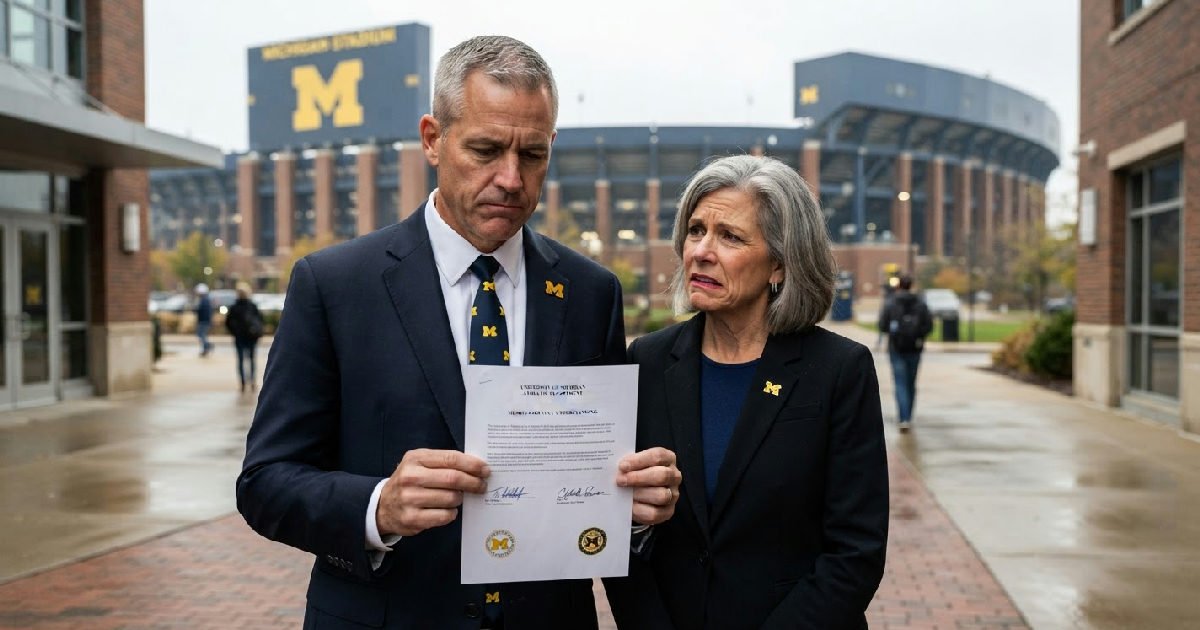
Michigan president’s job security questioned after costly Trev Alberts AD
Trev Alberts’ offer to become the University of Michigan’s athletic director was rescinded, creating a leadership crisis for the university. Cybele Raver.
The university now faces a potential financial fallout exceeding $21 million after backing out of a signed agreement with Alberts, who had already resigned from his post at Texas A&M.
Trev Alberts Michigan: costly reversal and mounting pressure
Raver, who led the search and is set to officially begin her term on December 1, informed board members on the night of November 23 that hiring Alberts was “not in the best interest of the university.”
This decision came just six days after she, along with interim president Domenico Grasso, signed a binding memorandum of understanding with Alberts. The reversal has plunged the athletic department back into uncertainty and drawn sharp criticism from the college sports community.
The financial consequences of Michigan’s about-face are substantial. According to his attorney, Tom Mars, the university owes Trev Alberts a full buyout of his five-year contract, valued at $17.2 million. On top of that, Michigan is also obligated to pay the $4 million buyout clause Alberts owed to Texas A&M for his departure.
This brings the total potential cost for an athletic director who never worked a single day in Ann Arbor to a staggering $21.2 million.
This expensive mistake has put a harsh spotlight on Raver before her presidency even officially begins. Insiders are questioning her leadership and the vetting process that led to the hire and its subsequent collapse.
“The question future Michigan president Cybele Raver is going to have to answer at some point in all of this is: what, exactly changed?” college football insider Richard Johnson noted. The rapid change of heart has left many, including university regents, baffled and concerned.
NBC Sports’ Nicole Auerbach posed an even sharper question on social media: “And, if her decisions to hire Alberts and then reverse course ends up costing the school tens of millions of dollars, should she keep her job?”
The situation has amplified concerns about the stability of leadership at Michigan, which is trying to navigate a complex and evolving landscape in collegiate athletics. This turmoil contrasts with the more stable College Football Playoff outlook some other major programs are enjoying.
The deposition that derailed the hire
The entire debacle hinges on comments Alberts made in a December 2025 deposition. The deposition was related to a Title IX lawsuit from his tenure as athletic director at the University of Nebraska. When asked directly if college coaches should never have sex with student-athletes, Alberts gave a nuanced answer that proved to be his undoing.
“I don’t know how to answer that,” Alberts stated in the deposition. “I mean, you know, it just depends.” He elaborated by suggesting that the COVID-era eligibility rules had created older student-athletes who might be closer in age to coaches, making the situation more “nuanced.” These comments were first reported by FOIAball on November 20, three days after Michigan had signed its agreement with Alberts.
Once the remarks became public, they created a firestorm. Alberts later released a statement to ESPN, saying he was “shocked and disheartened” by Michigan’s decision and that his words had been taken out of context.
“The egregious characterization of words taken out of context from a deposition regarding an incident that occurred years ago is wrong and unfair,” he said. But the damage was done. For a university that has dealt with its own misconduct scandals, the comments were evidently a dealbreaker.
‘A total clown show’: national reaction to the debacle
The public reversal was met with widespread derision. ESPN analyst Paul Finebaum did not mince words, calling the situation at Michigan “a total clown show.” He added, “Michigan has become a laughingstock all over the country, and there’s no nice way of putting it.” The incident has been portrayed as a case study in mismanagement, tarnishing the university’s reputation on a national scale.
The criticism extends beyond just the athletic department, pointing to systemic issues within the university’s governance. The search was led by Raver, but the failure to uncover the deposition comments before signing a binding contract suggests a significant breakdown in the vetting process. For a high-profile institution, it represents a damaging and embarrassing unforced error.
The move by Alberts leaving Texas A&M for a job that evaporated in days was as shocking as when Saquon Barkley ignites eagles with a surprise performance.
Alberts expressed his own frustration, noting he had “already begun working on behalf of Michigan Athletics.” In his statement, he reaffirmed his excitement for the role he thought he had secured. Instead, he was left without a job, while Michigan was left with a massive bill and a renewed search for an athletic director.
A pattern of turmoil in Ann Arbor
This latest controversy is not an isolated incident but rather another chapter in a period of significant instability for the University of Michigan. The institution has been weathering a storm of leadership changes and scandals for several years.
Former president Santa Ono resigned in 2025, following his predecessor Mark Schlissel, who was dismissed over an inappropriate relationship. The university also endured a major scandal involving former provost Martin Philbert.
The athletic department, specifically, has been a source of constant drama. Former football coach Jim Harbaugh left for the NFL with the program still on NCAA probation. His successor, Sherrone Moore, was fired after nearly a year for an inappropriate relationship with a staff member.
The outgoing athletic director, Warde Manuel, is himself leaving after agreeing to a $7.14 million separation agreement in July 2026 amid a “culture review” that found “serious concerns.”
This backdrop of chaos makes the bungled Alberts hire even more damaging. It suggests that the systemic issues plaguing the university have not been resolved. The search for a new athletic director was meant to be a step toward stability.
Instead, it has created yet another crisis and highlighted the challenges facing a department in desperate need of steady leadership. While not in the collegiate space, financial incentive programs are becoming more complex, as seen in esports with the ESL Club Incentive program.
What happens next for Michigan?
With Alberts out of the picture, Michigan’s search for its next athletic director is back at square one. University spokesperson Paul Corliss issued a statement confirming the search is “ongoing” and that “the values that define Michigan will guide our decisions.” However, finding a top-tier candidate willing to step into such a volatile environment will be a significant challenge.
For C. Cybele Raver, the path forward is fraught with difficulty. She will assume the presidency under a cloud of her own making, facing questions about her competence from faculty, alumni, and major donors. Her first major decision has backfired spectacularly, costing the university millions and making it a national punchline. Rebuilding trust will be her immediate and most pressing task.
Meanwhile, the athletic programs continue to operate in a state of flux. The football team, under first-year coach Kyle Whittingham, holds a turbulent 6-5 record. The department is still paying off its former AD, Warde Manuel, and now faces a massive new liability for Alberts.
The episode serves as a stark reminder that on-field success is difficult to sustain without competent and stable leadership off the field.