

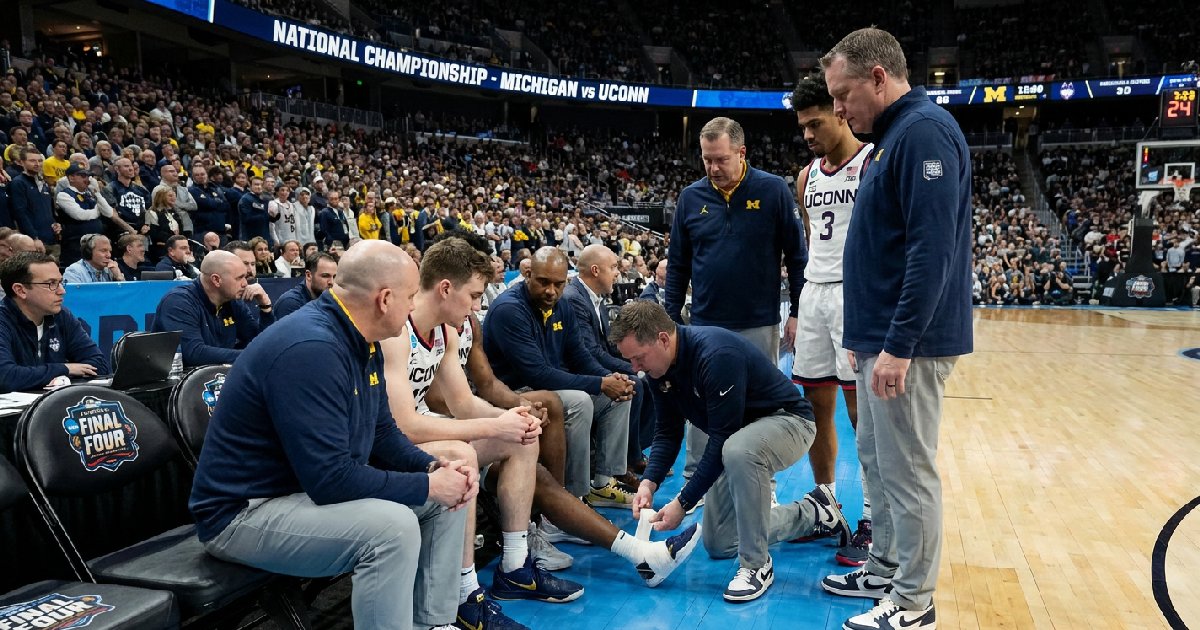
Michigan Basketball Injury Report for UConn Final
The stakes for the national championship have shifted as Michigan prepares to face UConn with a roster hampered by late-season attrition. As both programs descend on the final stage of the tournament, the availability of key rotation players has become the central narrative surrounding the matchup. For Michigan, the challenge isn’t just the defensive prowess of the Huskies, but the logistical puzzle of filling minutes left vacant by recent medical updates.
Michigan Rotation Under Pressure
Entering the title game, Michigan’s medical staff has been working around the clock to clear several contributors who have dealt with nagging issues throughout the tournament run. While the starting five remains largely intact, the depth that allowed the Wolverines to outlast opponents in earlier rounds is now looking remarkably thin. Sources close to the program indicate that the training room has been particularly busy since the semi-final victory, with the focus on lower-body management and fatigue-related recovery.
The timing is particularly difficult. UConn’s style of play relies on a punishing physical interior presence and a bench that rarely sees a drop in production. To counter this, Michigan needs its secondary unit to provide high-energy minutes to prevent the starters from hitting a wall in the second half. If the bench remains limited, the Wolverines risk being outpaced in the transition game, an area where the Huskies have historically excelled.
UConn Prepared for a Physical Final
UConn arrives at this championship game boasting a relatively clean bill of health compared to their opponents. This disparity in physical condition often dictates the tempo of a final, where nerves can lead to early exhaustion. The Huskies have built their season on a foundation of “next man up” basketball, but with their primary rotation firing on all cylinders, they have the luxury of sticking to their established game plan.
And yet, Michigan has shown a stubborn resilience throughout this month. Even with limited numbers, their coaching staff has successfully pivoted to a slower, more methodical half-court game when necessary. The question for tonight is whether they can force UConn into that grind or if the Huskies will use their depth to turn the game into a track meet that Michigan’s injured roster simply can’t win.
Strategic Adjustments for the Wolverines
Expect Michigan to lean heavily on their defensive schemes to mask any lack of lateral quickness caused by lingering injuries. They may shift into a more static zone periodically to protect players from foul trouble or to catch a breath. This carries its own risks, as UConn’s perimeter shooters are seasoned at finding gaps in zone coverage.
On the offensive end, the pressure falls squarely on the playmakers to be efficient. Every possession counts when you aren’t sure how much juice is left in the tank. If Michigan can control the glass and limit UConn to one shot per trip, they can offset the disadvantage of a shortened bench. But if the Huskies start racking up second-chance points, the physical toll on an already depleted Michigan squad could become insurmountable before the ten-minute mark of the second half.
The Road Ahead
The outcome of this championship will likely be remembered for how Michigan managed its personnel during the final forty minutes of the season. Regardless of the final score, the battle in the training room has become just as pivotal as the battle on the court. For UConn, the goal is simple: exploit the depth advantage and keep the pressure high from the opening tip.
Frequently Asked Questions
Which Michigan players are most affected by the injury report?
The focus remains on the secondary rotation and frontcourt depth. Specific game-time decisions are often kept close to the chest until warmups, but the primary concern is whether the bench can provide double-digit minutes without a drop in defensive intensity.
How does UConn usually capitalize on opponent injuries?
The Huskies are known for their high-motor play. They typically increase the pace of the game when they sense an opponent is fatigued, using a full-court press or quick transition buckets to test the conditioning of a short-handed roster.
Can Michigan still win with a shortened bench?
Absolutely. It requires their primary stars to avoid foul trouble and for the team to dictate a slower tempo. If they can keep the game in the 60s or low 70s, they have a high-percentage chance of keeping it competitive until the final buzzer.