

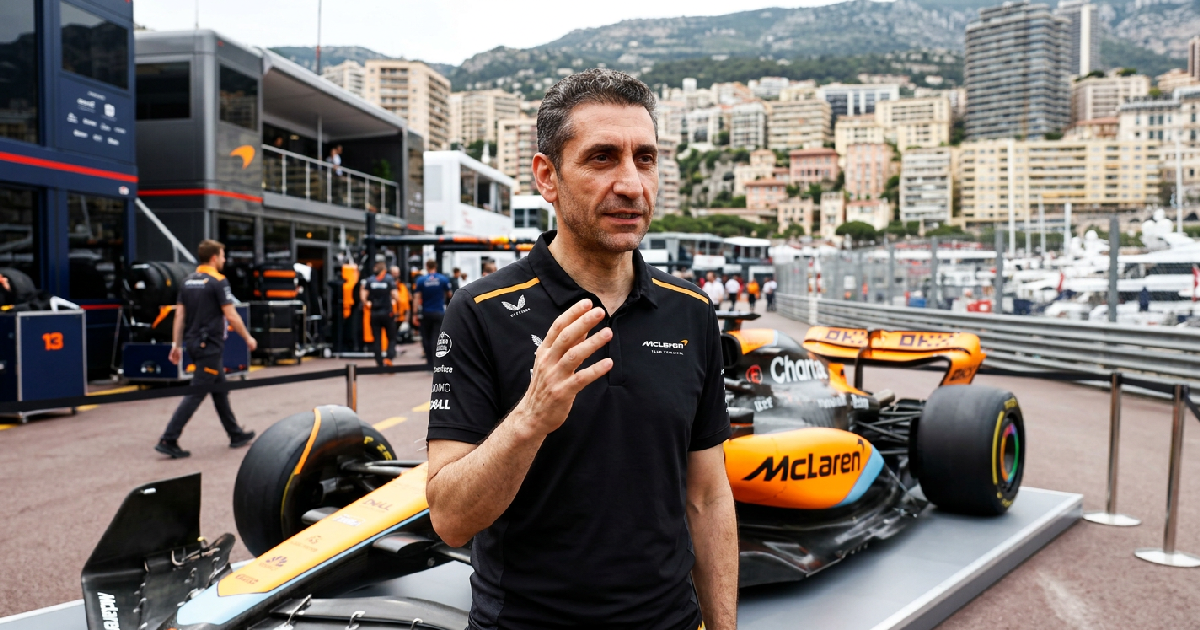
Andrea Stella details McLaren MCL38 chassis and tire issues in Monaco
McLaren Team Principal Andrea Stella has detailed the technical factors that hampered the team’s performance during the Monaco Grand Prix qualifying, where Oscar Piastri and Lando Norris secured second and fourth on the grid respectively. While the starting positions appear strong, the team faced a significant pace deficit throughout the weekend.
Stella attributed the struggle to a combination of inherent chassis limitations and a specific design philosophy that makes the MCL38 “very gentle on the tyres,” a trait that backfired on the unique Monte Carlo street circuit.
The qualifying results on Saturday, May 25, 2024, saw Oscar Piastri finish with a time of 1:10.424, trailing pole-sitter Charles Leclerc by 0.154 seconds. Lando Norris followed in fourth with a 1:10.542, roughly a quarter-second off the lead Ferrari.
Despite the top-four lockout, the drivers and management expressed frustration over the car’s inability to generate the necessary heat for a single flying lap. This struggle was predicted by the team due to the car’s design, which prioritises tyre longevity over rapid energy introduction.
Chassis grip and tyre temperature management hurdles
Andrea Stella identified two primary technical issues that defined the weekend. The first is a fundamental lack of overall chassis grip and aerodynamic load. “From a chassis point of view we lack grip overall,” Stella admitted, noting that improving aerodynamic load remains a clear objective for the development team.
Without this baseline grip, the drivers were unable to match the high-speed commitment seen from their rivals.
The second factor is the MCL38’s tendency to be gentle on its rubber. In Monaco, where track temperatures and surface characteristics require drivers to “fire up” their tyres almost instantly, this characteristic became a liability. Stella explained that finding the right “window” for the tyres was an arduous task.
The car’s inability to introduce energy effectively meant they lost significant time in the initial sectors of the lap compared to the competition.
And while some hoped this trait might offer an advantage at high-degradation tracks, Stella warned against over-optimism for the upcoming Barcelona race. Much like team principals like Toto Wolff must manage expectations after technical setbacks, Stella cautioned that McLaren remains slightly behind its intended development trajectory. He emphasised that the team must materialise aerodynamic opportunities themselves rather than relying on track characteristics.
Lando Norris faces technical failures and trackside debris
Lando Norris endured a particularly difficult buildup to the qualifying session. On Friday, May 24, an electrical failure during Free Practice 2 (FP2) caused his car to shut down at the Nouvelle Chicane.
This technical issue cost him the majority of the session and forced the McLaren mechanics to break the FIA curfew on Friday night. The crew worked late to replace the battery pack, wiring, and the ESME Pack to ensure the car was ready for Saturday’s action.
The misfortune followed Norris into the first part of qualifying. During Q1, a large piece of an advertising banner became lodged under his MCL38. Stella described the incident as “catastrophic” for performance, estimate a loss of downforce equivalent to three seconds per lap.
The team principal was vocal in his criticism of the track conditions, stating that loose banners had been an issue since the first practice session and “should not happen” at this level of racing.
The lack of confidence in the car was a recurring theme. Lando Norris noted that the gap to the front-runners was more extreme than expected, contrasting it with the feel of the car from the previous year.
“It’s just not a weekend where we had confidence in the car and that ability to push like we had last year,” Norris remarked. The frustration mirrors the sentiment often voiced by professional athletes, such as when Gleyber Torres discussed the frustration of missed time and performance hurdles.
McLaren tests and rejects new front wing concept
In addition to managing the race weekend, McLaren used the Monaco sessions to further evaluate a new front wing concept. The part had been briefly tested and shelved during the prior event in Canada. Both drivers ran the modified wing during Friday and Saturday morning practices to gather data for future development.
However, the team made the tactical decision to revert to the baseline front wing for the actual qualifying session.
Stella clarified that the new wing was not intended to provide an immediate, major jump in lap time. Instead, it represents the starting point of a new aerodynamic concept that will be iterated upon in the coming months.
Testing it in Monaco was vital for the engineering team to understand its response, even if it wasn’t the optimal choice for the narrow streets of Monte Carlo. The team preferred the predictability of the baseline configuration for the high-stakes Q3 shootout.
Despite the challenges, both drivers remain in contention for a podium finish. Oscar Piastri noted that while he felt roughly a second off the pace during Friday’s practice, the team made significant strides to close the gap to Ferrari by Saturday afternoon.
The focus now turns to Sunday, where tyre management—usually a McLaren strength—will be tested against the difficulty of overtaking on the world’s most famous street circuit.