

Nico Rosberg says Max Verstappen was “lucky” to avoid Dutch GP pile-up
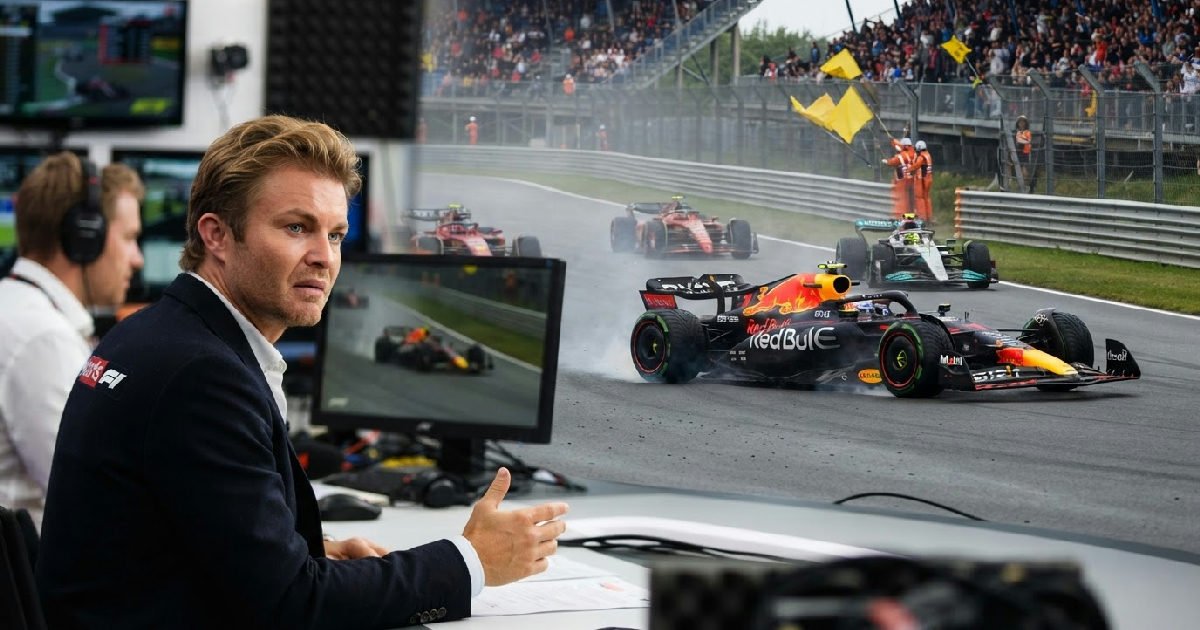
Red Bull Racing driver and four-time Formula 1 world champion Max Verstappen narrowly avoided triggering a potentially catastrophic multi-car pile-up during the opening lap of the 2026 Dutch Grand Prix on Sunday, August 23. That’s according to insightful commentary from 2016 Formula 1 champion Nico Rosberg, who spoke on Sky Sports F1 following the race.
Verstappen’s violent crash in damp conditions at his home race resulted in an early exit and a red flag. Fortunately, the incident saw him as the sole driver caught up in his immediate spin, despite the entire field following close behind. Rosberg highlighted the significant “luck” involved in preventing a much worse outcome.
Rosberg details the Max Verstappen Dutch GP crash escape
Nico Rosberg didn’t mince words when assessing the incident, noting the inherent difficulty of the conditions. “Everybody’s here cheering him on and then to go out of the race so early on like that, but it was the conditions,” he explained. He emphasised how challenging it is to judge grip limits on slick tyres in mixed wet and dry conditions.
“It’s just so incredibly hard in those conditions and especially on the slick tyre to judge the limit of the grip there, and so even the greatest of the moment, the greatest driver here, had a big crash,” Rosberg added.
He pointed out that had Verstappen’s car remained on the racing line, the consequences could have been severe. A driver’s ability to adapt to changing track conditions often defines their success in such scenarios.
Rosberg continued, “And as Max said, we really got lucky there because if he spins and remains in the middle of the track and you have the whole pack coming at full speed, that could be a multi-car massive shunt with people driving right into him.
That could have been a really bad outcome, so he even got a bit lucky there.” His analysis underscored the high stakes of early race incidents on a congested track.
Anatomy of the opening lap incident
The ill-fated lap for Max Verstappen began from his seventh-place starting position on the grid. As he navigated the opening moments of the Dutch Grand Prix, the Circuit Zandvoort presented a treacherous mix of damp and drying asphalt, particularly at the banked final corner known as Arie Luyendykbocht.
Verstappen, running on slick tyres, misjudged the grip available. He touched a lingering wet patch on the inside of the corner, applying too much throttle for the compromised surface. This small error at high speed sent his Red Bull RB22 into an uncontrollable spin.
The impact with the outside concrete wall was significant, reportedly ripping off at least one wheel and destroying the right-side suspension. His stricken car then slid back across the racing line, coming to rest in a dangerous position. The incident triggered a red flag, halting the race for approximately 25 to 30 minutes while debris was cleared and the track deemed safe.
While Verstappen’s crash was the main focus, Audi driver Gabriel Bortoleto also experienced an unrelated spin at the same corner. Fortunately, Bortoleto managed to continue, though his teammate Nico Hulkenberg narrowly avoided colliding with him. The G-force endured by Verstappen in his impact was below the 15G threshold, meaning a mandatory medical centre visit wasn’t required.
Verstappen’s candid assessment of Red Bull’s 2026 car
Speaking to Sky Sports F1 after his early exit, Max Verstappen offered a frank assessment of his Red Bull RB22’s performance in the 2026 season. He admitted that the team is grappling with a car that isn’t quite at the sharp end of the grid, especially compared to their previous dominant campaigns.
“I mean, if you look at the average, the whole season we have been fourth fastest,” Verstappen stated, acknowledging their current position in the pecking order. He noted that the Dutch GP weekend had starkly highlighted this performance deficit. The team is clearly looking for improvements, but immediate changes appear limited.
Verstappen suggested that significant performance gains might only come with changes implemented for the next season. “We’re getting towards the end of the season. You also have to look at next year. I think there are a few things in the car that we are looking at that can only be changed next year to really find a lot more performance.”
Despite the challenges, the four-time champion remains focused on maximising the current package. “So, we will just try to maximise everything we can with this car. But it’s not going to be the most straightforward end to the season. But we’ll try to do the best we can,” he concluded, underlining his pragmatic approach to the remaining races.
Implications for the drivers’ championship
Verstappen’s early retirement from the Dutch Grand Prix had direct consequences for his championship aspirations. The Dutchman walked away from his home race weekend with a meagre three points, all collected from a sixth-place finish in the sprint race. This result further widens the gap to the current championship leader.
He now sits sixth in the drivers’ standings with 112 points, a substantial 130 points behind Kimi Antonelli. This deficit makes his path to a fifth consecutive world title considerably more challenging. The crash at Zandvoort served as a significant setback, particularly as the season progresses towards its crucial final stages.
While Verstappen remains committed to extracting the most from his Red Bull, the points gap suggests that the championship fight may be moving beyond his grasp this year. The team’s current performance, described by Verstappen as “fourth fastest” on average, compounds the difficulty of closing such a significant points difference. Every race now becomes critical for him and Red Bull Racing.
Wider context of Zandvoort’s challenging conditions
Circuit Zandvoort is renowned for its unique layout and often presents drivers with formidable challenges, especially in variable weather conditions. The banked corners and narrow track sections demand absolute precision, leaving little margin for error. Sunday’s damp-but-drying track amplified these difficulties significantly.
Rosberg elaborated on the conditions, noting the “wet, dry; it’s a mix of everything.” He added, “It’s incredibly difficult on slick tyres to drive through this high-speed, fast corner. It’s the hardest thing in the world.” This sentiment highlights that even the sport’s most elite drivers can be caught out by the ever-changing grip levels.
The former champion also pinpointed a specific detail contributing to Verstappen’s error. “Max is clearly tighter than everybody else, and when you look more closely it looks like the dry patch is offset about 50 centimetres from the inside.” This nuance suggests that a slight deviation from the ideal line on the slick tyres, combined with excessive throttle, was enough to lose control.
“I think he just put a bit too much throttle down and you’re gone,” Rosberg surmised, ultimately attributing the crash to a “mistake” by Verstappen. Such conditions test a driver’s ability to adapt instantaneously, and even the best can fall victim to the track’s unforgiving nature when the limits are pushed a fraction too far.