

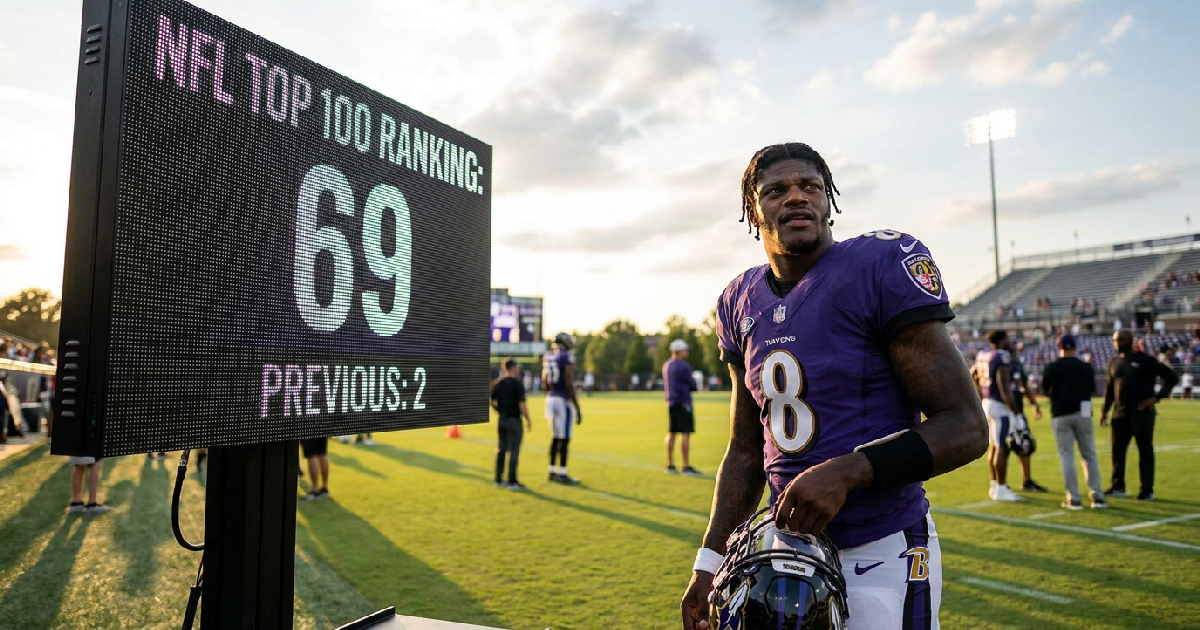
Lamar Jackson’s 69th NFL ranking sparks debate, baffles analysts
Baltimore Ravens quarterback Lamar Jackson found himself at the center of a heated NFL debate this week after the NFL Network’s annual “NFL Top 100” list for the 2026 season placed him at No. 69. The ranking, revealed on Monday, July 13, 2026, marks a staggering 67-spot plunge for the two-time MVP, who was ranked No. 2 just last year.
This dramatic demotion has sparked widespread criticism from analysts and fans alike, who contend the peer-voted list unfairly discounts Jackson’s career achievements and focuses too heavily on an injury-marred 2025 season. The sharp fall highlights the often-perplexing nature of player-driven rankings and the pervasive influence of recency bias in professional sports.
Dramatic drop in Lamar Jackson NFL ranking fuels player outrage
The sheer scale of Lamar Jackson’s fall from grace on the NFL Network’s list has been a primary point of contention. Going from the second-best player in the league to 69th in a single offseason struck many as preposterous, especially for a quarterback with two MVP trophies.
Mike Florio of Pro Football Talk didn’t mince words, stating, “There aren’t 68 players better than him in the NFL. There aren’t 28. There aren’t 18. There arguably aren’t eight.” He pointed to flaws in the voting process itself, suggesting it unfairly penalizes players coming off an “off year.”
How NFL Top 100 voting works
The “NFL Top 100” list is compiled from votes cast by current NFL players, making it a peer-reputation ranking. Players submit their top 20 choices, with points awarded on a sliding scale from 20 down to one.
This methodology, while offering unique insight into how players perceive their rivals, is often susceptible to recent performance and personal biases. Ballots are typically collected between Thanksgiving and New Year’s, meaning a player’s early-season struggles or injuries can heavily influence their standing.
Ian Cummings, an analyst with Pro Football Network (PFN), echoed Florio’s sentiment, calling Jackson’s 69th ranking absurd. “What are we doing here?” Cummings questioned, highlighting PFN’s own ranking of Jackson as the second overall player in the league. He stressed that Jackson, “when he’s on his game and fully healthy, he is truly transcendent.”
Jackson’s teammates also rallied to his defense. Wide receiver Zay Flowers praised his versatility, noting, “He can do anything from anywhere in the pocket, running. If that’s not a threat, I don’t know what is.”
Kyle Van Noy, an outside linebacker who played three seasons with Jackson, celebrated his journey, saying, “A lot of people said he wasn’t quarterback enough. I think he’s proven those people wrong.”
The 2025 season: Injuries and performance
Jackson’s significant slide on the NFL Top 100 list is largely attributed to his 2025 campaign, which saw him miss four games due to injury. He finished the season having played 13 games, a lower count that undoubtedly impacted his overall statistical output.
Despite these setbacks, Jackson still managed to throw for 2,549 passing yards and 21 touchdowns against seven interceptions. His rushing numbers, typically a dominant aspect of his game, dipped to a career-low 349 yards. In total, he accounted for 23 touchdowns.
Even with the reduced playing time and an injury-hampered performance, Jackson’s efficiency remained notable. He finished fourth in the league with a 103.8 passer rating. He also led the NFL in passer rating, yards per attempt, and completion percentage over expected on play-action passes, demonstrating flashes of his elite ability.
Offensive line struggles hampered production
The Baltimore Ravens’ offensive line was identified as a “glaring liability” throughout the 2025 season, a factor that undoubtedly contributed to Jackson’s injuries and hampered production. A weak offensive front can expose any quarterback, and Jackson’s dynamic, run-heavy style makes him particularly vulnerable without solid protection.
This isn’t the first time an injury-plagued season has seen Jackson’s ranking plummet. Following an injury-riddled 2022 campaign, he dropped 36 spots to 72nd from his 36th ranking the year prior. This pattern suggests players’ votes are heavily influenced by a season’s immediate outcomes, rather than a holistic view of a player’s career.
Critics and the recency bias factor
The “NFL Top 100” controversy also underscores a long-standing pattern of criticism directed at Jackson. Even with two MVP awards and a first-team All-Pro selection in 2024, he’s never quite shaken off certain narratives.
Some critics have leveraged his injury-affected 2025 season as an opening to downgrade his overall standing. Former Philadelphia Eagles linebacker and sports media analyst Emmanuel Acho articulated this perspective, suggesting some fans are “done drinking the Lamar Kool-Aid.”
Acho acknowledged Jackson’s physical gifts but highlighted his perceived shortcomings in major postseason games, pointing to multiple instances where he “didn’t get it done” despite strong defensive support.
This kind of intense scrutiny has followed Jackson throughout his career. Early on, former NFL General Manager Bill Polian famously suggested Jackson should switch to wide receiver, a take that has since been widely refuted by Jackson’s success. It seems every time the Ravens suffer a major loss or Jackson faces an injury, the calls to question his greatness resurface.
But the criticisms often ignore the context of his unparalleled career statistics. Jackson holds the NFL record for most single-season rushing yards by a quarterback (1,206 in 2019) and has two 1,000-yard rushing seasons, a feat no other quarterback has achieved.
He is also the all-time leader in quarterback rushing yards, surpassing Michael Vick’s record in December 2024 to reach 6,110 yards, with his career total now standing at 6,522 yards.
These achievements often get overshadowed during periods of less stellar performance, demonstrating a clear pattern of recency bias. It’s a phenomenon common across sports, where a player’s most recent outing weighs disproportionately on public and even peer perception.
This is similar to how a star player like Gleyber Torres, currently with the Detroit Tigers, might see shifts in public sentiment during an injury-extended absence, despite a strong career.
Emmanuel Acho’s take on Jackson’s postseason struggles
Emmanuel Acho’s assessment touches on a sore point for many Jackson supporters: the absence of a Super Bowl appearance. “From a football perspective, it’s just the ultimate tease,” Acho stated, implying that Jackson’s incredible talent hasn’t yet translated into the ultimate team success.
While reaching a Super Bowl is a primary goal for any quarterback, it’s also a team achievement, and pinpointing blame solely on the signal-caller can be overly simplistic. Still, for many, a championship remains the ultimate benchmark for a player’s legacy.
Looking ahead: A bounce-back 2026?
Despite the current debate, there’s considerable optimism surrounding Lamar Jackson’s prospects for the 2026 season. The Baltimore Ravens have made moves to address key areas, including bringing in a new scheme under first-year Offensive Coordinator Declan Doyle.
An improved offensive line is also expected to provide better protection and open up more opportunities for Jackson’s unique playmaking ability. Many analysts predict a significant bounce-back year for the star quarterback, suggesting his 2025 struggles were an anomaly rather than a decline.
PFN still ranks Jackson as the second-best player in the league, a stark contrast to the NFL Network’s list. This disparity highlights the subjective nature of player evaluations and the different metrics various experts prioritize. His 2024 season, which included 4,172 passing yards and 41 touchdowns, alongside 915 rushing yards, was statistically superior to his MVP years, showcasing his peak potential when healthy and supported.
Contract restructuring and cap space impact
The Ravens also restructured Jackson’s contract in March 2026 to create significant salary cap space. This maneuver involved converting $49.95 million of his $51.25 million 2026 base salary into a signing bonus, reducing his 2026 cap number by nearly $40 million.
While this move increases his 2027 cap hit to $84.49 million, it provides the team with immediate flexibility to strengthen the roster around him. Jackson will still earn his $52 million in 2026.
This financial commitment from the Ravens underscores their continued belief in Jackson as the franchise cornerstone. His fully guaranteed five-year, $260 million deal, signed in April 2023, also includes a no-trade clause, solidifying his long-term presence in Baltimore.
A refreshed offensive scheme and an upgraded supporting cast could be exactly what Jackson needs to reassert his dominance and silence the critics who have emerged after his recent injury troubles.
Whether he can lead the Ravens to a Super Bowl remains the ultimate question for many. But few doubt his individual talent. Much like the intense scrutiny surrounding George Russell’s recent contact in a Montreal sprint, every move by a top athlete is magnified.
Despite the low ranking, the expectation for Jackson to perform at an elite level continues, fueled by his previous MVP seasons and dynamic playmaking.