

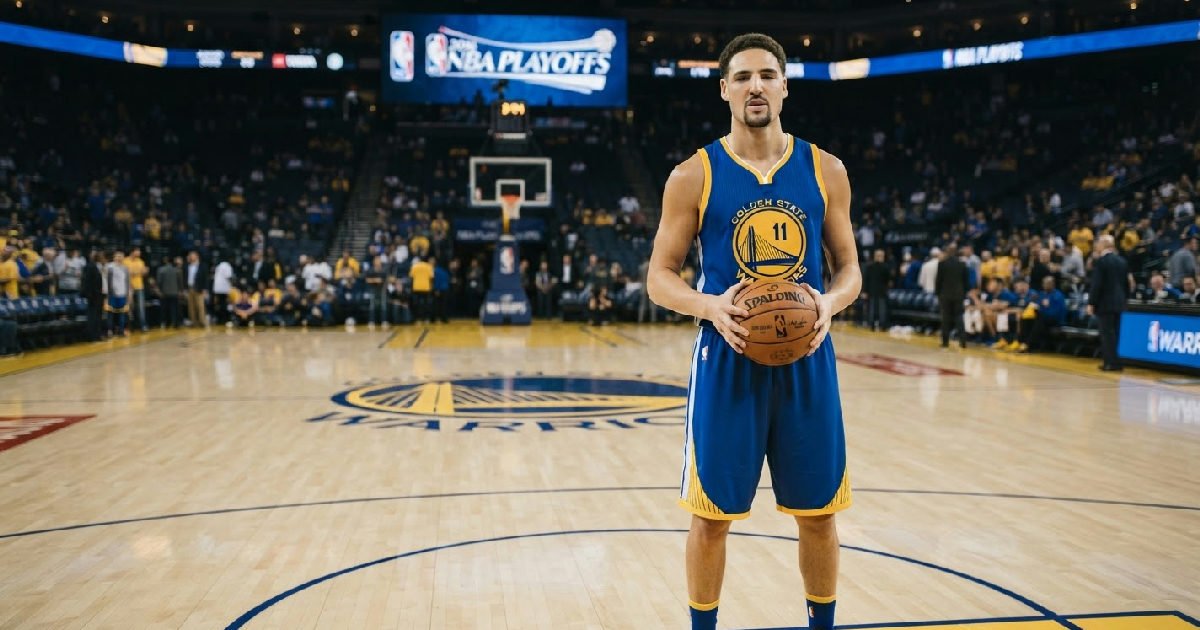
Klay Thompson asserts 2016 playoff scoring dominance in legacy defense
Golden State Warriors guard Klay Thompson recently ignited a social media firestorm, emphatically pushing back against fans who dared to rank legendary shooter Ray Allen above him. The four-time NBA champion didn’t mince words, pointing directly to his scoring prowess during the 2016 NBA Playoffs as irrefutable evidence of his individual greatness. Klay Thompson asserts his place among the greats.
The exchange, widely reported on August 21, 2026, stems from an ongoing online debate about Thompson’s historical standing, particularly given his role alongside other superstars throughout his career. His spirited defense highlights the fierce pride athletes take in their accomplishments and the often-contentious nature of comparing eras and individual contributions.
Klay Thompson asserts his legacy in online exchange
The controversy began when Thompson, known for his usually calm demeanor, engaged with critics on social media. Fans frequently attempt to downplay his impact, suggesting that his success was primarily due to playing alongside generational talents like Stephen Curry and, later, Kevin Durant.
It’s a debate that often parallels discussions about how artificial intelligence is changing various fields, prompting scrutiny of individual contributions versus systemic advantages, much like how miners pivot to AI infrastructure in the crypto world.
Thompson directly addressed these arguments after seeing fans consistently place other iconic shooters, including Ray Allen, higher on all-time lists. His response was immediate and unequivocal. “Holy st, I led the 2016 playoffs in points scored, you casuals,” Thompson posted, as captured in a screenshot shared by NBA Pass on X.
This abrasive retort quickly drew further pushback, with some pointing out that despite his statistical output, Thompson had always been part of a star-studded roster. Another fan countered that Thompson hadn’t “carried a team without another superstar by his side.” But the veteran sharpshooter had a ready answer, highlighting his contributions before Durant’s arrival.
“You do realize I was the 2nd leading scorer on two championship teams without KD? You want me to go to a bad team and put up empty stats? That’s easy, buddy,” Thompson fired back. This pointed comment underscores his belief that winning championships as a key contributor is more valuable than accumulating statistics on a losing team.
The 2016 playoff scoring showcase
Thompson’s assertion about his 2016 playoff performance isn’t just bravado; the numbers back him up. During that postseason run, he indeed outscored some of the league’s most prolific offensive talents, including his then-teammate Stephen Curry and Cleveland Cavaliers superstar LeBron James.
Thompson finished the 2016 NBA Playoffs with an astounding 582 total points. For context, LeBron James registered 552 points, Kyrie Irving had 530, Kevin Durant tallied 511, Russell Westbrook recorded 468, and Stephen Curry put up 452 points. Thompson’s ability to lead such an elite group in total scoring speaks volumes about his offensive capabilities.
Playing in all 24 playoff games, Thompson averaged 24.3 points, 3.7 rebounds, and 2.3 assists. These averages represented a significant bump from his regular-season numbers of 22.1 points, 3.8 rebounds, and 2.1 assists, demonstrating his capacity to elevate his game when it mattered most. He was also a one-time champion and a two-time All-Star by this point in his career.
His offensive explosion was particularly evident in specific series. Against the Portland Trail Blazers in 2016, Thompson averaged an impressive 31.0 points per game. Later, in the Western Conference Finals against the Oklahoma City Thunder, he maintained a high level of play, averaging 24.7 points, 4.4 rebounds, and 1.7 assists across seven grueling games.
Comparing two legendary shooters: Klay Thompson versus Ray Allen
The debate between Klay Thompson and Ray Allen often boils down to a comparison of their respective careers and impacts. While both are celebrated as two of the greatest three-point shooters in NBA history, their paths and roles within their teams differed significantly, fueling these passionate discussions among fans.
Statistically, Thompson holds an edge in career playoff scoring average, surpassing Allen by 3.1 points per game. Thompson has also amassed 283 more points than Allen in total NBA postseason scoring. However, Allen’s longevity and primary offensive role for much of his career paint a different picture in regular-season statistics.
Ray Allen, drafted in 1996, played 18 NBA regular seasons, averaging 18.9 points per game and accumulating 24,505 total points. Klay Thompson, drafted in 2011, has played 13 seasons so far, averaging 18.6 points per game and scoring 17,346 points. Allen’s longer career accounts for a substantial 7,159-point lead in total regular-season scoring.
When it comes to championships, Thompson currently boasts four NBA titles, all with the Golden State Warriors. Ray Allen, on the other hand, secured two championships during his illustrious career, one with the Boston Celtics and another with the Miami Heat. These team accolades are often a significant factor in how fans and analysts perceive a player’s overall legacy.
Beyond statistics: roles and team dynamics
Critics often highlight that Thompson’s individual statistics were shaped by the presence of a once-in-a-generation talent like Stephen Curry, who was in the midst of his second consecutive MVP campaign during the 2015-16 season. Curry averaged 30.1 points, 6.7 assists, 5.4 rebounds, and 2.1 steals, leading the league in both points and steals that year.
This gravitational pull often created open looks and favorable matchups for Thompson.
However, Thompson’s value extends far beyond just his scoring. His defensive prowess, particularly against some of the league’s elite forwards, has been a cornerstone of the Warriors’ dynasty. He frequently took on the challenge of guarding the opposing team’s best perimeter scorer, often sacrificing offensive opportunities to expend energy on the defensive end.
This dual threat was never more apparent than during the Golden State Warriors’ rivalry with the Cleveland Cavaliers in the mid-2010s. The two teams clashed in four consecutive NBA Finals from 2015 to 2018.
The intensity of these matchups, where every strategic decision mattered, often brings to mind the detailed planning seen in complex virtual environments, similar to how dynamic Kill Block maps shape outcomes in gaming.
The meticulous strategy required from players echoes the critical need for precise calculations, much like a pitcher’s control in baseball, where Ryan McMahon voices thumb injury concern after a key win, impacting his team’s strategic options.
Speaking on an August 14, 2026, Twitch livestream with PlaqueBoyMax, Thompson expressed immense respect for James. “We saw (LeBron James) for four straight Finals, and I haven’t seen anyone control the game as well as he does,” Thompson stated. “He can do everything on the court. There’s no weaknesses …
He was the toughest opponent I ever faced. No question.” This acknowledgment underscores the demanding two-way role Thompson often embraced.
Thompson is out to prove he can still contribute to a championship contender in the twilight of his own career.