

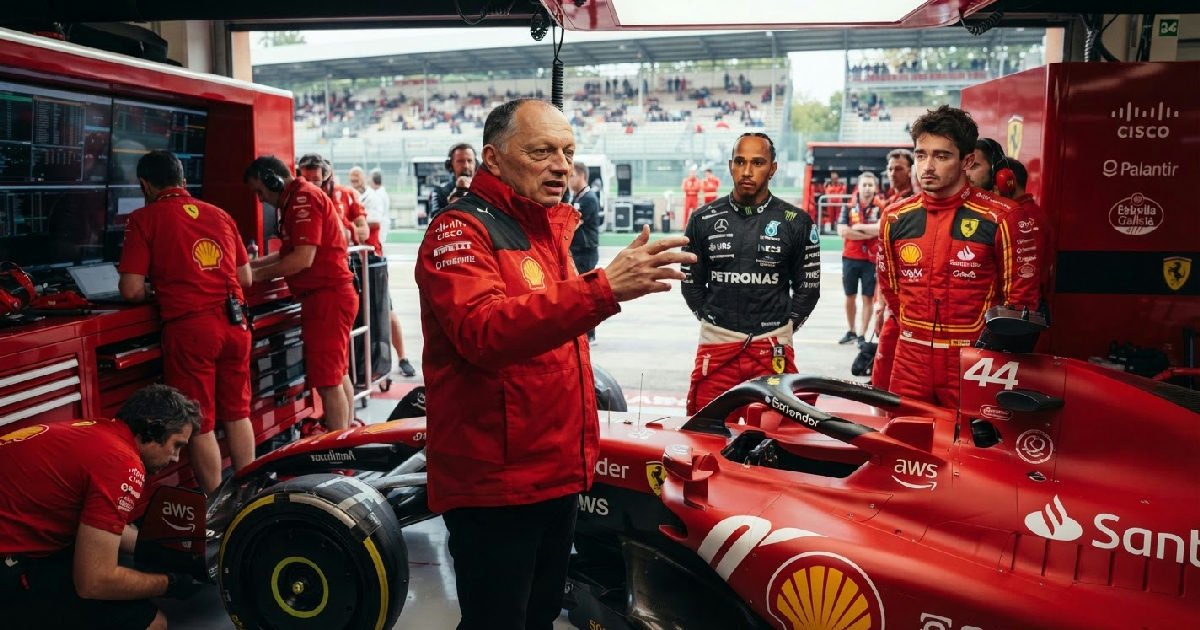
Fred Vasseur confirms Ferrari will aggressively
Ferrari will relentlessly pursue in-season car development until the final race of 2026, with Team Principal Fred Vasseur confirming the team will “push until the end” with its Formula 1 upgrades. Vasseur dismissed suggestions that the sport’s cost cap would force the Maranello-based squad to slow down its development push for drivers Lewis Hamilton and Charles Leclerc.
The declaration signals Ferrari’s aggressive intent to maximise its performance in a season where the championship fight is separated by the slimmest of margins. The team’s steady stream of updates to its SF-26 challenger has already paid dividends, securing its current second place in the Constructors’ Championship and delivering victories for both Hamilton and Leclerc.
Fred Vasseur confirms strategy and dismisses fears
Speaking in an exclusive interview, Fred Vasseur projected confidence in the team’s financial management and development pipeline. He stated unequivocally that Ferrari is not at risk of breaching the sport’s spending limits, a concern that has been voiced by rival teams who have pursued different development strategies throughout the year.
“The strategy is that we will continue to push until the end,” Vasseur explained. “We have a plan. We have no issue with the cost cap, we are following the plan and will continue like this.” This approach remains vital in a closely contested championship, where performance margins are often razor-thin.
He also highlighted the unpredictable nature of the Formula 1 season, noting that unexpected incidents can significantly impact a team’s budget within the cost cap framework. It’s difficult to anticipate the number of crashes that could occur until the end of the season, Vasseur noted.
A tale of two philosophies: Ferrari vs McLaren
Ferrari’s development approach contrasts sharply with some of its closest rivals, most notably McLaren. While the Woking-based team has opted to introduce large, consolidated upgrade packages every few races, Ferrari has chosen a path of smaller, more frequent incremental improvements introduced at nearly every grand prix weekend.
“You have McLaren coming each three or four races with a big package on the car, and we are more trying to bring upgrades each race but much smaller,” Vasseur noted. He insisted that despite the different timing, the overall expenditure over the season is comparable. “At the end, in terms of cost, it’s the same,” he added.
The team principal explained that Ferrari’s method aligns with its internal processes. Ferrari brings upgrades to almost every race, ensuring these new components fit with the team’s production and wind tunnel capacities, a strategy that is proving effective.
This continuous development helps maintain pressure on rivals and allows for steady validation of new parts, a key factor with the team under pressure to back a lead driver for the championship.
Anatomy of a contender: The SF-26 in detail
The subject of this intense development is the SF-26, the car Ferrari unveiled on January 23, 2026. The machine represented a significant philosophical shift for the team, particularly in its suspension design. The SF-26 features pushrod actuation on both the front and rear, moving away from the pullrod setup of its predecessor and aligning its design with rivals Red Bull and Mercedes.
This change was made to improve the car’s aerodynamic platform and handling characteristics. Another key feature visible on the 770 kg car is a significant channel in the lower bodywork around the diffuser. This design, similar to one seen on the Mercedes, is intended to better manage airflow to the car’s floor, generating more consistent downforce.
Powered by a 1.6-litre V6 turbocharged engine limited to 15,000 RPM, the SF-26 has proven to be a formidable package. As of the Dutch Grand Prix, the car has secured two Grand Prix victories—one for Lewis Hamilton in Barcelona and another for Charles Leclerc in Great Britain—along with a total of nine podium finishes in full grands prix.
Powering the push: Engine upgrades and the ADUO system
Ferrari’s aggressive strategy extends to its power unit. The team is leveraging the sport’s Additional Upgrades and Development Opportunities (ADUO) system, which grants extra development tokens to manufacturers proven to be lagging behind the benchmark engine supplier. Ferrari was granted two tokens after the first ADUO ranking deemed its power unit was over 4% behind Red Bull.
The first of these tokens was used for an upgrade at the Austrian Grand Prix in June. The second is scheduled to be deployed at the team’s home race in Monza this weekend. This update is expected to deliver a crucial performance boost, estimated to be around 15 horsepower, which could halve Ferrari’s straight-line speed deficit to the dominant Mercedes power unit.
These successive engine upgrades for the current season are part of a broader, methodical approach to closing the performance gap and exploiting every possible avenue for improvement within current regulations. This is distinct from Ferrari’s two-phase development strategy for its 2026 car, which includes an initial specification primarily for testing and validation.
For many teams, this has become a crucial 2026 season to prove their concepts before the next major rule change.
Implications for the 2026 title fight and beyond
Ferrari’s commitment to a full-season upgrade plan sends a clear message to the paddock: it is fully focused on the current championship battle. This stands in contrast to rivals like Mercedes, which has indicated limitations on its development budget for the current season beyond already planned upgrades, potentially shifting focus towards the 2027 project earlier.
The major regulation overhaul for 2027, which will require a complete redesign of the chassis, aerodynamics, and power unit, looms large over the entire grid. Teams must constantly balance the immediate need for performance against the long-term necessity of preparing for a new era of Formula 1. Ferrari, for now, is signaling that the 2026 fight is far from over.
By maintaining its development cadence, Ferrari not only aims to solidify its P2 position in the constructors’ standings but also keeps its championship hopes alive. The constant stream of new parts keeps pressure on Red Bull and McLaren, forcing them to react and potentially stretching their own resources as the season progresses towards its climax.