

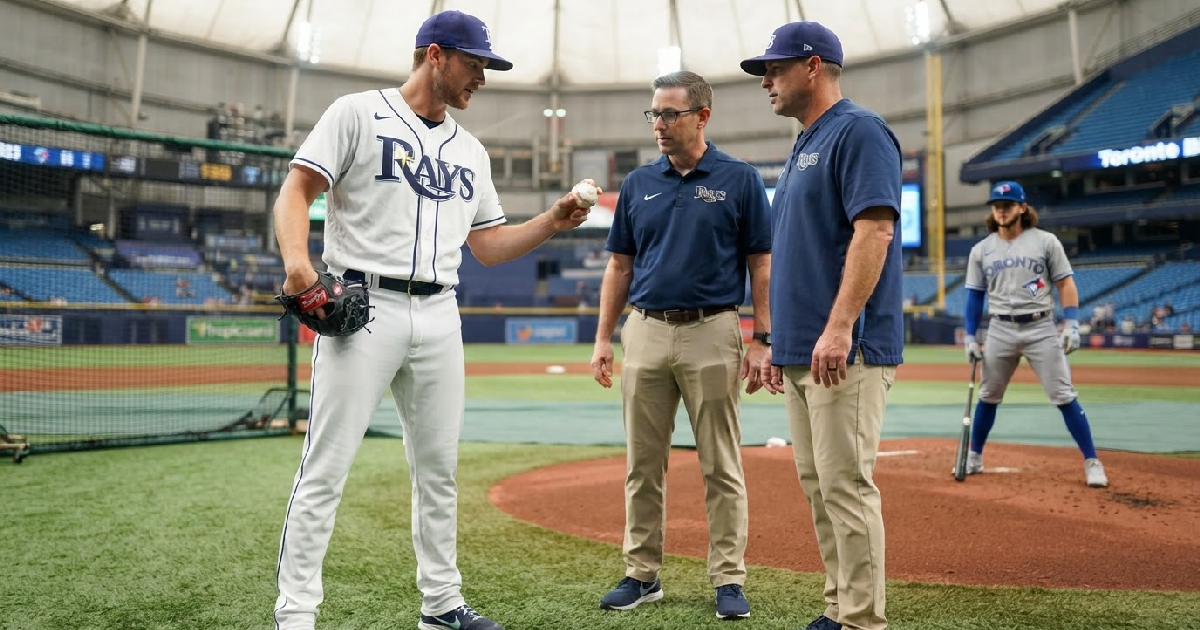
Drew Rasmussen Unveils Two-Seam Runner Pitch Fuelled by Bo Bichette
Tampa Bay Rays right-handed pitcher Drew Rasmussen, 30, has successfully developed a potent new two-seam runner pitch. This innovative addition to his arsenal came directly from his significant struggles against Toronto Blue Jays infielder Bo Bichette. The pitch saw crucial initial success against Bichette at Tropicana Field on September 24, 2022.
This strategic adjustment was made possible through close collaboration with Rays pitching coach Kyle Snyder and pitching director Winston Doom. Rasmussen candidly admitted he felt he had “nothing to get this guy out” when facing Bichette in 2022. The newly developed two-seam runner, which Statcast identifies as a sinker, now provides a critical weapon against tough hitters.
How Bo Bichette inspired the Drew Rasmussen two-seam
Rasmussen’s frustration with Bo Bichette’s hitting prowess reached a peak during the 2022 season. Bichette, a formidable right-handed batter, seemed to have an answer for every pitch Rasmussen threw. The Rays pitcher found himself without an effective inside pitch to challenge Bichette’s comfort zone.
Bichette’s career statistics against Rasmussen underscore the pitcher’s dilemma. Over 24 plate appearances, Bichette holds a .261 batting average, with 6 hits and 3 RBIs. A particularly telling moment occurred on August 2, 2022, when Bichette delivered a two-out RBI single off Rasmussen, contributing to the pitcher’s first loss at Tropicana Field in 18 career appearances.
Rasmussen’s existing repertoire, which included a four-seam fastball, gyro slider, sweeper, and curveball, was consistently being hit effectively by Bichette. This pattern left Rasmussen feeling vulnerable, especially in high-leverage situations. He recognized the urgent need for a new strategy to neutralize the Toronto star.
The birth of a new pitch
Faced with this challenge, Rasmussen approached the Tampa Bay Rays‘ coaching staff. He engaged in intensive discussions with Kyle Snyder, the team’s pitching coach, and Winston Doom, the pitching director. Their goal was to create a pitch that would effectively counter Bichette’s plate coverage.
The coaching staff meticulously analyzed Rasmussen’s pitching mechanics. They noted his naturally high arm slot and his propensity for supination, an outward forearm rotation during his delivery. These unique physical attributes suggested a potential for generating significant arm-side movement on a new pitch.
Collaboration and biomechanical insights
Through their collaborative efforts, the team explored how Rasmussen could manipulate seam orientation at release. The aim was to force the ball to break towards his arm side, a movement distinct from his existing pitches. This process began in 2022 and saw further refinement during Spring Training.
They discovered that Rasmussen could grip the new pitch similarly to his cutter. However, by subtly altering the seam orientation, they could harness air resistance to create an opposite break. This biomechanical precision allowed for the development of a seam-shifted pitch that appeared identical out of the hand but behaved differently.
The two-seam runner’s characteristics
The result of this focused development was a two-seam runner, which Statcast officially classifies as a sinker. This new offering boasts an average velocity of 95.6 mph, providing the crucial inside movement Rasmussen desperately needed. It has subtle arm-side run, effectively jamming right-handed hitters.
The ability to create this pitch, which shares a release point and wrist position with his cutter but moves in the opposite direction, offers Rasmussen a significant strategic advantage. It forces hitters to make split-second decisions based on subtle, late movement. This complexity adds another layer of deception to his already formidable repertoire.
Immediate impact and future arsenal integration
The effectiveness of Rasmussen’s new sinker was evident almost immediately. When he next faced Bichette on September 24, 2022, at Tropicana Field, the pitch proved to be a game-changer. Rasmussen used the newly developed sinker to induce a double play from Bichette early in the game.
Later in the same game, Rasmussen struck out Bichette looking on another inside sinker. These crucial moments provided tangible proof of concept for the new pitch. It transformed a hitter who previously had Rasmussen’s number into one he could confidently challenge.
A refined multi-fastball approach
The two-seam runner has since become an integral part of Rasmussen’s diversified six-pitch arsenal. This repertoire now includes a powerful 96 mph four-seam fastball, a sharp 90.4 mph cutter, and the new 95.6 mph sinker. He complements these with an 89.7 mph “kick” changeup, an 80.7 mph curveball, and an 85 mph sweeper.
Crucially, his three fastballs—the four-seamer, cutter, and two-seamer/sinker—now account for over 80% of his combined pitch usage. This strategic mix of pitches, all delivered at similar high velocities but with varying movements, creates immense difficulty for opposing batters. Hitters have mere milliseconds to identify and react to the subtle differences in trajectory.
This innovative approach aligns with modern pitching philosophies that prioritize velocity and varied movement profiles. By having multiple high-velocity options that move distinctively, Rasmussen gains a significant advantage. He can adapt his attack based on daily feel or hitter tendencies, maintaining effectiveness even if one pitch isn’t performing optimally.
Rasmussen’s ascendant career trajectory
Drew Thomas Rasmussen, born on July 27, 1995, in Puyallup, Washington, made his Major League Baseball debut with the Milwaukee Brewers on August 19, 2020. His career took a significant turn when he was traded to the Tampa Bay Rays in May 2021. The Rays’ reputation for pitch development proved to be a perfect fit.
Upon joining the Rays, Rasmussen primarily relied on his four-seam fastball and a hard slider. The team’s analytical approach and focus on optimizing each pitcher’s unique attributes led to a transformation of his repertoire. This continuous refinement has been a cornerstone of his recent success.
Sustained elite performance
Rasmussen’s commitment to evolving his game has translated into sustained elite performance on the mound. He earned American League All-Star selections in both the 2025 and 2026 seasons, a testament to his consistent dominance. These accolades highlight his emergence as one of the league’s premier right-handers.
Over the 2025-2026 campaigns, Rasmussen has posted an impressive 2.96 ERA and a 3.65 FIP across 249 1/3 innings.
His 2.77 ERA since 2021 ranks as the second-lowest in all of Major League Baseball among pitchers who have thrown at least 400 innings, a statistic placing him just behind two-way superstar Shohei Ohtani, who holds a 2.72 ERA over the same period.
These numbers are a clear indicator of the profound impact his strategic pitch development, spurred by challenges like Bo Bichette, has had on his overall game. His journey serves as a compelling example of how targeted innovation can redefine a player’s career.