

Bills stadium grass field fails, prompting swift replacement ahead of opener
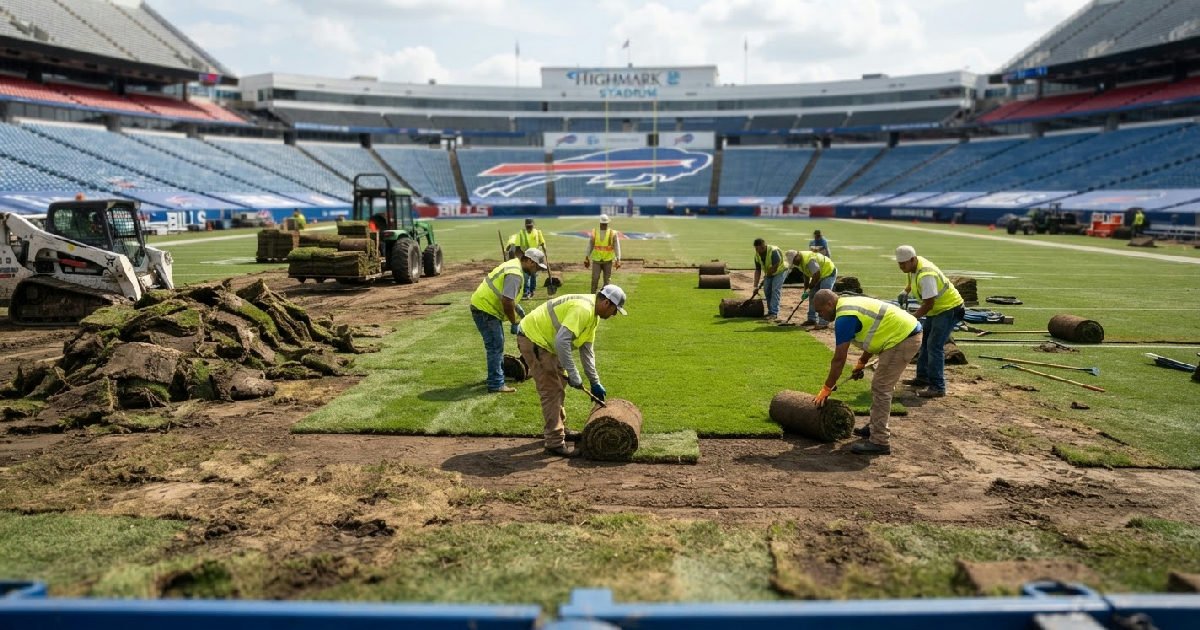
Orchard Park, NY – The Buffalo Bills have entirely replaced the natural grass playing surface at their new Highmark Stadium after just two preseason games. This abrupt decision follows significant issues with the field, which was initially installed in October 2025.
The field’s poor performance during August 2026 preseason play prompted widespread concern from both players and field experts. The swift action aims to ensure a safe and stable playing surface for the team’s regular-season home opener against the Detroit Lions on September 17, 2026.
Experts Decry Failed Bills Stadium Grass Field
Initial turf problems included grass separating, large damaged patches, and sod chunks coming loose. This led to a scramble by the organization to rectify the situation before competitive regular season games begin. Such rapid operational adjustments are not uncommon in professional sports when facing unexpected challenges.
The failure of the state-of-the-art stadium’s new grass field has drawn sharp criticism from industry veterans. Legendary groundskeeper George Toma didn’t mince words, stating, “That hurts me. That’s terrible to happen at all, but so soon? Somebody fell asleep.”
His comments underscore the rarity and severity of a field failing so quickly in a modern NFL facility. An unnamed “award-winning sports agronomist” with extensive experience across professional and collegiate sports surfaces called it “the worst sod I’ve seen in the NFL in my career.”
This expert, who requested anonymity due to fears of professional repercussions, expressed disbelief. He added, “I can’t even imagine how that could have happened.”
Tony Dick, a sports management professor at Baldwin Wallace University and former assistant head groundskeeper for the Cleveland Browns, echoed these sentiments. He watched film of the preseason games and concluded, “You cannot tell me that field was safer than the artificial turf they just left.”
Dick further emphasized the risk to star players like quarterback Josh Allen, stating, “I’m never putting Josh Allen on a field in that condition.” The consensus among these experts points to a significant failure in the initial field installation.
Key Voices on Bills Stadium Turf Issues
Several prominent individuals and entities have weighed in on the problems with the Buffalo Bills’ new grass field. Their diverse perspectives highlight the technical, operational, and player safety aspects of the turf’s premature failure.
- George Toma: Legendary groundskeeper.
- Tony Dick: Sports management professor at Baldwin Wallace University and former Cleveland Browns assistant head groundskeeper.
- Unnamed “award-winning sports agronomist”: Has extensive experience installing pro and college surfaces; requested anonymity.
- Buffalo Bills (via Tim Graham): Stated they consulted with the NFL and an independent expert.
- Aaron Ramella: Bills senior director of fields and grounds.
- Pete Guelli: Bills president of business operations.
- Unnamed Bills player: Described the field as “ass.”
- Joshua Palmer: Bills veteran wideout.
- Josh Allen: Bills Quarterback.
- Connor McGovern: Bills center.
- Expert with Cornell University: Stated that the move to resod the field is not unusual.
These commentators collectively paint a picture of a complex situation. It required immediate attention to uphold professional standards and player welfare.
Bills Defend Field Safety Amid Technical Glitches
Despite the widespread criticism, the Bills organization maintains that the field was deemed safe and playable by consultants. Pete Guelli, the Bills’ Chief Operating Officer and President of Business Operations, noted that both the NFL and an independent expert reviewed the surface during the preseason game against the Pittsburgh Steelers.
While acknowledging the issues, Guelli highlighted the proactive nature of the decision. “We are committed to providing our players with the best possible playing surface. With three consecutive home games to start the season, we felt this was the right time to replace the field,” he explained.
This comes after Guelli initially insisted the field was suitable and simply needed time to settle. Aaron Ramella, the Bills’ Senior Director of Fields and Grounds, provided technical insight into the turf’s failure.
He indicated the Kentucky bluegrass sod, sourced from Tuckahoe Turf Farms in New Jersey, “didn’t knit together as well as we hoped.” Ramella explained that while roots grew downward, they weren’t expanding laterally as expected, making the surface prone to tearing and chunks coming loose when players impacted the ground.
Strategic Decision to Re-Sod: A Calculated Risk
The decision to replace the entire field was not entirely unforeseen by the Bills, although the timing was quicker than anticipated. Ramella admitted, “We knew eventually we were going to have to replace the grass. It was a little bit sooner than we had hoped, but this isn’t a surprise for us.”
The original plan involved a “thinner cut” sod that would thicken over 10 months of maintenance. Guelli elaborated on the logistical considerations behind the rapid replacement.
He noted the team had multiple fields on reserve at Tuckahoe Turf Farms, anticipating regular changes throughout the year. The three-week window before the regular season opener, combined with three consecutive home games early in the season, made the timing critical.
Guelli framed it as an opportunity to “get ahead of it” rather than waiting for further deterioration. The replacement turf, also Kentucky bluegrass from Tuckahoe Turf Farms, is a “thicker cut” designed to provide immediate stability.
The hope is that this new sod, installed by September 4, 2026, will offer a much-improved playing experience for the team and its opponents. Ensuring robust playing surfaces is critical for player safety in contact sports, affecting athlete long-term welfare.
Player Safety Concerns and the Future of Natural Grass
The debate around natural grass versus artificial turf is perennial in professional sports, with player safety often at the forefront. While natural turf is often lauded as safer in ideal conditions, the Buffalo situation highlights the critical importance of proper installation and maintenance.
An unnamed Bills player reportedly described the initial field simply as “ass,” reflecting the on-field experience. Prominent players such as quarterback Josh Allen, veteran wideout Joshua Palmer, and center Connor McGovern would have been directly impacted by these substandard conditions.
Protecting these athletes from avoidable injuries is paramount, especially when multi-million dollar contracts are on the line. Poor field conditions can significantly affect player performance and career longevity.
Professor Dick, the former Browns groundskeeper, didn’t rule out a return to artificial turf for the Bills in the future. He predicted, “You might have artificial turf back in there within three years, just because it’s safer than whatever that was.”
This reflects a growing sentiment that poorly maintained natural grass can pose a greater threat than a well-engineered artificial surface. The league constantly weighs these trade-offs in stadium design and field management.
The Road Ahead for Highmark Stadium’s Field
The new sod faces its first major test in just 13 days, when the Bills host the Lions. The unnamed agronomist remains skeptical about its long-term viability, commenting, “They will have a difficult time.”
He added, “There’s so much going wrong, and there’s so little time. If that field makes it through the second game, I’ll be shocked.” This highlights the compressed timeline and the challenges of establishing a new field mid-season.
Aaron Ramella acknowledges the ongoing learning process for managing the new field. “Until we can get a full season of play on the field, we will continually be learning and correcting what we do to the field,” he stated.
This suggests that even with the new installation, ongoing adjustments and scrutiny will be necessary to maintain a high-quality surface. An expert with Cornell University, however, offered a more tempered view.
The Cornell expert noted that resodding a field is not an unusual occurrence in professional sports. While the Bills’ situation is notable for its early timing, it’s a relatively common operational adjustment for teams committed to natural grass.
Ultimately, the performance of “Sod 2.0” under the rigors of an NFL season will be the true measure of success for the Bills’ grounds crew. The outcome will be closely watched by teams across the league.