

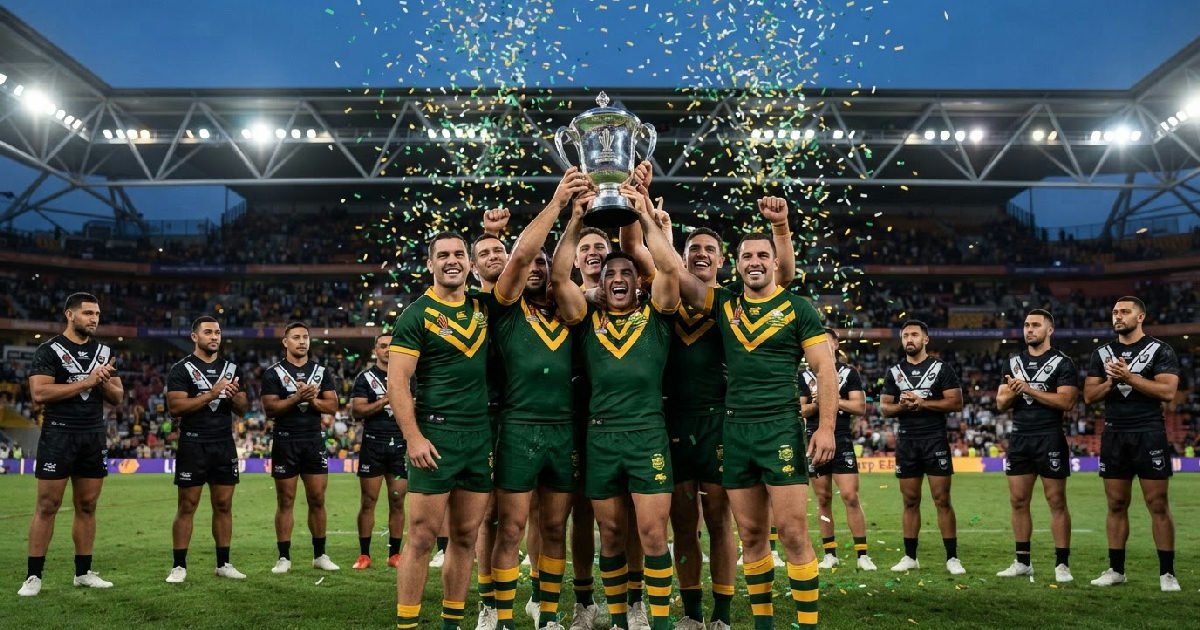
Australian Kangaroos defend title vs NZ
The Australian Kangaroos will defend their Men’s Rugby League World Cup title against the New Zealand Kiwis in the 2026 Final.
This highly anticipated showdown will unfold at Suncorp Stadium on Sunday, November 15, 2026, with kick-off scheduled for 2:35 PM +06 Brisbane time. The final pits two of rugby league’s fiercest rivals against each other in a battle for global supremacy, concluding the seventeenth staging of the sport’s premier international tournament.
Australian Kangaroos defend their path
Both nations have navigated a challenging path to reach the pinnacle event. Australia aims to assert its dominance on home turf, while New Zealand is driven by the ambition to secure its first victory over the Kangaroos on Australian soil since 2015. The match promises to be a thrilling encounter, not just for the fans packed into Suncorp Stadium, but for rugby league enthusiasts worldwide.
The 2026 Rugby League World Cup has been a journey of high stakes and intense competition. This edition, notably moved to 2026 after France withdrew as the original host, has seen Australia, Papua New Guinea, and New Zealand share hosting duties. Both finalists have demonstrated exceptional form throughout the tournament, overcoming strong challenges to earn their place in the final.
Australia’s route to the final included dominant performances against Samoa (44-12, 30-10), the Cook Islands (66-6), and Fiji (36-22). Their campaign wasn’t without its tight moments, however, as they narrowly edged out New Zealand 24-20 in a tense Round 1 encounter. That earlier match offers a tantalizing preview of the close contest expected in the final, indicating just how evenly matched these two powerhouses are.
Kiwis’ determined challenge for glory
New Zealand, under the guidance of Head Coach Stacey Jones, has displayed significant prowess, securing impressive wins against Tonga (34-10), Fiji (78-0), and the Cook Islands (82-16). While they suffered narrow defeats to Australia earlier in the tournament (22-24 and 14-16), these close margins suggest the Kiwis are more than capable of springing an upset.
Their journey reflects a team building momentum and cohesion, peaking at the right time for the ultimate challenge.
The Kiwis’ quest is not just about winning a World Cup; it’s about breaking a long-standing drought against their trans-Tasman rivals on Australian soil. Their performance in this final could signify a shift in the balance of power within international rugby league, adding an extra layer of narrative to an already compelling fixture.
Kangaroos’ formidable lineup unveiled
The Australian Kangaroos enter the final with a star-studded lineup, a testament to the depth of talent available to the reigning champions. Captained by Isaah Yeo at lock, the squad boasts a blend of experienced veterans and explosive young talent. Reece Walsh, a tournament standout with nine tries in six Test appearances, takes the fullback position, providing a dynamic attacking threat from the back.
On the wings, the Kangaroos feature lethal finishers in Jack Bostock, who marked his tournament with a Round 1 hat-trick, and Tom Trbojevic, who has amassed eight tries in just four World Cup games. The centres will be manned by Kotoni Staggs and Bradman Best, offering both power and agility.
The halves pairing of Cameron Munster at five-eighth and Tom Dearden at halfback promises creativity and strategic kicking.
Australia’s strength in the pack
The Kangaroos’ forward pack is equally imposing, built for both power and relentless defence. Patrick Carrigan and Tino Fa’asuamaleaui will start as props, providing grunt and go-forward, while Harry Grant takes the crucial hooking role. In the second row, Jacob Preston and Liam Martin offer work rate and attacking versatility.
The interchange bench, featuring Ethan Strange, Keaon Koloamatangi, and Cameron Murray, ensures sustained intensity throughout the eighty minutes. This depth is often a deciding factor in tight contests, allowing Australia to maintain pressure and adapt to game flow.
The collective strength of this Australian squad, combined with their recent track record, positions them as favorites. But they know too well that a World Cup final demands absolute perfection against an opponent as driven as New Zealand.
New Zealand’s determined challenge
The New Zealand Kiwis bring a powerful and cohesive unit to Suncorp Stadium, led by their influential captain, James Fisher-Harris, at prop. Kalyn Ponga starts at fullback, known for his elusive running and attacking flair. The wing positions are filled by Jamayne Isaako, the tournament’s top scorer with 84 points, and Ronaldo Mulitalo, both capable of breaking open a game with their speed.
In the centres, Dane Gagai and Casey McLean will provide a strong defensive line and attacking options. McLean has been a try-scoring machine himself, matching Tom Trbojevic with eight tries in the tournament. Kodi Nikorima at five-eighth and Jahrome Hughes at halfback form a creative and experienced halves combination, crucial for directing the Kiwis’ offence.
Kiwis’ formidable forward pack and key players
The Kiwis’ forward pack is built on strength and aggression, with James Fisher-Harris partnering Moses Leota in the front row. Jeremy Marshall-King will be at hooker, orchestrating play from the ruck. Isaiah Papali’i and Briton Nikora occupy the second-row spots, bringing strong carries and robust defence, while Joseph Tapine anchors the scrum at lock.
The interchange bench includes Te Maire Martin, Naufahu Whyte, and Erin Clark, providing crucial impact off the bench.
This New Zealand team, under Coach Stacey Jones, has shown a significant ability to perform under pressure, with key players like Jamayne Isaako consistently delivering points. Their resilience and collective spirit will be vital as they face the daunting task of overcoming Australia in front of a home crowd.
Match officials and the big stage atmosphere
Overseeing this colossal final will be a highly experienced team of match officials. Grant Atkins has been appointed as the referee, with Matt Noyen and Tyson Brough serving as touch judges. Wyatt Raymond will take on the critical role of Senior Review Official, ensuring all contentious decisions are reviewed with the utmost scrutiny.
The integrity of the officiating team is paramount in a match of this magnitude, where every call could have significant consequences.
Suncorp Stadium in Brisbane, a venue synonymous with classic rugby league encounters, is expected to provide an electric atmosphere. With ground conditions reported as good and fine weather forecast, all elements are in place for a spectacular display of skill and athleticism. The roar of the crowd, combined with the high stakes, will undoubtedly add to the tension and excitement of the final.
A wider sporting landscape
Major sporting spectacles generate immense revenue from ticketing, broadcasting rights, and sponsorships, influencing local economies and global sports markets. The sheer scale of the Rugby League World Cup Final is no exception, showcasing the expansive reach of such events. This dynamic financial ecosystem underpins the global appeal and accessibility of rugby league’s premier competition.
Official tickets for the final start from $39, making the spectacle accessible to a wide range of fans eager to witness history at Suncorp Stadium. Broadcasters like Digicel will carry the match live, ensuring millions globally can tune in. Live streaming options further enhance the event’s reach, allowing rugby league enthusiasts worldwide to follow the action.
Beyond the Rugby League World Cup, the day also features other significant rugby events, such as the Rugby Union Nations Championship. Scotland is set to face Australia in rugby union at Murrayfield Stadium in Edinburgh, kicking off at 3:10 PM GMT. This dual presence of major rugby codes underscores the sport’s widespread global presence and fervent following on November 15, 2026.
Historical rivalry and what’s at stake
The rivalry between Australia and New Zealand in rugby league is one of the sport’s most enduring and passionate. Matches between the Kangaroos and Kiwis are always fiercely contested, characterized by brutal physicality, tactical brilliance, and moments of individual magic. This history adds significant weight to the World Cup Final, making it more than just a game; it’s another chapter in a storied sporting rivalry.
For Australia, winning means cementing their status as the undisputed giants of international rugby league, adding another trophy to their already impressive cabinet and defending their crown on home soil. It would be a testament to their sustained excellence and the strength of their domestic competition. The pride of wearing the green and gold, and the expectation of a nation, weigh heavily on the Kangaroos.
Kiwis chasing a historic upset
For New Zealand, a victory would be monumental. While the Kiwis famously defeated Australia in the 2008 Rugby League World Cup final held in Brisbane, they are still keenly seeking their first victory over the Kangaroos on Australian soil since 2015.
More broadly, it would underscore their ascension as a consistent threat at the highest level, challenging Australia’s long-held dominance.
The competitive pressures are undeniably high in such a final, and a World Cup title would be a defining moment for this generation of Kiwis, etching their names into the annals of New Zealand rugby league history.
The implications extend beyond the immediate bragging rights. The winner will carry immense momentum into future international competitions, while the loser will face a period of reflection and rebuilding. Ultimately, the 2026 Rugby League World Cup Final is set to deliver an unforgettable spectacle, a true battle between two titans of the sport vying for the ultimate prize.