

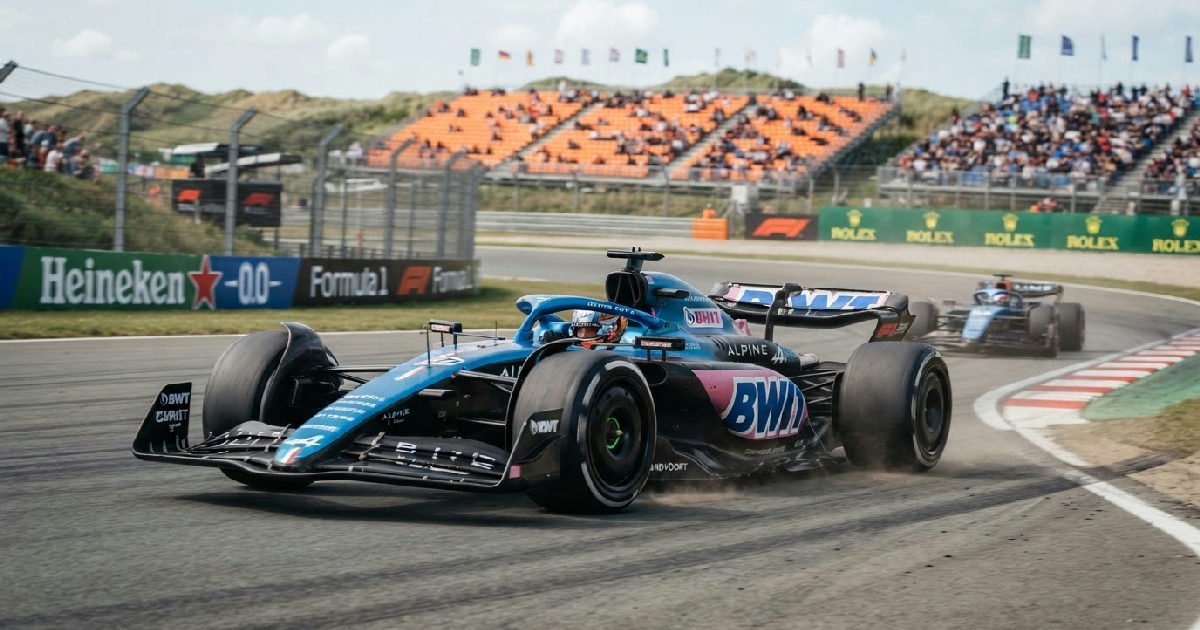
Pierre Gasly praises Alpine’s Zandvoort F1 upgrade as a ‘big jump forward’
Alpine driver Pierre Gasly has lauded the team’s new Formula 1 upgrade package as a “big jump forward” after a strong showing in sprint qualifying for the Dutch Grand Prix. The Frenchman secured eighth place on the grid at Zandvoort, positioning himself as the ‘best of the rest’ behind the sport’s top teams.
The performance boost stems from a significant update to the A526 car, which Alpine fast-tracked for the recent Zandvoort event. Only Gasly’s car received the new parts due to a strategic decision. This left teammate Franco Colapinto to qualify in 13th with the older specification.
Gasly hails immediate impact from the Alpine F1 upgrade
The positive results were immediately apparent to Pierre Gasly from inside the cockpit. He reported a much-improved feeling and responsiveness from the car, which directly translated into faster lap times around the challenging Zandvoort circuit. His strong performance meant he out-qualified a Red Bull, alongside Alpine’s direct midfield rivals, Racing Bulls and Audi.
“It’s definitely positive. The feeling inside the car is a lot better,” Gasly told reporters after the session. “The upgrade reacts to what I was trying to do with my driving inside the cockpit. It’s only been two sessions, so a lot to understand.”
This improved connection between driver input and car behaviour is exactly what engineers aim for when introducing new components. Gasly’s newfound ability to place the car with more confidence allowed him to extract maximum performance. This is a promising sign for the upcoming races.
“But in terms of performance signs, it’s definitely a big jump forward which is positive and hopefully we can build on that,” he added. “I’m hoping we can translate that into good points for the weekend.” Gasly acknowledged that further improvements are still needed, but overall, it’s a solid step.
A difficult but necessary split strategy
While one side of the Alpine garage celebrated a clear step in performance, the other experienced a mix of frustration and optimism. Teammate Franco Colapinto pushed his older-spec A526 to its limit, but could only manage 13th place. This starkly illustrated the effectiveness of the new upgrade.
“It was a good lap but it is quite frustrating when you are so far away of your team-mate,” Colapinto admitted. The decision to provide the upgrade to only one driver is a common but tough scenario in F1. It often arises from intense pressure to manufacture and deliver performance-enhancing parts quickly.
It also gives the team a direct A/B test, allowing engineers to compare data from both the new and old specifications on the same track. This analysis relies on extensive computing power to process telemetry and run simulations. This critical area is continuously developed by F1 teams seeking a competitive edge. The team’s young driver, Franco Colapinto, continues to push hard despite the challenges.
Despite his personal disadvantage for the weekend, Colapinto quickly saw the bigger picture for the team. He noted the Alpine F1 upgrade had allowed the team to leapfrog its main competitors once again. “The good part is that Pierre is ahead of them, so the upgrade made us jump them again, which is really, really positive for the future,” he said.
The relentless midfield development war
Colapinto’s comments highlight the brutal reality of Formula 1’s midfield battle in the 2026 season. The gap between teams like Alpine, Racing Bulls, and Audi is often measured in mere hundredths of a second. A single, well-executed upgrade package can entirely reshuffle the competitive pecking order from one race to the next.
Bringing these updates to the track represents a costly and relentless development war. Teams pour millions into research, wind tunnel testing, and manufacturing throughout the season. Each new component must justify its significant expense by delivering tangible performance improvements on the stopwatch.
Funding this constant innovation is a major challenge for every team. They rely on a complex portfolio of revenue streams, including prize money, owner investment, and high-profile commercial sponsorships. Securing consistent backing remains crucial in the high-stakes world of Formula 1.
For Alpine, this Zandvoort upgrade is a critical victory in that ongoing battle. It validates their development direction and provides a much-needed performance injection as the season progresses. The key now is ensuring these parts can be manufactured quickly enough for Colapinto to benefit in upcoming races. The competition demands continuous improvement.
Long-term lessons for the 2026 regulation reset
While the immediate goal is securing points this weekend, the success of this upgrade carries significant long-term implications for Alpine. Every lesson learned about the current car’s aerodynamic philosophy and performance provides invaluable data. This data is crucial for the monumental challenge ahead: the 2026 Formula 1 regulation overhaul.
The 2026 season will introduce cars and power units radically different from the current generation. Regulations mandate a shift to 100% sustainable fuels and a rebalanced power unit configuration. The complex MGU-H component will be removed, and electrical output will dramatically increase to 350kW.
This regulatory reset presents a huge opportunity for a midfield team like Alpine to make a significant leap toward the front of the grid. Successfully designing, validating, and deploying upgrades, like the one seen at Zandvoort, builds confidence. It also refines crucial processes vital for the 2026 project.
Driver feedback and extensive simulator work remain central to this process. Teams continuously refine these sophisticated technological tools to gain every possible advantage. The development war continues as other teams, like Ferrari and McLaren, are also unleashing Zandvoort upgrades.
The Zandvoort test
The Circuit Zandvoort, with its high-speed, banked corners and demanding changes of direction, is a stern test of a car’s aerodynamic platform. The fact that the A526’s new parts performed well here is a strong indicator that the aerodynamic concept is sound. It particularly shows effective downforce generation.
Outlook: converting promise into points
Gasly’s positive assessment provides a significant morale boost for the team. However, the job is far from over, as he himself noted. The team still needs to refine its understanding of the new package. They must also convert the strong one-lap pace into sustained performance over a full race distance.
“We still need to look for more, it’s not perfect but overall, definitely a good step,” Gasly cautioned. The focus now shifts intently to the sprint race and Sunday’s main Grand Prix. The team will be closely monitoring tyre degradation and overall race pace. They need to see if the Alpine F1 upgrade delivers consistently under pressure.
For Alpine, this weekend in the Dutch dunes represents more than just another race. It’s a validation of their hard work back at the factory in Enstone and a clear sign that they are on the right path. It’s a “big jump,” but in the relentless world of Formula 1, the moment you stop pushing forward, you get left behind.