

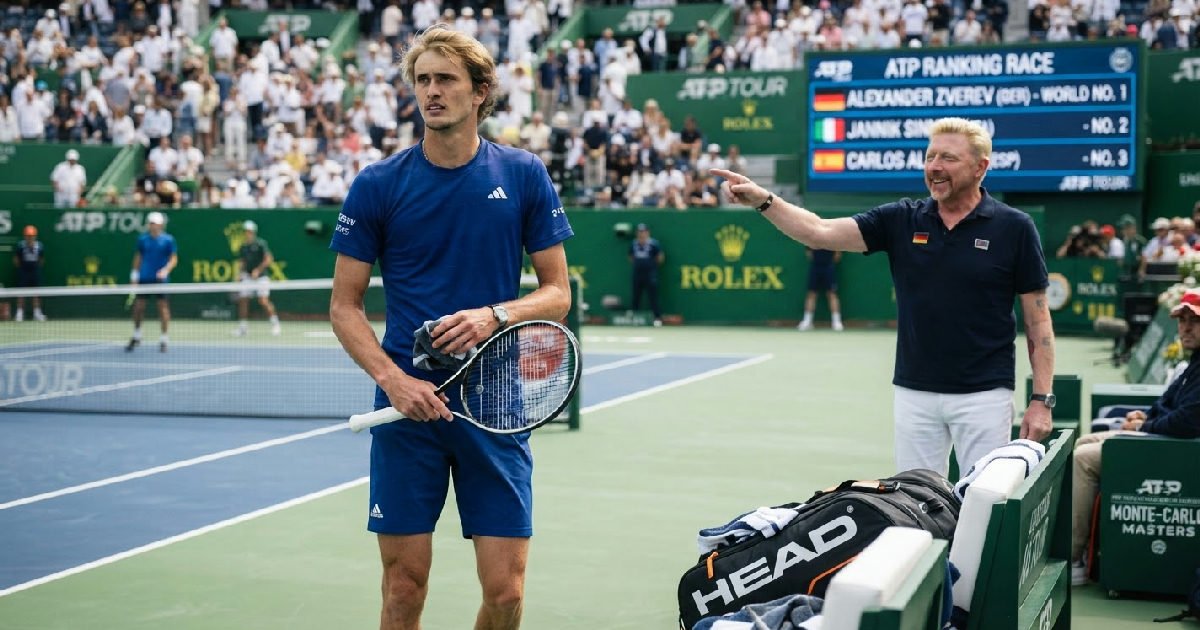
Alexander Zverev world number one, boris Becker sets date for German star
The narrow path to Alexander Zverev world number one ranking
Alexander Zverev currently holds the world number two spot in the ATP rankings, but the difference between him and the top player, Jannik Sinner, remains significant at 1,810 points following the US Open.
However, the actual race for the year-end ranking is far tighter, which is what gives tennis legend Boris Becker confidence in his prediction.
The standard ATP ranking is a rolling 52-week calculation, but the “Race to the ATP Finals” tracks points earned only during the 2026 season.
Zverev is currently leading Sinner in the Race, a key metric indicating that the German is on course to end the year as the world number one.
This difference in points tracking is critical because Sinner, despite his lead in the overall rankings, still has a substantial 2,550 points to defend through the end of the calendar year.
In contrast, Zverev only has 1,080 points to defend until the 2027 season begins, giving him a much clearer path to climb the official standings in the coming months.
It’s this discrepancy in required defense points that provides the concrete statistical backing for Becker’s optimistic forecast.
Becker’s updated timeframe and the Turin calculation
Six-time major champion Boris Becker believes Alexander Zverev has the momentum and schedule necessary to dethrone Sinner sooner than expected, specifically predicting the German will take the top spot before the ATP Finals in Turin.
Becker shared his confidence on social media platform X, writing, “Think Sascha is going to take it by the time Turin comes along…”
This prediction highlights the urgency of the autumn Asian Swing and indoor European tournaments, where Zverev can maximize his gain while Sinner faces the pressure of defending significant points.
The prediction contrasts sharply with earlier comments made by Becker in June 2024, following Zverev’s first Grand Slam victory at Roland Garros.
At that time, Becker had suggested Zverev, who turned 29 around that period, had the potential to achieve world number one but would need “the next two or three years” to realize that goal.
Zverev’s rapid accumulation of major titles in 2026—winning both Roland Garros and the US Open—has clearly accelerated Becker’s timeline, forcing a major revision of the forecast.
The impact of Sinner’s injury and absence
Jannik Sinner’s withdrawal from the US Open due to a right knee injury proved costly, giving Zverev the opportunity to seize the title and close the overall points gap.
While injuries are an unfortunate part of the sport, they create significant opportunities for competitors, particularly in a high-stakes delay such as Sinner’s absence.
Sinner’s expected return to competitive action remains a major variable in the final standings, especially considering his upcoming defense duties.
The Italian star, who holds a commanding position in the overall rankings, was notably dumped out of the French Open early this year, showing that even the best players are vulnerable when carrying issues.
Becker had previously noted that when Sinner missed action earlier this year, “no one knows how or when he’ll return” to peak form, introducing uncertainty into the rankings battle.
Zverev’s immediate schedule and looming rematches
With the Grand Slam season concluded, Alexander Zverev’s focus immediately shifts to the remaining ATP 500 and 1000 tournaments, beginning with the Asian swing.
His first major test after his triumph in New York will be at the China Open in Beijing, an ATP 500 event.
Crucially, Jannik Sinner is also entered into the China Open draw, marking a potential return to competition for the Italian as the defending champion.
Should Sinner be fit enough to compete, the Beijing tournament offers the first direct confrontation between the world’s top two players since Zverev began his late-season surge.
Zverev is also scheduled to participate in the Shanghai Masters, another critical ATP 1000 event that offers substantial ranking points.
Before these major tournaments, Zverev is scheduled for two team competitions: Germany’s Davis Cup Qualifier tie against Croatia in Halle, followed by representing Team Europe at the Laver Cup in London.
These events, while not offering ATP ranking points, are essential for maintaining match sharpness and confidence heading into the final months of the season.
Scrutiny over time violations and shot clock
Zverev’s dominant performance at the US Open was slightly overshadowed by renewed scrutiny regarding his tendency to take excessive time before serving.
Opponents and commentators noted that he frequently pushed the limits of the shot clock, particularly concerning his habit of bouncing the ball repeatedly.
This behavior is frustrating for opponents and spectators alike, and there have been calls for umpires to enforce the shot clock rules more strictly in future tournaments, reducing any potential advantage Zverev gains.
The persistent issue surrounding his slow service routine suggests that this aspect of his game might be one area where officials will focus renewed scrutiny in the coming weeks.
Establishing the new Big Three dynamic in tennis
Zverev’s exceptional season, now boasting two Grand Slam titles, solidifies his position alongside Jannik Sinner and Carlos Alcaraz as the sport’s dominant trinity.
The emergence of these three players, all under 30, signals a decisive shift in the men’s game, moving past the dominance of the previous generation.
Becker himself identified this shift following Zverev’s Roland Garros win, calling the German one of the new “Big Three” in men’s tennis.
The constant pressure and injury absences of both Sinner and Alcaraz have allowed Zverev to demonstrate a remarkable level of consistency across surfaces in 2026.
His ability to perform at the highest level while others struggle with fitness issues is proving to be his most valuable asset this year.
Despite his recent successes, some pundits still harbor reservations about Zverev’s ability to consistently defeat a fully fit Sinner or Alcaraz in a best-of-five set match, pointing to prior head-to-head records.
However, Zverev’s game has demonstrably evolved, showing increased confidence and consistency that allows him to capitalize decisively when his rivals falter.
Consistency versus peak performance debates
Becker’s belief in Zverev stems from recognizing his consistent strong play, noting that Zverev has been “playing consistently well for many months.”
While peak performance from Sinner or Alcaraz might still be untouchable, Zverev is proving that consistent high-level play over a full season is the guaranteed route to the world number one ranking.
The current ATP ranking system rewards consistency over spectacular flashes, ensuring that players who show up deep into every major tournament eventually climb to the top.
This is a stark departure from the criticism Becker leveled at Zverev in October 2025, when the German legend expressed worry that Zverev was “no longer the third force in tennis.”
Zverev has soundly answered those critics with his 2026 run, utilizing his powerful serve and improved baseline game to overwhelm rivals.
The pivotal race toward the ATP Finals
The final weeks of the season will be intensely focused on the battle between Zverev and Sinner for the year-end top spot, culminating at the ATP Finals in Turin.
The financial and historical prestige of ending the year as world number one is immense, and Zverev has never achieved this feat.
To realize this dream and validate Becker’s prediction, Zverev needs to maintain his exceptional run through Beijing, Shanghai, and the various indoor European hard-court events.
The pressure is now squarely on Sinner to return healthy and replicate his form from the first half of the year, which gave him his current points buffer.
If Sinner’s right knee injury causes him to miss substantial parts of the Asian swing or hinders his performance, the shift to Zverev at number one is almost inevitable before Turin.
For Zverev, the goal is simple: win points and avoid any major setbacks, securing the top ranking that many, including his compatriot Boris Becker, now firmly believe he deserves.
Analyzing the historical context of Becker’s forecasts
Boris Becker’s predictions, while often insightful, have historically been mixed regarding his assessment of Alexander Zverev’s career trajectory.
In November 2021, Becker predicted Zverev would achieve the world number one ranking in 2022, a forecast that ultimately proved premature.
Zverev’s progress was subsequently hampered by injuries and off-court issues, preventing him from immediately fulfilling that potential.
The earlier advice Becker offered to Zverev—to “Win everything you can, because at some point, your time will be up”—suggests a pragmatic coach’s view on maximizing a player’s peak years.
Now, however, the German star has demonstrated a sustained period of success unmatched by his previous efforts, lending credibility to Becker’s latest and more aggressive timeline.
This year’s results confirm Zverev is finally fulfilling the promise that had been attached to his name since his early 20s.
The current situation, where the current world number one faces a high-stakes delay due to injury while Zverev is surging, makes this perhaps the most opportune moment for Becker’s forecast to materialize.
It’s clear that while the overall ranking point deficit still favors Jannik Sinner, the momentum and mathematical factors involved in the year-end race are now heavily weighted toward Zverev.
For tennis fans, the conclusion of the 2026 season promises to be a thrilling statistical and physical duel for the sport’s ultimate individual prize.