

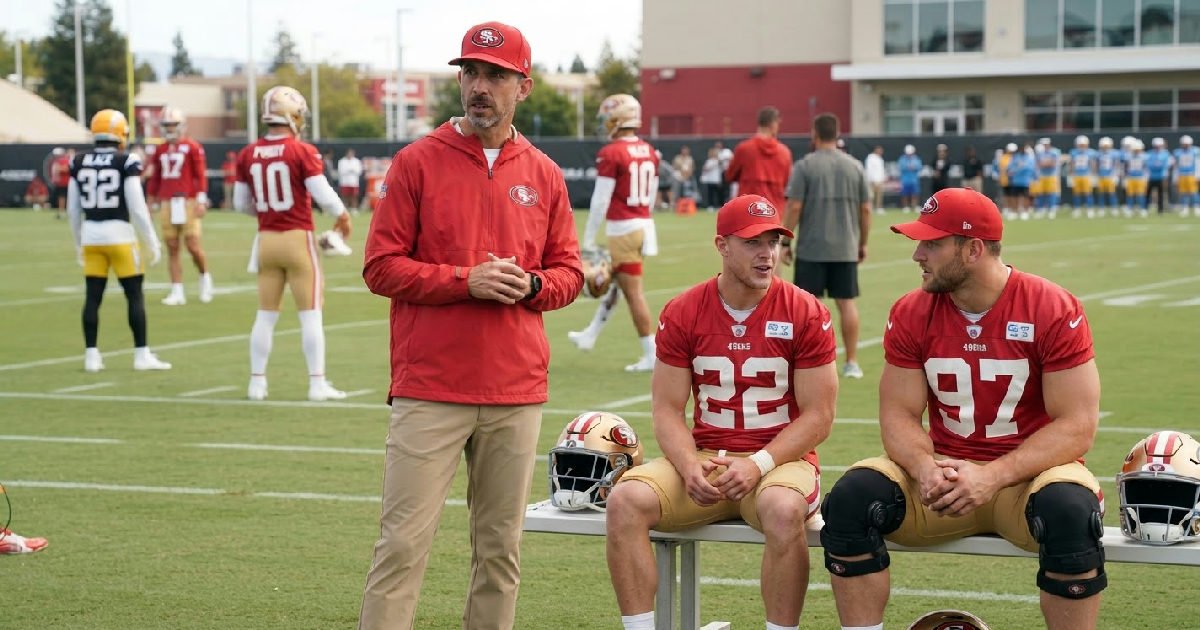
San Francisco 49ers manage growing 49ers injury concerns with cautious approach to Christian McCaffrey and Nick Bosa
A mounting toll of 49ers injury concerns rocks training camp
The San Francisco 49ers organization is once again facing significant 49ers injury concerns during their 2026 training camp, prompting fans and media to urge the team to “put everyone in bubble wrap.” This wave of ailments, impacting star players like running back Christian McCaffrey and defensive end Nick Bosa, has shifted the focus from preparation to player management, forcing coach Kyle Shanahan to prioritize caution.
The team’s cautious approach became evident during the joint practice with the Los Angeles Chargers on August 18, where several key players were either held out or removed early, highlighting the fragility of a roster built for a championship run. The accumulating injuries revive unwelcome memories of the team’s 2024 season, which was derailed by an unprecedented number of physical setbacks.
Management opts for extreme caution with key veterans
The team is making headlines not just for the injuries themselves, but for their highly conservative handling of veterans, particularly Christian McCaffrey and wide receiver Mike Evans. McCaffrey missed practice due to what the team described only as “tightness,” sparking initial speculation of a ‘hold-in’ which the 49ers quickly dismissed.
Head Coach Kyle Shanahan confirmed that McCaffrey, who turns 30 this year and tallied a league-high 413 touches in the 2025 season, would have practiced if it were a game week. Shanahan is specifically concerned about the running back trying to play through minor tightness and risking a major injury.
McCaffrey was seen working out separately before the joint scrimmage and will be held out of Thursday’s preseason game in Los Angeles.
Meanwhile, veteran wide receiver Mike Evans exited the August 18 practice early after suffering tightness in his left quad, the same injury that kept him out for 12 days earlier in camp. Shanahan played down the incident, assuring reporters that the removal was purely precautionary.
Evans had connected with quarterback Brock Purdy on a successful 20-yard pass play against Chargers cornerback M.J. Mickens shortly before his removal.
Nick Bosa’s prolonged absence due to knee tendinitis
Defensive end Nick Bosa, who suffered a devastating ACL tear last season, is another marquee name being handled with extreme care. Bosa hasn’t practiced with the team since August 3, 2026, due to ongoing tendinitis in his surgically repaired knee.
Shanahan classified the two-time Pro Bowl defensive end as week-to-week as of August 11, emphasizing that there is “no concern” about a major setback. The team is simply waiting for the soreness and inflammation to subside completely before letting Bosa return to full activity.
Rookie Kaelon Black offers a silver lining at running back
Amid the worries surrounding McCaffrey’s workload and fragility, rookie running back Kaelon Black is rapidly cementing his place in the backfield rotation. Black, a third-round pick, delivered a standout performance in the joint practice against the Chargers, providing a much-needed morale boost for the offense.
Black had been sidelined for the previous two weeks with an adductor injury but showed no signs of rust upon his return. His highlight was an explosive 50-yard carry to the left early in the session, demonstrating the violence and strength the coaching staff was looking for. He also made a crucial catch at the goal line during a red zone drill, showcasing his versatility.
Black’s quick recovery and dynamic play are timely. If McCaffrey’s ‘tightness’ situation requires the veteran to be load-managed early in the season, Black appears ready to step into a significant role. His performance offers the 49ers a reliable option for protecting their star runner’s 30-year-old body from excessive wear and tear.
Historical parallels and the mounting injury metrics
The current situation is particularly alarming given the 49ers’ recent history of injuries. The team’s 2024 season was catastrophic, with San Francisco finishing as the most injured team in the NFL according to Adjusted Games Lost (AGL) metrics. That year, they ranked 31st in offensive AGL and 30th in defensive AGL.
The high AGL figures in 2024 included a staggering 32.2 AGL at the running back position, ranking second all-time. This disastrous campaign followed a 2023 season where the 49ers won the NFC and finished fourth in fewest AGL, demonstrating the dramatic impact health can have on the team’s title aspirations.
The unsettling ‘substation theory’ gains traction
The unrelenting cycle of injuries has even given rise to a bizarre, unsubstantiated rumor circulating among fans: the “substation theory.” This speculation suggests that the team’s practice facility, which shares a property line with an electrical substation, is responsible for the extensive and chronic injury problems.
While devoid of scientific basis, the theory’s popularity reflects the deep frustration and search for an explanation for why the 49ers consistently seem to struggle with player health.
The sheer volume of absences, including 18 players off the field at one point in early August, lends credence to the idea that something external might be at play, despite the more logical explanations of intense training and high-volume usage of key players.
Head Coach Kyle Shanahan’s health and the leadership gap
Adding to the organizational anxiety is the fact that Head Coach Kyle Shanahan has been largely absent from running training camp due to his own severe injuries. Shanahan suffered a severe concussion and required 40 stitches to his face following a car accident on July 14, 2026, when his Tesla was on autopilot.
Shanahan admitted he was reaching for his phone in the back seat at the time of the accident, accepting full responsibility and stating that taking your eyes off the road is always “your fault.” He is still experiencing symptoms like headaches and fatigue, but expects to be at 100% health eventually.
In Shanahan’s absence, the team has relied on a shared leadership structure involving assistant coach Chris Foerster, offensive coordinator Klay Kubiak, and defensive coordinator Raheem Morris. While the staff has experience, the head coach’s physical distance during a critical period of roster shaping has been a quiet source of concern for the team attempting to meet their championship expectations.
Quarterback evaluation and the Mac Jones trade
The joint practice also provided more fodder for the ongoing quarterback discussion behind starter Brock Purdy. Purdy himself acknowledged the team’s struggles during the August 18 session, saying he didn’t think it was their “best day” after a two-minute drill stalled out near the red zone.
While Purdy’s status remains unchallenged, the emergence of Kurtis Rourke has significantly altered the dynamic for backup Mac Jones. Rourke’s impressive debut has reportedly given the 49ers a new level of confidence in their quarterback depth that they didn’t possess earlier this year.
Jones, who is in the final year of his contract, was a potential trade piece in the offseason, but his market was quiet. Now, Rourke’s promise, combined with the inevitability of quarterback injuries across the league, could motivate the 49ers to deal Jones mid-season.
The 49ers could potentially secure a high-end 2027 draft pick for Jones, who is almost certain to sign elsewhere in free agency next March. Rourke’s performance makes the possibility of trading Jones a viable strategy, allowing the team to recoup assets without sacrificing a competent backup behind Purdy.
Defining the balance for the 2026 season
The key challenge for the San Francisco 49ers for the remainder of the preseason lies in defining the balance between caution and preparation. While veteran starters like McCaffrey and Bosa need to be protected, the team must also ensure the first-string units develop the necessary cohesion and rhythm for a challenging opening schedule.
The team’s core identity, built on aggressive defense and a high-volume rushing attack, puts an inherently high physical toll on its stars. Managing the roster through this lens means acknowledging the increasing age of key players and implementing load management far sooner than they would have in previous years.
If the 49ers can successfully navigate the next few weeks without any major setbacks, the strategy of excessive caution will be vindicated. But the constant cycle of soft tissue injuries, compounded by the absence of their head coach, means the entire organization is walking a tightrope heading into the 2026 campaign.
Ultimately, the 49ers’ championship hopes hinge on avoiding a repeat of 2024’s injury disaster. The current training camp philosophy—treating every veteran like they are wrapped in protective material—suggests they’ve learned a painful lesson about prioritizing long-term health over short-term practice reps.