

World Cup Betting Tax Rules Favor Prediction Markets Over Sportsbooks Amid Regulatory Gaps
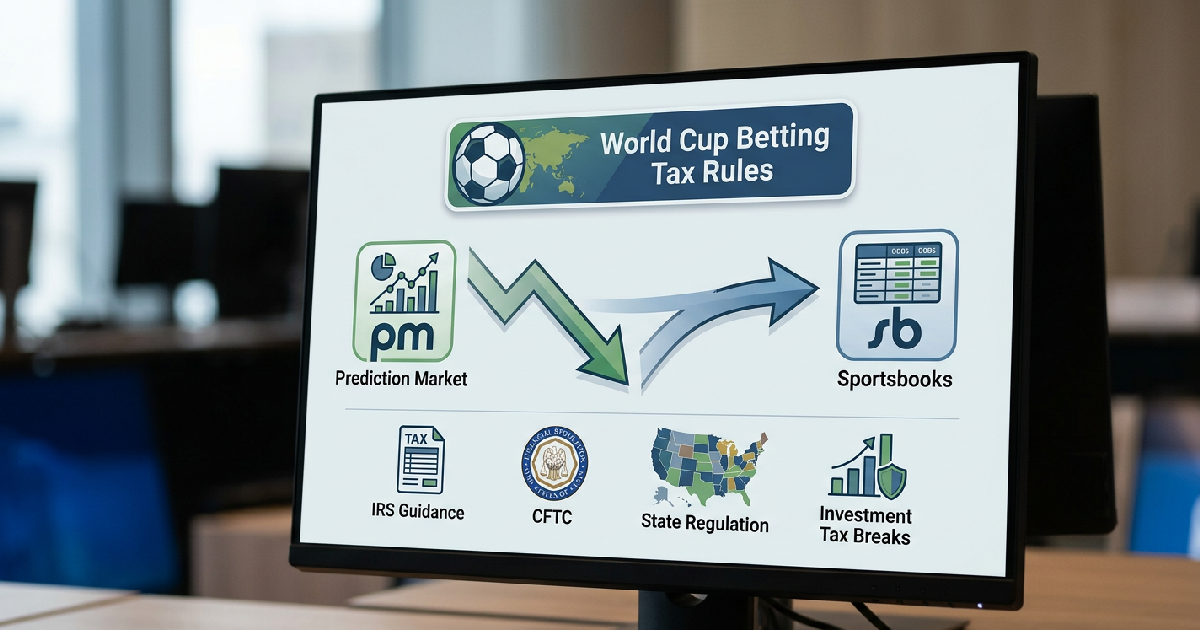
Americans placing wagers on the 2026 FIFA World Cup through prediction markets may face a lighter tax burden than those using traditional sportsbooks. This potential tax advantage stems from tax breaks typically aimed at investments, according to a report by Caitlin Reilly published today, July 12, 2026.
The situation highlights a significant grey area in U.S. tax law. The Internal Revenue Service (IRS) has yet to issue formal guidance on how prediction market contracts will be treated for federal income tax purposes, a point that remains unresolved as of May 29, 2026.
Differing Tax Treatment Creates Uneven Playing Field
The core of this potential tax disparity lies in the differing regulatory classifications of prediction markets versus traditional sports gambling. If prediction market gains are treated as financial contracts, specifically Section 1256 contracts under federal law, they could receive more favorable tax treatment.
This classification means gains would be subject to a blended capital gains rate. Under this structure, 60% of the gain is considered long-term capital gain and 40% is short-term capital gain, regardless of the holding period. This approach often leads to lower tax rates compared to ordinary income and offers greater access to loss deductions.
For example, net losses from these contracts can offset other capital gains plus an additional $3,000 for individual filers. Furthermore, there’s a potential three-year carryback election for losses. Prediction markets generally issue Forms 1099-B, K, or MISC, aligning with investment reporting standards.
Conversely, winnings from traditional gambling are generally treated as ordinary income and are fully taxable. Losses from traditional gambling are deductible only to the extent of winnings. These deductions are only available if the taxpayer itemizes, a condition many individual filers may not meet.
Regulatory Ambiguity and Market Classifications
The ongoing debate is fueled by a fragmented regulatory environment. Despite substantial activity, particularly during events like the 2026 FIFA World Cup, the IRS hasn’t clarified how prediction market transactions should be taxed federally.
Prediction market platforms, including Kalshi, Polymarket, PredictIt, Robinhood, Coinbase, and Gemini, often argue their offerings are legitimate futures contracts. They contend these fall under the oversight of the Commodity Futures Trading Commission (CFTC). This self-classification is a key part of their strategy to secure investment-style tax treatment.
But many states contest this view, frequently asserting that these platforms constitute illegal gambling. This results in a complex patchwork of state-level legal battles and regulatory initiatives across the United States. The Commodity Futures Trading Commission (CFTC) and state gambling regulators are grappling with these jurisdictional issues.
This regulatory grey area is further shaped by legislative developments. The One Big Beautiful Bill Act (OBBBA), passed by Congress, adjusted gambling loss deduction provisions for tax year 2026. However, this act did not explicitly clarify the tax status of prediction markets.
State-Level Scrutiny on Prediction Market Taxation
Without clear federal guidance, U.S. states are independently addressing the classification and taxation of prediction markets, creating diverse regulatory landscapes. A total of 38 states and the District of Columbia currently have legal sports betting, which generates significant revenue.
Several states are actively contesting the legality and taxation of prediction markets. These include Massachusetts, Illinois, Maryland, Nevada, New Jersey, New York, Ohio, Montana, Connecticut, California, and Alabama. Each state is navigating the complexities of these emerging markets.
North Carolina, for instance, is considering a new state budget which includes a 6% tax on prediction market operators’ net trading fee revenue. This proposed rate contrasts sharply with the 18% corporate income tax levied on traditional sports betting providers in the state. Currently, prediction market providers in North Carolina are subject to a 2.25% corporate income tax rate.
And some prediction market companies might benefit from operating in states with no corporate income tax. These states include Nevada, Ohio, South Dakota, Texas, Washington, and Wyoming. Such variations highlight the fiscal incentives for states to clearly define and tax these markets, which affects their revenue streams.
Industry Adaptations and Future Implications for Betting
Major players in both traditional sports betting and prediction markets are adapting to this uncertain environment. Firms like Fanatics, DraftKings, and FanDuel, which run traditional sportsbooks, have also launched their own prediction markets. This diversification reflects an industry hedging against evolving regulatory outcomes.
For American bettors, the current lack of definitive guidance presents both an opportunity and a risk. The potential for more favorable tax treatment on prediction markets could draw more participants, especially for large wagers during events like the World Cup. However, the absence of formal IRS rules means future changes or even retroactive rulings remain a possibility.
Pressure is mounting on federal regulators to provide a clear stance. An IRS bulletin issued on April 1, 2026, concerned withholding agents regarding foreign athletes and entities for the World Cup. This shows the agency’s engagement with World Cup-related financial flows, although specific guidance for domestic prediction markets is still pending.
Broader Impact on Wagering Dynamics
The evolving tax landscape could significantly reshape how Americans engage with major international events. If prediction markets consistently offer a tax advantage, it’s plausible that wagering volume could shift away from traditional sportsbooks. Such a shift would not only affect individual bettors but also impact the revenue streams of states that rely on sports betting taxes.
The argument that prediction markets are complex financial instruments rather than simple games of chance continues to gain ground. This perspective is reinforced by the involvement of financial and crypto-centric platforms such as Coinbase and Gemini, listed among prediction market providers. Their participation underscores an industry view of these markets as investment vehicles.
Ultimately, clarity from the Internal Revenue Service is crucial to establish a level playing field across the betting ecosystem. Without it, the 2026 FIFA World Cup continues to highlight a contentious and financially significant debate over the future of gambling and investment taxation in the United States. The valuation of international firms often hinges on such regulatory clarity.