

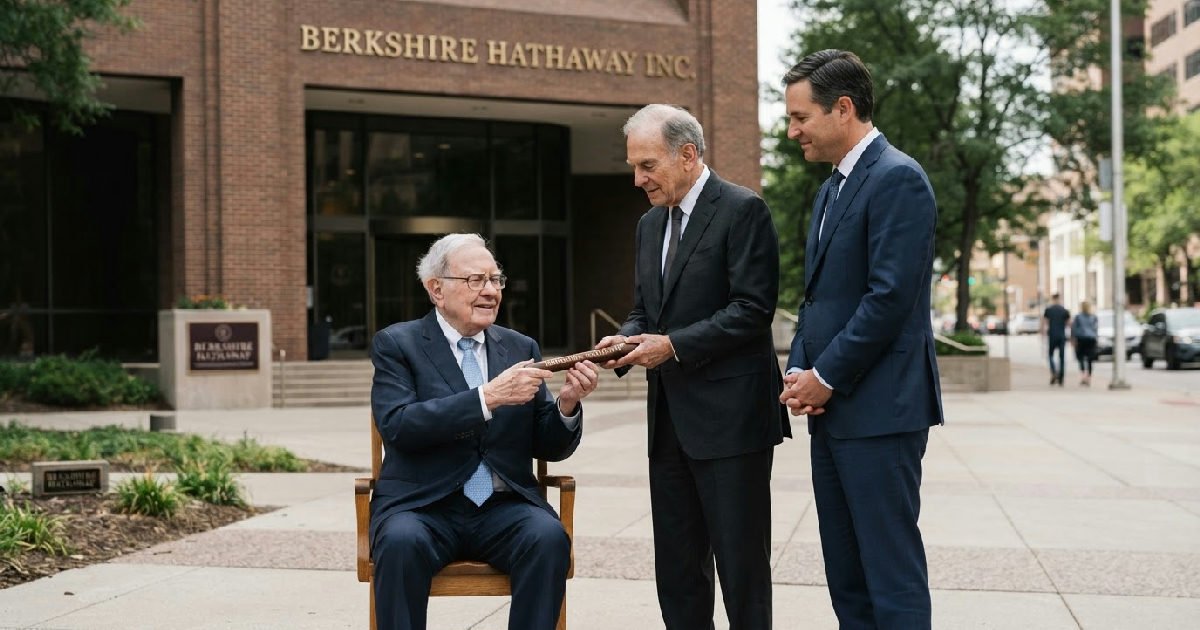
Warren Buffett steps down as Berkshire Hathaway chairman
Warren Buffett, the iconic 96-year-old investor, officially stepped down as Chairman of Berkshire Hathaway Inc. on September 18, 2026, marking the end of his extraordinary six-decade tenure leading the diversified conglomerate. His son, Howard Buffett, 71, has been elected as the new Chairman, while Greg Abel, 64, continues in his role as Chief Executive Officer.
Buffett will now serve as Chairman Emeritus and remain a member of the Board of Directors. This pivotal leadership transition, announced by the Omaha, Nebraska-based company, completes a long-anticipated succession plan for one of the world’s most influential companies. Buffett attributed his decision to age, acknowledging that “Father Time always wins,” but expressed profound confidence in the new leadership.
Why Warren Buffett steps down
Warren Buffett’s departure from the chairman role concludes a remarkable era that began when he took control of Berkshire Hathaway in 1965. Under his guidance, the struggling textile manufacturer was transformed into a formidable conglomerate valued between $1 trillion and $1.1 trillion. His investing philosophy, often termed “value investing,” became a beacon for generations of investors.
Buffett became Chairman and CEO of Berkshire in 1970, a dual role he held for more than five decades. His consistent strategy of acquiring undervalued companies and holding them for the long term yielded an astounding compounded annual return of 19.7% during his leadership. This far outpaced the S&P 500 over the same period, solidifying his reputation as the “Oracle of Omaha.”
Transforming a textile mill into a titan
The transformation of Berkshire Hathaway from its humble origins into a global powerhouse employing nearly 400,000 people is a testament to Buffett’s unique vision. The company now owns dozens of entities across construction, manufacturing, consumer goods, and insurance, creating a vast and resilient portfolio. This diversified structure has been a hallmark of its enduring success.
Buffett’s approach prioritised strong management within acquired companies, often allowing them significant operational autonomy. This decentralized model fostered growth while maintaining the distinct cultures of its various subsidiaries. His deep understanding of business fundamentals and unwavering discipline defined his unparalleled career.
New chapter begins with Howard Buffett and Greg Abel
The new leadership structure sees Howard Buffett taking the reins as Chairman, a role Warren Buffett explicitly designed to safeguard the company’s unique culture and values. “Greg runs the company; Howard will guard its culture and values – both worth more than anything on our balance sheet,” Warren Buffett stated.
Howard Buffett, who has served on Berkshire’s board since 1993, brings 33 years of direct experience with the company’s ethos. His father noted, “No company has been or will be more shareholder-minded than Berkshire,” underscoring the importance of maintaining that commitment. Howard is also CEO of the Howard G. Buffett Foundation, demonstrating his leadership capabilities.
Abel’s operational command solidifies
Greg Abel’s role as CEO was cemented when he officially succeeded Warren Buffett at the start of 2026, a decision announced by Buffett at the company’s annual shareholder meeting in May 2025. Buffett expressed immense satisfaction with Abel’s performance, stating his expectations were “sky high” and Abel had “exceeded them.”
Abel has been progressively taking on more significant operational responsibilities for some time, making crucial decisions that have consistently earned Buffett’s approval. This gradual transition ensured continuity and stability, preparing Abel to fully lead the company’s extensive operations. His leadership signals a new era focused on strategic execution and growth.
Market performance and future outlook
Despite Warren Buffett’s enduring influence, Berkshire Hathaway’s stock performance this year has seen a gain of 1.3%, lagging behind the S&P 500’s 11.6% return. The company’s price-to-book value also slipped from around 1.62 to 1.53 since the announcement of Buffett stepping down as CEO. This suggests some investor apprehension about the post-Buffett era, even with a clear succession plan.
Berkshire’s considerable cash hoard, a key part of its financial flexibility, dropped to $365.5 billion in the second quarter from a record of nearly $397 billion in the prior period. This dynamic reflects ongoing capital deployment decisions and market conditions, which Abel will now navigate more independently. The value of Berkshire’s strategic assets and its diverse revenue streams remain robust.
Navigating post-Buffett market dynamics
The financial markets have long factored in Buffett’s eventual step-down, yet his formal exit as chairman still represents a symbolic shift. Investors will now be closely scrutinising Abel’s strategic moves and Howard Buffett’s role in upholding the corporate culture. The challenge will be to maintain Berkshire’s unique investment philosophy and operational excellence without the direct, daily involvement of its legendary founder.
The company’s future performance will depend heavily on its ability to continue identifying valuable acquisition targets and managing its vast portfolio effectively. Abel’s proven track record in the energy sector and his increasing responsibilities over the past years position him well, but the shadow of Buffett’s unparalleled success will undoubtedly loom large.
A carefully orchestrated succession plan
The transition of leadership at Berkshire Hathaway has been anything but sudden. It’s the culmination of a meticulously planned succession that began years ago, underscoring Buffett’s long-term vision. He acknowledged that “the timing is right to complete the transition,” ensuring the company’s stability.
Buffett, with a net worth of $145 billion, pledged to dispose of his roughly $140 billion stake in Berkshire Hathaway completely by 2034. Since 2006, he has donated approximately $66 billion in shares, part of a major philanthropic pledge. This philanthropic commitment highlights another dimension of his extraordinary legacy beyond investment returns.
The enduring influence of the “Oracle”
Even as Chairman Emeritus, Warren Buffett’s judgment and perspective will still be available to the board and leadership team. His continued presence, albeit in a reduced capacity, offers a measure of continuity. It also provides invaluable institutional memory and strategic counsel to Howard Buffett and Greg Abel as they steer the company forward.
The move allows Buffett to gracefully step back from the intense day-to-day demands of chairman while remaining connected to the company he built. His decades of experience and unwavering commitment to shareholder value have set a standard that few can match, securing his place as one of the most impactful figures in modern finance.
His influence will undoubtedly persist through the company’s culture and the principles he instilled.