

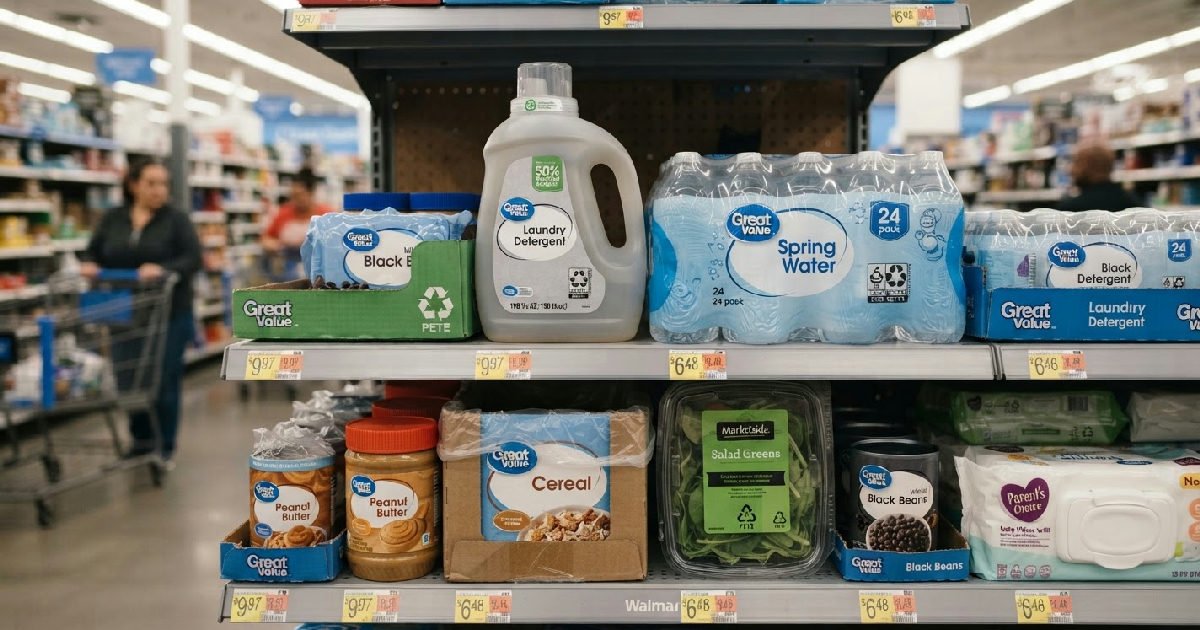
Walmart falls short on 2025 packaging sustainability targets
Walmart has failed to meet several of its key 2025 packaging sustainability targets for private-brand products, confirming in a new report that ambitious goals for recyclability and plastic reduction have been missed. The retail giant’s FY2026 Environmental, Social, and Governance (ESG) Report details the shortfalls, pointing to a complex web of market pressures and logistical challenges.
The company fell short on its goals to make all its private-brand packaging recyclable, reusable, or compostable, to reduce its use of virgin plastics, and to increase the amount of recycled content in its products.
Walmart packaging sustainability: A closer look at the missed targets
Walmart acknowledged the miss, stating that it had anticipated the outcome and continues to grapple with what it calls necessary “trade-offs among product protection, food safety, cost, regulatory requirements, [and] recycled material availability.”
This setback for the world’s largest retailer highlights the immense difficulty large corporations face in translating green pledges into reality, an issue seen across various sectors, similar to the strategic complexities facing other giants like the fast-fashion company behind the Shein Hong Kong IPO.
The data presented in Walmart’s report, which covers the period from February 1, 2025, to January 31, 2026, paints a clear picture of the challenges. On three of its most significant packaging commitments, the company not only missed the mark but, in some cases, lost ground compared to previous years.
The results underscore a disconnect between corporate ambition and the practical realities of global supply chains.
Recyclability goal sees a surprising decline
One of the most prominent goals was to make 100% of its global private brand packaging recyclable, reusable, or industrially compostable by 2025. The final outcome was just 64.3%.
This figure is not just a significant miss but also represents a step backward, declining from 66.1% in fiscal year 2025 and 68.2% in fiscal year 2024. This suggests that as the company’s product portfolio evolves, incorporating new types of packaging has made it harder, not easier, to meet its sustainability criteria.
Virgin plastic use actually increased
Perhaps the most challenging goal was a planned 15% absolute reduction in virgin plastic use from a 2020 baseline. Instead of decreasing, Walmart’s use of new plastics actually grew. By the end of the reporting period, virgin plastic use was 4.12% above the FY2021 baseline.
This continues a multi-year trend of increases, which the company attributes to growth in product categories, particularly food. Walmart did note that it has managed to lower its “virgin plastic packaging intensity,” meaning the weight of plastic used per dollar of sales has gone down.
But in absolute terms, the company is using more new plastic than before.
Recycled content falls far short of goals
The company also struggled to incorporate post-consumer recycled (PCR) content into its packaging. The global target was to reach 17% PCR content, but the final figure was only 10.7%. For North America, where the goal was a more aggressive 20%, Walmart achieved just 12%.
Progress has been slow and incremental, rising only a few percentage points over several years. This particular failure highlights a critical bottleneck in the circular economy that affects countless industries, where supply chain volatility can derail even the best-laid plans.
The reasons behind the results
In its report, Walmart was candid about the reasons for missing its targets, framing the issue as a collision between its green ambitions and market realities. The company has essentially stated that without major shifts in the global materials market, its goals were unattainable.
This predicament is not unique to Walmart, as many industries are navigating pressures from inflation and supply chain disruptions, some of which are exacerbated by things like the recently announced Canada auto tariffs that can ripple through the economy.
“Progress across our packaging metrics continues to be influenced by trade-offs,” the company stated. This balancing act involves ensuring products are safe and protected, keeping prices low for customers, and complying with a patchwork of regulations, all while trying to source sustainable materials that are often scarce and expensive.
The global market for recycled materials is a key factor. “Increased demand has led to a global shortage of recycled materials, making it difficult to source feedstock in the necessary quantities and at price points that support our packaging goals and everyday low prices,” Walmart noted in a previous report.
The company concluded that without a “breakthrough in the cost and availability of recycled content,” the targets for PCR and virgin plastic reduction were unlikely to be met.
Progress in other areas and the path forward
While the headline packaging goals were missed, the report wasn’t entirely negative. Walmart has made more substantial progress in managing the waste from its own operations. The company aimed to divert 90% of its operational waste from landfills by 2025 and came close, achieving a global diversion rate of 84%. In the U.S., the rate was slightly higher at 84.8%.
This was achieved through large-scale recycling and reuse programs. In the last reporting year alone, Walmart recycled 6.1 billion pounds of cardboard, reused 117 million break-pack boxes, and repurposed over 400,000 tires into commercial entrance mats. These figures demonstrate a capability to manage waste effectively within its own walls, even as it struggles to influence the packaging of the products it sells.
The company is also pointing to specific product initiatives as evidence of its continued commitment. It recently began rolling out label-free packaging for its Great Value brand bottled water, a move designed to reduce plastic use and make the bottles easier to recycle. The initiative launched in three distribution centers with plans to scale further.
Broader implications for corporate sustainability
Walmart’s experience serves as a cautionary tale for the entire corporate world. It demonstrates that setting ambitious public targets can be a powerful driver of internal strategy but offers no guarantee of success, especially when dependent on external market forces.
The tension between a brand promise of low prices and the often-higher cost of sustainability is a fundamental conflict that many retailers have yet to resolve.
The company’s struggles reflect a broader industry pattern where companies often prioritize different strategic imperatives, much like how financial firms pursue a multibillion-dollar acquisition drive to secure market position. For Walmart, maintaining its “Everyday Low Price” promise remains a core part of its identity.
The high cost and limited availability of recycled plastics, as noted in its report, have posed a direct challenge to that principle, forcing the retailer to weigh environmental goals against consumer affordability. This inherent tension continues to shape its approach to sustainability.
What happens next?
With the 2025 deadline now passed, the focus shifts to what comes next. In its report, Walmart offered no new long-term packaging goals to replace the ones it missed.
Instead, the company stated, “We will continue measuring, reporting, and advancing our packaging strategies.” It reaffirmed its commitment to three guiding principles: eliminating unnecessary packaging, designing packaging for better recycling outcomes, and increasing the use of recycled content where feasible.
The lack of new, hard targets is conspicuous. It may signal a more cautious approach from the retail giant, which could be hesitant to make another set of ambitious promises until the market for sustainable materials becomes more stable and affordable. The pressure from consumers, investors, and regulators for environmental action isn’t going away.
How Walmart chooses to navigate these demands without concrete, time-bound goals will be a central part of its sustainability story in the years to come.